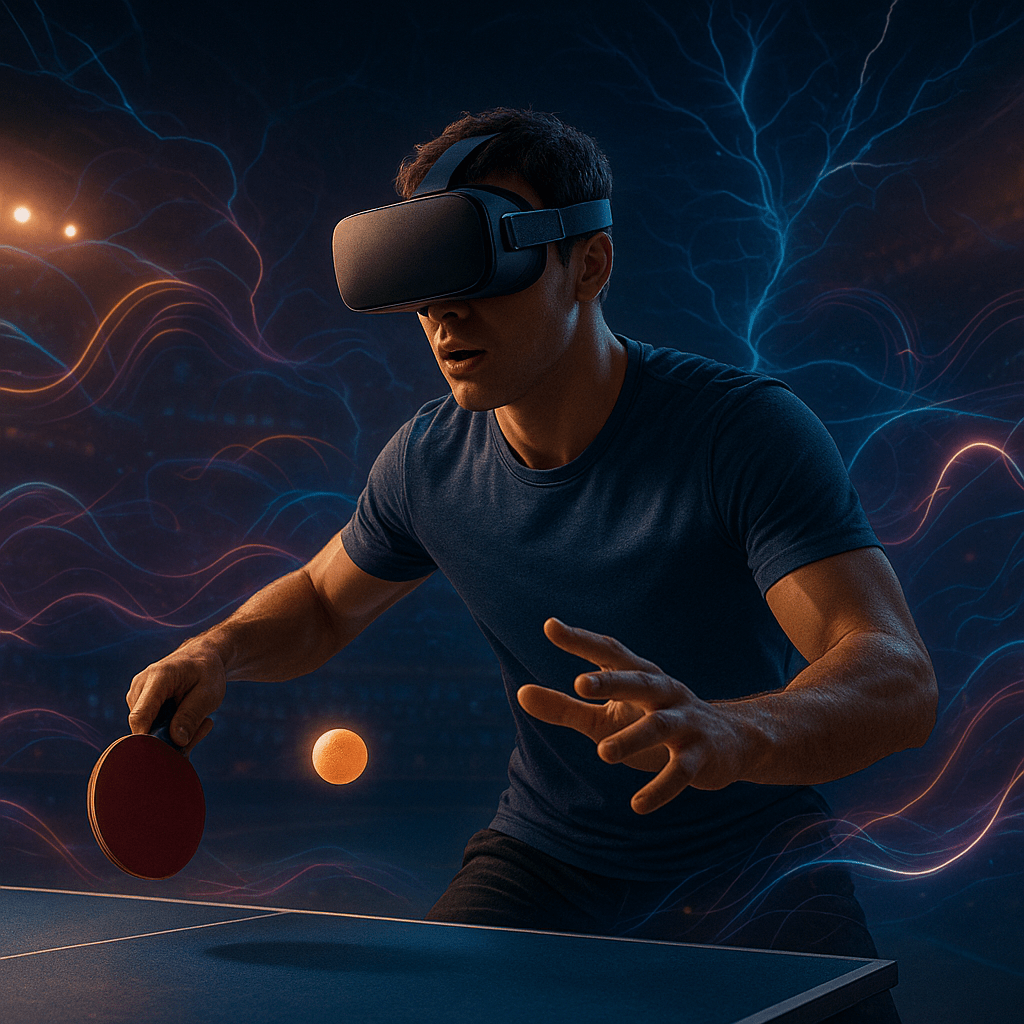
When a table tennis player faces an opponent, every fraction of a second matters. The sound of the ball striking the paddle, the opponent’s body posture and even subtle environmental noises can affect how quickly the player reacts. But what happens when something completely unexpected, such as a cow’s moo or a car honk, interrupts that focus?
A study from Coburg University of Applied Sciences in Germany, recently published in Virtual Reality, explores exactly that question. Titled Using a virtual reality oddball paradigm to study attention control in complex motor movements, the research investigates how the brain deals with sudden, irrelevant sounds during demanding tasks and how quickly people learn to tune them out.
The study combines neuroscience, sports science, and immersive technology to explore one of the most fundamental aspects of human cognition: the ability to maintain focus under distraction.
Why studying distraction matters
Attention is the cognitive glue that holds perception, memory, and movement together. Without it, even the simplest task can become error-prone. Psychologists have long studied how people shift their attention between competing sources of information; however, most experiments are conducted in sterile laboratory settings that do not accurately reflect the sensory overload of the real world.
In sport, selective attention is especially critical. A table tennis player must process complex visual and auditory information within milliseconds to strike a fast-moving ball accurately. Even minor distractions can impair timing and coordination. Previous laboratory studies have shown that unexpected sounds, known as “oddball stimuli”, can momentarily hijack attention and slow reaction times. But until now, these studies relied on button-press tasks rather than natural body movements.
By translating this established oddball paradigm into a virtual sports setting, the study aimed to observe distraction effects in a more realistic and dynamic context.
Bringing the lab into virtual reality
Virtual reality (VR) provides an ideal environment for testing attention in complex, yet controlled conditions. In VR, researchers can replicate real-world scenarios while maintaining precise control over every variable, from sound timing to object trajectories.
In this study, 33 healthy participants, aged between 18 and 30, wore a head-mounted display and entered a virtual gymnasium equipped with a digital table tennis table. Using a motion-tracked controller that acted as a virtual racket, they returned simulated table tennis balls aimed towards them from different sides.
Before each serve, participants heard either a standard sound (a simple gong, presented 90 per cent of the time) or a distractor sound (an unexpected environmental noise, such as a car horn or animal sound, presented 10 per cent of the time). Each distractor was unique, ensuring novelty throughout the experiment.
The task was simple: return the ball as accurately as possible while ignoring the sounds. Yet the sounds had no relevance to performance, providing an ideal way to measure involuntary distraction.
Measuring the milliseconds
Reaction time (RT) was measured as the interval between the ball’s appearance and the initiation of the racket’s movement. Using motion capture at 90 hertz, researchers recorded every millisecond of movement to determine how quickly participants responded after each sound. They also calculated hit rate (the proportion of successful returns) and motor precision (the distance between the ball and the target zone on the opposite side of the table).
Participants completed more than 500 trials divided into training, sound, and silent blocks. Between each block, they took short breaks and later filled out questionnaires on task difficulty, cybersickness, and perceived realism.
The findings were clear: reaction times were significantly slower following distractor sounds than after standard sounds. In the first few blocks, the “distraction effect” resulted in an average delay of around 45 milliseconds. Over time, however, the effect diminished until it disappeared almost entirely by the later trials.
This decline in distraction with experience indicates that the brain quickly adapts to irrelevant stimuli when they prove uninformative. Essentially, participants learned that these random sounds did not help them predict the ball’s trajectory and stopped paying attention to them.
Learning to focus through noise
The results reveal a fascinating interplay between involuntary attention and predictive processing. When a novel sound violates expectations, the brain generates what neuroscientists refer to as a prediction error. This triggers an automatic shift in attention to evaluate whether the new event is important. If it turns out to be irrelevant, attention is redirected to the main task, and the brain updates its internal model to ignore similar events in the future.
This process reflects how humans continuously fine-tune their focus in dynamic environments. From athletes blocking out crowd noise to surgeons filtering operating-room chatter, the ability to suppress irrelevant input is a hallmark of expert performance.
Interestingly, the study also found that participants’ reaction times were slower during silent trials than during sound trials, even when the sounds carried no task-specific information. This suggests that auditory cues may serve as general warning signals, subtly preparing the brain for upcoming events and improving readiness.
From the sports hall to the brain lab
Although the virtual table tennis task may seem playful, it represents a sophisticated neuropsychological experiment. By using VR, the researchers effectively bridged the gap between controlled laboratory research and real-world human performance.
The study emphasised that the immersive realism of VR allows scientists to study cognitive mechanisms during natural movements rather than isolated button presses. This approach not only enhances ecological validity but also provides insights into how cognitive control operates under realistic sensory and motor conditions.
Moreover, the research validates VR as a powerful tool for exploring the neural and behavioural foundations of attention. Future studies could combine VR with techniques such as EEG or fMRI to map brain activity during distraction and recovery. Such approaches may shed light on how attention networks are trained or impaired in different populations.
Real-world applications and next steps
Beyond academia, these insights could benefit fields that depend heavily on sustained focus under pressure. Athletes, surgeons, pilots, and even e-sports professionals could use VR-based simulations to train resistance to distraction in safe, repeatable conditions.
The authors suggest that similar paradigms could be extended to other sports or real-world scenarios where both auditory and visual distractions are common. For instance, learning to maintain concentration in environments filled with unpredictable noise could enhance performance and safety.
While the study used commercially available VR hardware, the researchers acknowledge certain limitations. Consumer-grade systems may lack the precision of laboratory motion-tracking tools, and VR environments can distort depth perception. However, since both standard and distractor trials were equally affected, these limitations did not undermine the main findings.
Reference
Streuber, S., Wetzel, N., Pastel, S., Bürger, D., & Witte, K. (2025). Using a virtual reality oddball paradigm to study attention control in complex motor movements. Virtual Reality, 29(56). https://doi.org/10.1007/s10055-025-01111-6