
In sport, we often imagine motivation as something a coach gives an athlete (a coachee). The coach delivers the speech, sets the challenge, offers encouragement, and lights the spark. The athlete, in this familiar story, is the one being shaped. However, a recent study published in the International Journal of Sports Science & Coaching led by Dr. Hugh Jiliang Liu from the University of Groningen, provided a detailed analysis. Their meta-analysis and systematic review suggest that motivation in coaching does not simply travel in one direction. It moves back and forth. Coaches shape athletes, but athletes also shape coaches.
That simple shift changes the whole picture. Coaching is not merely a set of instructions from the sideline. It is a living relationship in which encouragement, confidence, trust, and effort can circulate. When the relationship works well, the coach may help the athlete become more self-driven. In turn, an engaged and motivated athlete may help the coach feel more effective, more connected, and more energised to keep offering support.
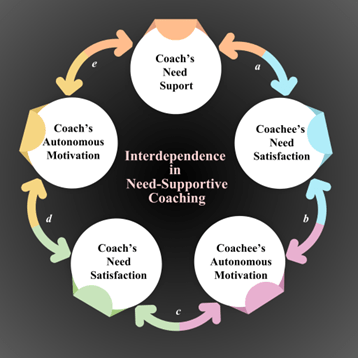
This is the central idea behind the study’s circular framework (Figure 1): great need-supportive coaching is not only delivered; it is also fed by the relationship itself.
The three psychological needs behind great coaching
The paper is grounded in Self-Determination Theory, a widely used theory of human motivation. Its starting point is easy to grasp: people are more likely to grow, persist, and flourish when three basic psychological needs are satisfied:
- Autonomy need: means feeling that one’s actions are self-endorsed and aligned with one’s own interests, values, and choices,
- Competence need: means feeling capable, effective, and able to improve through meaningful challenges, and
- Relatedness need: means feeling genuinely connected, valued, and cared for by others.
When these needs are satisfied, people can develop ‘autonomous motivation’, which refers to self-initiated and self-regulated motivation driven by personal interest and enjoyment of the activity. Individuals with high levels of autonomous motivation perceive their actions as self-chosen, experience a sense of connectedness with others, and feel competent in pursuing their goals—reflecting the satisfaction of the three BPNs.
For athletes, these needs translate into everyday experiences: ‘I have a say’, ‘I can get better’, and ‘I am part of something’. A need-supportive coach helps create those experiences by explaining the purpose of training, listening to athletes’ perspectives, setting challenges that stretch rather than crush them, giving clear, constructive feedback, and showing genuine concern for the athlete as a person.
The key insight of the research is that these needs do not belong only to athletes. Coaches have them too (Figure 1). Coaches also need to feel trusted, capable, and connected. When they do, they may be better able to create the kind of climate in which athletes thrive.
The loop that travels both ways
Imagine an athlete arriving at training after a difficult week. A controlling coach might respond only with demands: work harder, stop complaining, follow the plan. A need-supportive coach takes a different route. The coach still keeps standards high, but notices the athlete, explains the training goal, offers a manageable challenge, and makes space for the athlete’s voice. The athlete begins to feel more trusted, more capable, and more connected.
That feeling matters. When athletes’ basic needs are met, sport is less likely to feel like an obligation imposed from outside. It becomes something they can own. They are more likely to train because the activity feels meaningful, enjoyable, or aligned with who they want to become.
The intriguing part is what may happen next. A self-driven athlete can change the emotional climate for the coach. The coach sees engagement, effort, curiosity, and willingness. Coaching then feels less like pushing a resistant person uphill and more like building something together. That experience may satisfy the coach’s own needs for competence and connection, strengthening the coach’s motivation and to increase the likelihood that supportive coaching will continue.
What this means for coaches, clubs, and athletes
For coaches, the message is practical: motivation is not created by pressure alone. Athletes are more likely to invest themselves when they understand the purpose of training, feel capable of progress, and know that their relationship with the coach is built on respect. Need-supportive coaching does not mean lowering standards or giving athletes unlimited freedom. It means combining structure with voice, challenge with encouragement, and ambition with care.
For clubs and sports organizations, the message is equally important. If they want athletes to thrive, they should also consider the conditions in which coaches work. Coach education should not only teach techniques for supporting athletes; it should also help coaches experience autonomy, competence, and relatedness in their own roles. Supported coaches are more likely to become supporting coaches.
For athletes, the study offers a hopeful reminder that their motivation matters beyond their own performance. Their engagement, curiosity, and willingness may help shape the coach’s experience too. The relationship is not passive. Athletes are part of the motivational environment they share with their coaches.
Great coaching may be less like a command from the sideline and more like a dance. One person moves, the other responds. Trust grows. Energy circulates. When the loop is healthy, both coach and athlete may become more willing, more capable, and more connected in the pursuit of shared goals.
—Dr. Hugh Jiliang Liu
Why the original paper is especially valuable
One of the major strengths of the original paper is its scope. Rather than relying on a single team, sport, or season, the authors brought together evidence from 102 studies and more than 43,000 coaches and athletes. This gives readers a broad view of the field and makes the main message harder to dismiss as a one-off finding.
A second strength is its balance. Many studies of coaching motivation focus mainly on the athlete. The study deliberately widens the lens to include coaches’ own psychological experiences. This is important because a coach who feels unsupported, ineffective, or isolated may find it harder to support athletes well. By placing the coach and the athlete in the same motivational story, the paper moves the field closer to the reality of sport.
A third strength is the circular framework itself. The paper does not present coaching as a simple cause-and-effect chain. Instead, it shows a possible loop in which supportive coaching, athletes’ need satisfaction, athletes’ autonomous motivation, coaches’ need satisfaction, and coaches’ autonomous motivation are connected. This makes the article conceptually useful for researchers and practically useful for coach education.
Finally, the paper is valuable because it identifies what is still missing. The authors show that most existing studies examine individuals separately, even though coaching is inherently relational. Their call for more dyadic research (research that studies coaches and athletes together) is one of the article’s most important contributions. It points the field toward a more realistic understanding of how motivation develops in real relationships.
Reference
Liu, H. J., De Jonge, K. M., Den Hartigh, R. J., & Van Yperen, N. W. (2026). Basic psychological need support, need satisfaction, and autonomous motivation in coach-athlete relationships: A systematic review and meta-analysis. International Journal of Sports Science & Coaching, 21(2), 1178-1191. https://doi.org/10.1177/17479541251400621