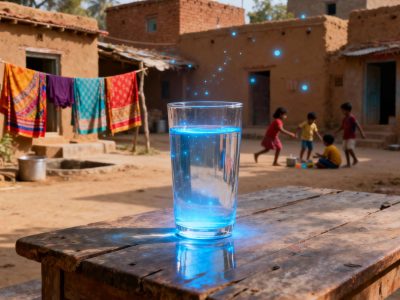
Access to clean drinking water remains one of humanity’s most urgent challenges. Despite decades of technological advancement, more than a quarter of the global population still lacks reliable access to safe drinking water. Waterborne diseases continue to kill hundreds of thousands of people every year due to the presence of microorganisms, i.e., protozoa, fungi, bacteria and viruses, while emerging pollutants such as micro/nanoplastics, pharmaceutical residues, PFAS, and industrial contaminants are rapidly intensifying the global crisis. Yet, in laboratories at the Technical University of Munich in Germany, researchers believe an ancient natural material may hold part of the solution: wood.
A growing body of research led by Antoni Sánchez-Ferrer at the Technical University of Munich is revealing how wood and cellulose-based materials can be transformed into sophisticated filtration systems capable of removing nanoparticles, toxic ions, and potentially even persistent contaminants from water. These studies are laying the foundations for a new generation of bio-derived water purification technologies.
The work spans multiple studies published in journals including Wood Science and Technology, Chemical Engineering Journal, Journal of Bioresources and Bioproducts, Discover Materials, and npj Clean Water. Together, the papers form a coherent scientific narrative centered on sustainable membrane science, reactive ionic liquids, nanocellulose engineering, and low-cost water detoxification technologies.
Why the global water crisis demands new solutions?
Conventional water treatment technologies have undoubtedly improved public health across developed nations. However, these systems are often expensive, energy-intensive, chemically demanding, and difficult to deploy in low-resource settings. Large-scale treatment plants require complex infrastructure, continuous maintenance, and significant operational expertise.
According to research published in Wood Science and Technology, contaminated water remains responsible for more than 500,000 diarrhoeal deaths worldwide each year. The researchers emphasized that centralized treatment systems remain inaccessible for many rural and developing regions due to financial and logistical barriers.
This challenge has intensified with the emergence of modern/emerging contaminants. Microplastics and nanoplastics are now found in drinking water, oceans, soil, and even human tissues. PFAS, often referred to as “forever chemicals”, resist environmental degradation and have been associated with numerous health concerns. Traditional membranes can remove many contaminants, but they often rely on petroleum-based polymers and energy-intensive manufacturing processes.
Scientists are, therefore, searching for filtration systems that are affordable, scalable, biodegradable, and environmentally sustainable. Wood and cellulose-based materials are emerging as serious candidates.
Wood membranes may be the solution for obtaining clean drinking water in developing countries, where high-performance water membranes or technologies are materially inaccessible or economically unaffordable.
— Antoni Sánchez-Ferrer
How wood naturally filters contaminants
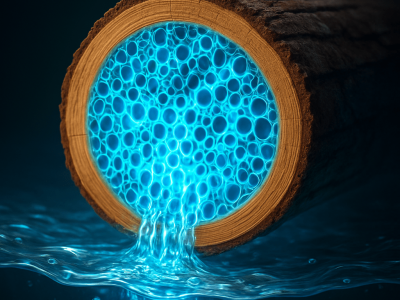
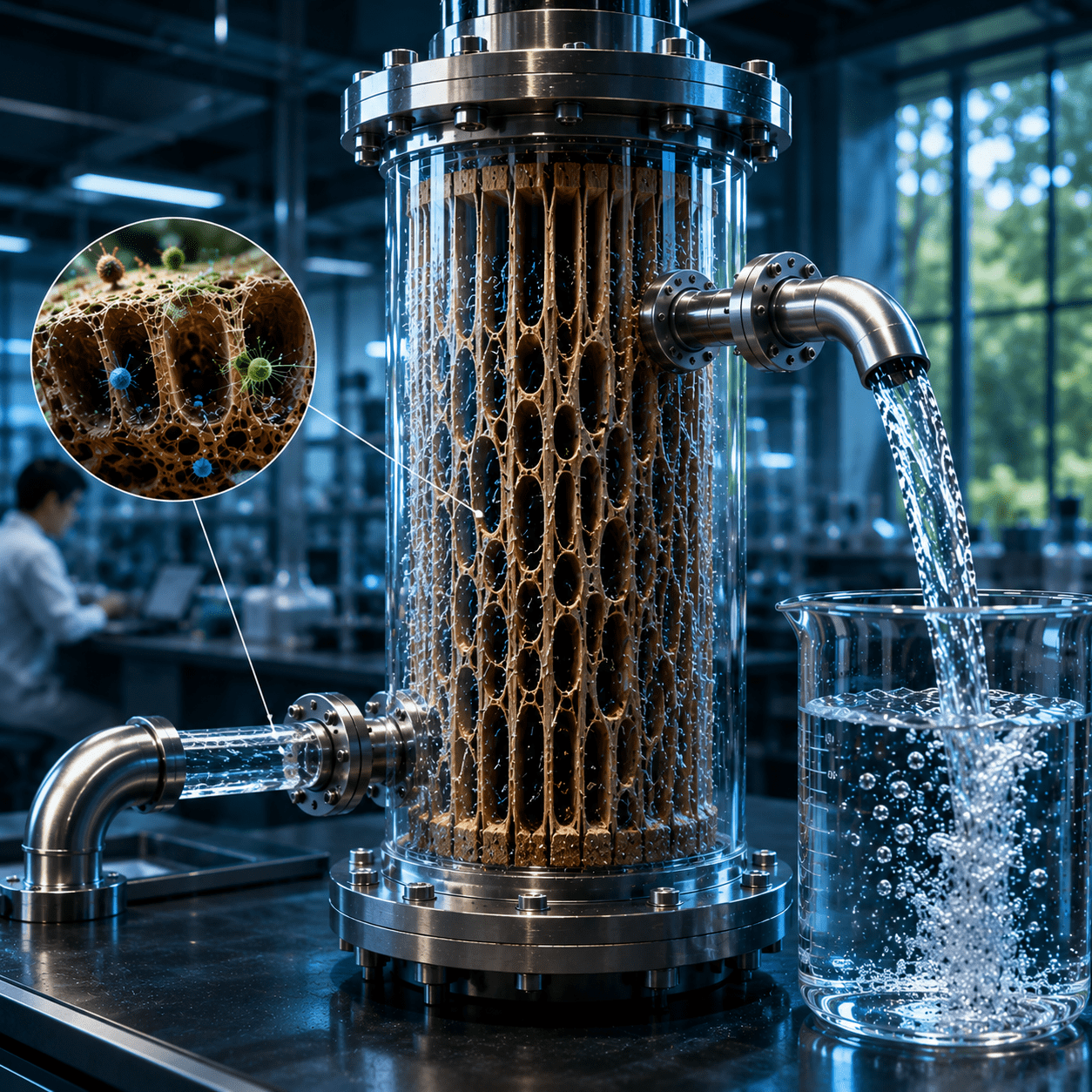
Wood is far more technologically sophisticated than it appears. At the microscopic level, it contains intricate vascular structures evolved by plants over millions of years to transport water efficiently. These natural microchannels, pits, and porous networks can also trap particles suspended in water.
In the paper entitled “Exploring wood as a sustainable solution for water filtration: nanoparticle removal, size exclusion, and molecular adsorption,” published in Wood Science and Technology, researchers investigated how different wood species could serve as filtration systems. The work was conducted at the Chair of Wood Science at the Technical University of Munich.
Certain wood configurations achieved nanoparticle removal efficiencies exceeding 99%, particularly in radial and tangential orientations, where the microstructure increased water residence time. Beech wood and silver fir performed especially well due to the dimensions of their pit structures, which acted as natural sieves for nanoscale contaminants.
The study also demonstrated that wood filters could potentially remove bacteria, protozoa, microplastics, and nanoplastics ranging in size from 200 nanometers to 20 micrometers. This is particularly important given the growing global concern surrounding plastic contamination in drinking water systems.
Importantly, the filtration mechanism was not limited to simple size exclusion. The researchers observed adsorption and diffusion processes within the amorphous domains of wood biopolymers, including amorphous cellulose, hemicellulose, and lignin. Electrostatic interactions further enhanced the removal efficiency for charged organic molecules.
The implications are substantial: wood filters may eventually provide low-cost household water treatment systems for regions where advanced infrastructure remains unavailable. The researchers estimated monthly filtration costs for a five-member family at only 0.28-0.34 USD based on European log prices.
Turning wood into advanced detoxification membranes
Natural wood filtration alone is impressive, but the researchers did not stop there. Two more studies pushed the concept further by chemically engineering wood into advanced ion exchange membranes capable of removing dissolved pollutants from water.
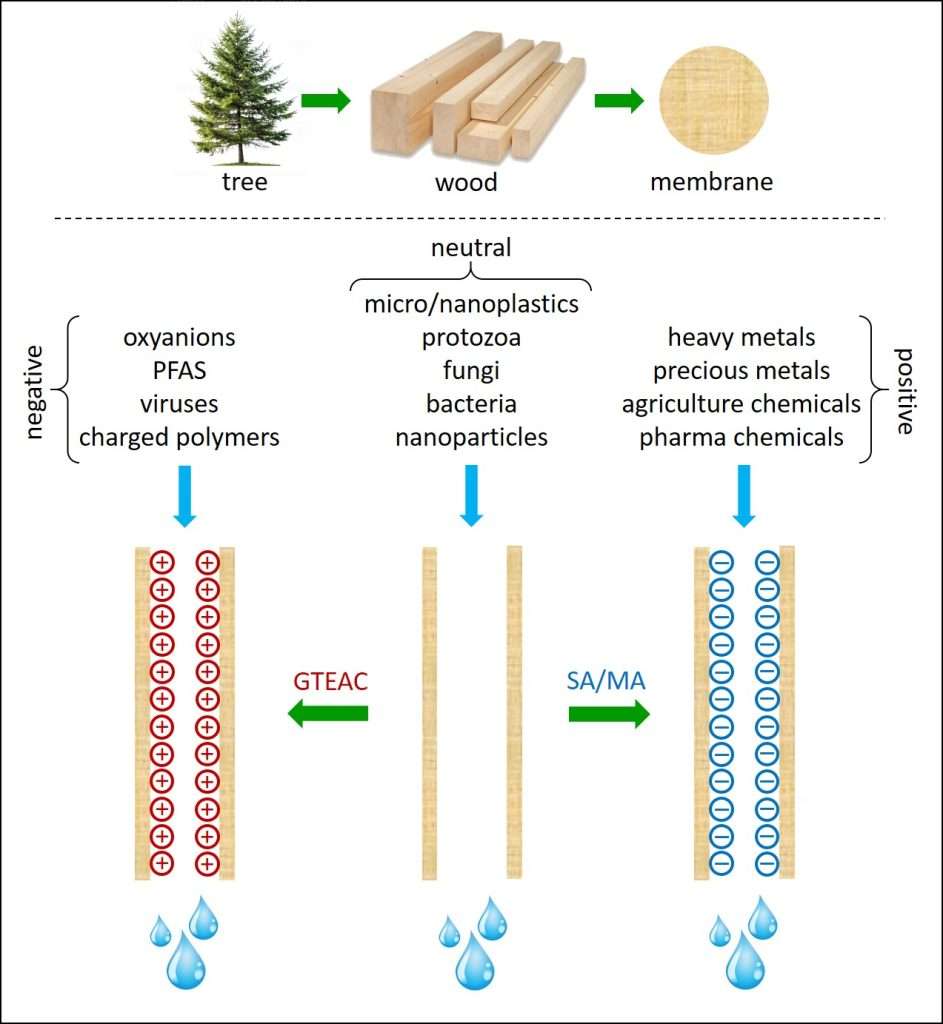
In the Chemical Engineering Journal paper entitled “Wood-supported cationic polyelectrolyte membranes from a reactive ionic liquid for water detoxification”, researchers developed quaternised wood membranes using a novel reactive ionic liquid, glycidyltriethylammonium chloride (GTEAC).
This chemistry enabled the graft polymerisation of cationic polyelectrolyte chains directly onto the wood scaffold. The resulting material functioned as an anion exchange membrane capable of removing nitrate, sulphate, and phosphate ions from water systems. The membranes also retained structural integrity after multiple regeneration cycles, demonstrating long-term durability.
Unlike many traditional membrane fabrication methods, the process avoided highly alkaline conditions that can damage lignocellulosic structures. Instead, the researchers employed a water-free quaternization process that preserved the native wood architecture while introducing functional ionic groups.
In the npj Clean Water paper entitled “Carboxylated wood membranes for selective capture and recovery of critical and commodity metal cations”. Sanchez-Ferrer’s team went further and used wood as scaffold introducing negatively charged groups by carboxylation of wood membranes via anhydride esterification with cyclic anhydrides, i.e., succinic anhydride (SA) and maleic anhydride (MA).
Both studies – GTEAC- and SA/MA-modified wood membranes – suggested that these engineered membranes could eventually target emerging negatively and positively charged contaminants, respectively. GTEAC-modified membranes can remove PFAS, viruses, oxyanions, and charged microplastics, while SA/MA-modified membranes can be used for the selective recovery of heavy and precious metals, and nitrogen-containing derivatives from agriculture and the pharma industry. This represents a major scientific shift. Rather than viewing wood as a passive filtration material, researchers are now transforming it into an active and tunable membrane platform.
The chemistry behind the cellulose revolution
Much of this innovation depends on cellulose, the most abundant biopolymer on Earth. Cellulose offers high mechanical strength, biodegradability, and a large surface area, making it attractive for sustainable materials engineering. However, native cellulose is chemically difficult to functionalise.
To overcome this limitation, researchers explored the use of reactive ionic liquids for cellulose grafting. In a study published in Discover Materials entitled “Quaternised cellulosic materials prepared from chain growth polymerisation of a grafted reactive ionic liquid”, the researchers investigated quaternised microfibrillated cellulose and nanocrystalline cellulose prepared using GTEAC-based graft polymerization.
The study revealed that graft polymerization substantially altered the structural properties of cellulose materials. Crystallinity decreased significantly, while intercrystallite spacing increased due to the insertion of poly(GTEAC) chains into amorphous regions. Moisture uptake nearly doubled, and the resulting materials exhibited enhanced sorptive performance.
Importantly, the researchers achieved this through solvent-minimized processing. Traditional cellulose functionalization often requires large quantities of hazardous organic solvents. By contrast, reactive ionic liquids simultaneously acted as both reaction media and functional monomers, aligning the process with green chemistry principles.
This chemistry is particularly significant because it opens pathways to manufacturing sustainable ion-exchange materials, adsorption systems, and smart filtration membranes using renewable biomass rather than petroleum-derived polymers.
Engineering sustainable ion exchange systems
The same chemistry was extended further in the Journal of Bioresources and Bioproducts paper titled “Anion exchangers prepared from graft polymerisation of microfibrillated cellulose using the reactive ionic liquid”. In this study, researchers functionalized microfibrillated cellulose into cationic polyelectrolyte-grafted materials capable of removing nitrate, sulfate, and phosphate ions under dynamic flow conditions. The filtration cartridges achieved removal efficiencies of 83.2% for nitrate, 98.1% for sulfate, and 94.9% for phosphate.
The study also evaluated sustainability metrics, including process mass efficiency, E-factor, and energy efficiency scores, reinforcing the system’s environmental advantages. This is increasingly important as industries face mounting pressure to reduce chemical waste and carbon footprints associated with membrane manufacturing.
The work illustrates how cellulose science is evolving beyond packaging and paper technologies into advanced environmental engineering applications. Researchers are effectively designing bio-derived ion exchange systems that rival conventional synthetic membranes while potentially offering superior sustainability.
A future built from forests and Green Chemistry
Individually, the papers focus on wood filtration, cellulose chemistry, membrane science, or reactive ionic liquids. Collectively, they point towards a future in which forests and plant-based materials become foundational components of next-generation environmental technologies.
They are highly engineered biomaterials involving nanoscale structural tuning, graft polymerisation chemistry, ion exchange mechanisms, and advanced materials characterisation using techniques such as SAXS, WAXS, FTIR, SEM, DSC, and TGA.
At the same time, the sustainability advantages are difficult to ignore. Wood and cellulose are renewable, biodegradable, abundant, and globally accessible. If scalable manufacturing pathways can be established, such systems could dramatically lower the economic and environmental costs of water purification technologies.
The researchers themselves suggest that future work may involve surface functionalisation strategies capable of selectively targeting pathogens and pollutants. Wood scaffolds could eventually support microfiltration, ultrafiltration, and nanofiltration systems for applications ranging from drinking water treatment to pharmaceutical purification and industrial wastewater remediation.
As the global water crisis intensifies, the idea that forests may help shape the future of clean water no longer sounds like science fiction. It increasingly resembles a serious scientific roadmap.
References
Sánchez-Ferrer, A., & Guerrero Parra, J. (2025). Exploring wood as a sustainable solution for water filtration: nanoparticle removal, size exclusion and molecular adsorption. Wood Science and Technology, 59, 42. https://doi.org/10.1007/s00226-025-01645-7
Ahmed, M. J., Sánchez-Ferrer, A. (2025). Wood supported cationic polyelectrolyte membranes from a reactive ionic liquid for water detoxification. Chemical Engineering Journal, 505, 158841. https://doi.org/10.1016/j.cej.2024.158841
Ahmed, M. J., Wu, B., & Sánchez-Ferrer, A. (2025). Anion exchangers prepared from graft polymerisation of microfibrillated cellulose using the reactive ionic liquid. Journal of Bioresources and Bioproducts, 10, 310 to 324. https://doi.org/10.1016/j.jobab.2025.04.001
Ahmed, M. J., Wu, B., & Sánchez-Ferrer, A. (2026). Quaternised cellulosic materials prepared from chain growth polymerisation of a grafted reactive ionic liquid. Discover Materials, 6, 36. https://doi.org/10.1007/s43939-025-00530-1
Sánchez‑Ferrer, A., Upadhye, D., Ahmed, M.J., & Wu, B. (2026). Carboxylated wood membranes for selective capture and recovery of critical and commodity metal cations. npj Clean Water, 9, 36. https://doi.org/10.1038/s41545-026-00577-4