For most of Earth’s history, the oceans were bathed in sunlight, allowing marine food webs to arise and evolve long before leafy plants had evolved to grow on dry land. Then, around 700 million years ago, the oceans were unexpectedly plunged into perpetual darkness by the explosive growth of polar sea ice. The sea ice reflected most of the solar energy the water had absorbed, and it isolated the cold air in winter from the warmth of the ocean.
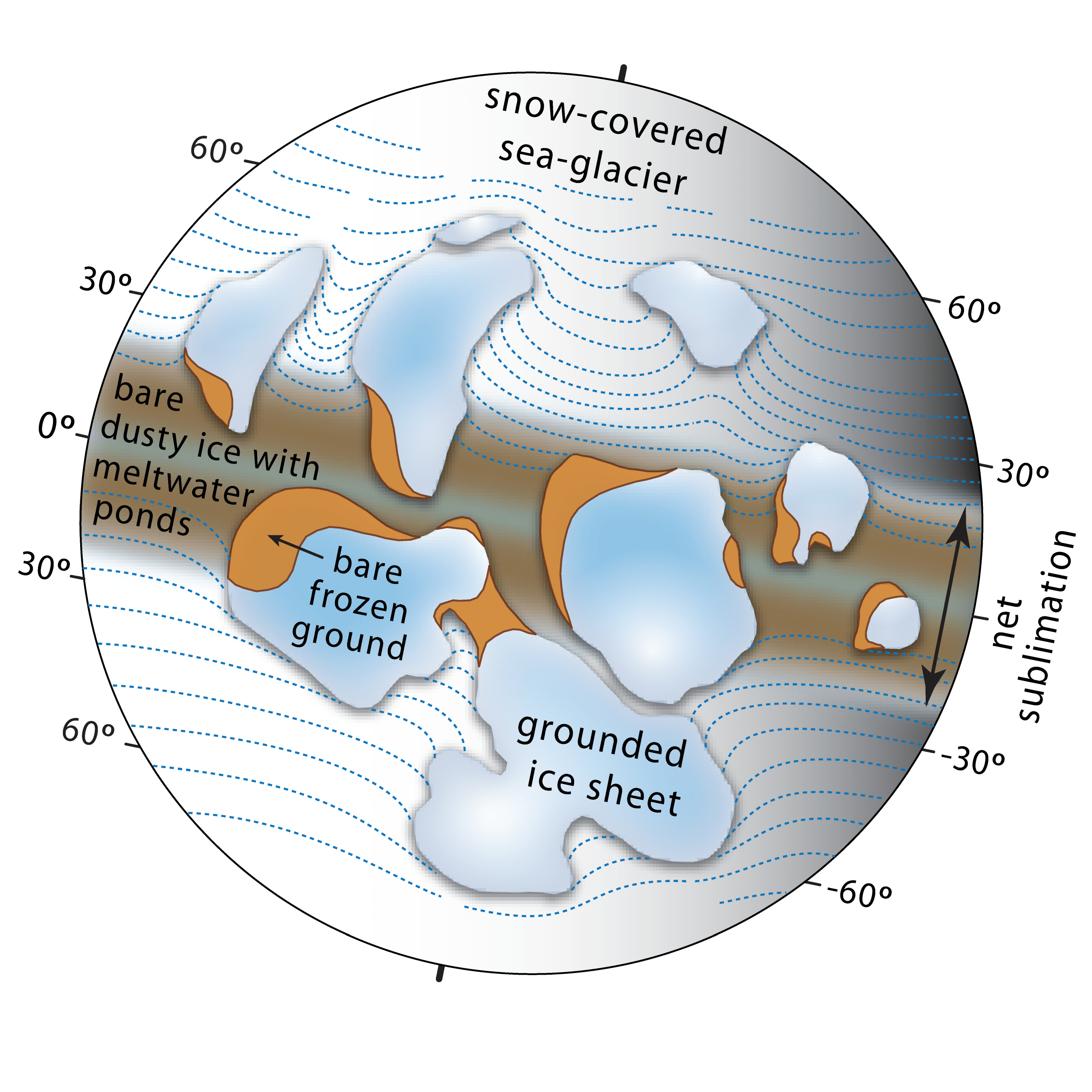
Surface temperatures were below the freezing point nearly everywhere. The floating ice rapidly thickened and spread under its own weight, creating a global ice shell or ‘sea glacier’ of nearly uniform half-mile thickness. Slowly, ice sheets spread over much but not all of the land, fed by moisture sublimated off the equatorial sea glacier (Figure 1).
The first of two tandem ‘Snowball Earth’ episodes lasted for 56 million years, by which time the slow rise of gaseous CO2 emitted by volcanoes finally overcame the loss of solar radiation being reflected by the frozen surface. A second, equally severe but briefer panglacial episode occurred 10−20 million years later. It ended about 100 million years before the base of the Cambrian.
Migration is nature’s response to climate change
Since most fossils known from before and after each Snowball represent marine organisms, it has generally been assumed that the latter were descended from the former, and that transitional forms survived in the Snowball oceans. In a new scientific perspective titled “Ecosystem relocation on Snowball Earth: a polar–alpine ancestry for the extant surface biosphere?”, geologist Paul F. Hoffman of the University of Victoria (British Columbia) and Harvard University (Cambridge) takes a different view. It is the view espoused by Charles Darwin in the Origin of Species (1859) that, in response to climate change, biomes migrate to higher or lower elevations and latitudes, following the climate to which they are adapted. Consequently, extinctions occur at the poles and in the mountains in response to global warmings, while originations occur in the tropics. Severe coolings cause extinctions of tropical species and originations of polar ones.
Migration and selective survival on Snowball Earth
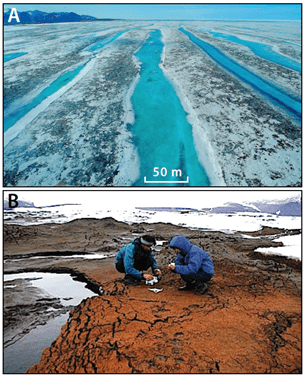
In the extreme case of Snowball Earth, microbial communities that were already adapted to sea ice and the margins of polar and mountain glaciers, simply moved with the advancing ice fronts to the equatorial zone of net ablation on the new Snowball Earth. As a result, their habitat expanded, the Sun rose year-round, and nutrients were provided by windblown dust from bare frozen ground.
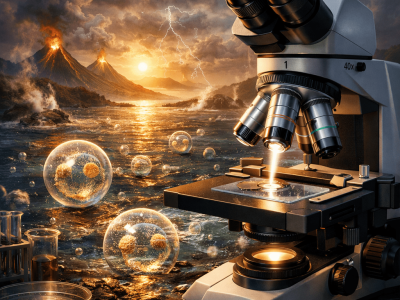
Microbial mats on bare ice surfaces provided protection and sustenance for diverse bacteria, archaea, algae, protists, viruses and even early invertebrate animals. They grew and evolved, and when each Snowball finally melted, they divided between those that retreated with the ice margins and those that restocked the biotically near-vacant oceans. Accordingly, the present surface biosphere descended from a cold-adapted subset of pre-existing diversity. Marine fossils before and after are related, but not by direct descent.
The living surface biosphere is descended from a polar−alpine subset of pre-Cryogenian life forms.
— Paul F. Hoffman
How the theory of Snowball Earth was first developed
The existence of a tipping-point in sea-ice extent, beyond which its growth becomes self-sustaining and unstoppable, emerged in the late 1960’s from independent numerical calculations by Russian and American climatologists. The driver for sea-ice advance was the reinforcing feedback when cooling converts solar absorptive seawater into reflective ice and snow. Since it was then assumed that such a ‘white earth’ disaster would be permanent, the question that arose was why it had never occurred.
Then, in 1981, researchers studying planetary atmospheres at the University of Michigan suggested that ice-covered oceans could be self-destructive. Processes of plate tectonics would continue to emit CO2 and other greenhouse gases, which are normally removed by rainfall and chemical reactions that occur when silicate rocks like granite are converted into soil, and the carbon is sequestered as carbonate sediment. If oceans were ice-covered, there would be no rain, only snow. Bare ground would be frozen, and CO2 consumption would fall nearly to zero. If cold enough, CO2 might be deposited as ‘dry ice’ at the poles in winter, but it would sublimate back to the atmosphere in summer.
Over millions of years, CO2 could slowly rise ten-thousand times in concentration, enough to trigger deglaciation. Once open water appeared at the Equator, ice-reflectivity feedback would operate in reverse: reduced ice area, more solar absorption, faster melting. Total deglaciation would occur a thousand times faster than the CO2 excess could be consumed. As a result, the prolonged frozen state would be directly followed by the warmest-ever climates, moderating over a few million years.
How geologists learned about the theory
If the frozen state was self-destructive, its occurrence in the geologic past could not be ruled out a priori. Before 1989, however, geologists were unaware of these theoretical developments. Their own studies had shown since the 1930’s that the products of continental ice sheets were exceptionally widespread in late Precambrian time. But they were free to assume that few continents were simultaneously glaciated because none of the glacial deposits were independently dated.
Then, in 1986, new paleomagnetic results showed that a late Precambrian ice sheet in South Australia had reached sea level within a few degrees of the contemporaneous equator, on a sea coast where no mountains existed. Three years later, Caltech biologist-turned-geologist Joseph L. Kirschvink proposed that the low-latitude glaciation in Australia represented a self-reversing ice-covered ocean and he named the phenomenon ‘Snowball Earth’, alluding to its appearance from outer space. However, most geologists were skeptical that tropical continents could be glaciated if the oceans were ice-covered. For nearly a decade, Kirschvink’s hypothesis lay dormant and the worlds of climate physics and glacial geology remained disconnected.
How the predictions made by the theory were verified
In fact, the power of the hypothesis was the theory behind it. Because of the theory, the hypothesis made predictions that could be tested with new geological observations. A Snowball Earth should last for millions of years. Its onset and termination should be globally synchronous at low and all latitudes, respectively. Its termination should occur under extreme CO2 ‘greenhouse’ forcing, and should be followed by unprecedented global warming. Around the millennium, the hypothesis finally received the attention it deserved, thanks to a provocative paper published in the American multidisciplinary journal Science.
As a result, both the theory and the geology became much better known. A glacial chronology was developed by isotopic dating and atmospheric CO2 records were inferred from the isotopic fingerprints of stratospheric photochemistry in surface minerals. By 2015, to the astonishment of many, the predictions regarding Snowball synchroneity, duration and ultra-greenhouse aftermaths had been confirmed, and numerical simulations had shown that geological records of continental glaciation were compatible with ice-covered oceans. There is now a consensus that two discrete Snowball Earth episodes occurred during the Cryogenian Period (720−635 Ma), but the fate of marine life remains unresolved.
Reconciling the fossil record of marine life with perpetually dark oceans
Most Precambrian fossil assemblages older and younger than the Cryogenian glaciations are of marine origin. They include Cyanobacteria, red and green algae, fungi, and single-celled animals (protists). It was logical to assume that the younger fossil taxa were descended from the older, and that their intermediaries had survived in the Snowball oceans. This is at odds with numerical simulations showing that Snowball Oceans would have been perpetually dark over 99.9% of their area, causing marine food webs to collapse.
Consistent with geological evidence, simulations showed that ice sheets fed by sublimation from the equatorial sea-glacier, would slowly build up over the continents (Figure 1), causing the salinity of the residual seawater to rise and its freezing point to fall. Since the ocean was everywhere in contact with ice, its temperature was close to the freezing point, which was depressed by its salinity and the pressure effect of the thick ice cover. Estimated brine temperatures of −4 to −7°C (25−19°F) would have been fatal for most eukaryotes, since rates of genetic damage repair fall with temperature, while damage rates do not.
This matters beyond three countries
Although the study focuses on Egypt, India, and Indonesia, its implications extend across the Global South. Emerging economies collectively account for a substantial share of future energy demand growth and climate vulnerability. Decisions made today regarding infrastructure, water allocation, and energy systems will lock in development trajectories for decades.
The Water–Energy–Climate nexus provides a diagnostic lens to anticipate unintended consequences. It challenges policymakers to move beyond sectoral silos and short-term optimization. As climate change intensifies hydrological variability and energy demand patterns, integrated planning becomes not optional but indispensable.
For researchers, the study highlights the need for interdisciplinary analysis that bridges political economy, environmental science, and public administration. For practitioners, it emphasizes that renewable energy deployment and water security strategies must be evaluated jointly. For citizens, it reveals that climate resilience is fundamentally a governance challenge.
Coastal embayments as refugia for marine life in ice-covered oceans?
It has been proposed that long narrow embayments with constricted entrances, like the Red Sea or Persian Gulf, could retard sea-glacier invasion such that optically thin ice could exist at their landward extremities if they were situated in the equatorial zone and were warmed by dark ice-free coastal land (Figure 1). However, the Red Sea and most other narrow embayments, like the Gulf of California, have coastal escarpments that would tend to be glaciated in a Snowball climate regime. At Snowball onsets, simulations suggest that sea ice advanced across the tropical ocean in 200−300 years, which would have been insufficient time for adaptation by organisms not accustomed to such brutal conditions.
References
Hoffman, P.F., 2026. The Tooth of Time: Charles Darwin’s prophecy regarding selective survival on Snowball Earth. Geoscience Canada, v. 53, no. 1, https://doi.org/10.12789/geocanj.2026.53.227
Hoffman, P.F., 2025. Perspective: Ecosystem relocation on Snowball Earth. Proceedings of the National Academy of Sciences USA, v. 122, no. 20, e2414059122, https://doi.org/10.1073/pnas.2414059122