The use of music is widespread in resistance training settings, just as it is common to observe runners using headphones during their training sessions. Indeed, music appears to enhance performance across various activities, including increases in strength and improved tolerance during prolonged, moderate-intensity running. It is also well established that higher music volume and faster beats per minute may exert additional influences on performance. But what about in the context of kickboxing?
Brazilian researcher Jonatas Deivyson Reis da Silva Duarte, while prescribing a strength and conditioning program for an amateur kickboxer, began to question certain training processes and sought evidence-based solutions in the scientific literature. Upon observing that, at the time, there was no evidence regarding the effects of music on kickboxing performance (although some studies have since emerged), he initiated an investigation aimed at improving the quality of the athlete’s training.
This study was published in the first semester of 2026 in Sports Science for Health. Although conducted in Federal University of Mato Grosso, Brazil, the study also involved collaboration with researchers from University of Porto – Portugal and Vrije Universiteit Brussel – Belgium.
Strength training in kickboxing
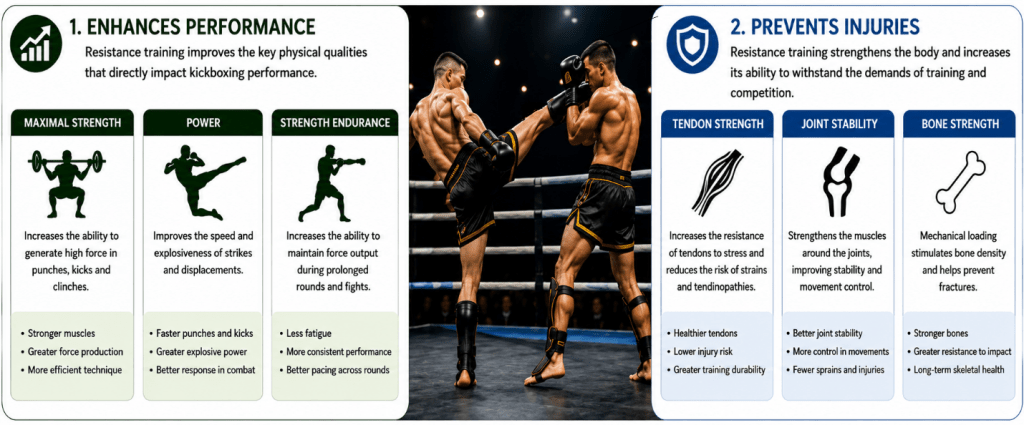
From a traditional perspective in the 20th century, many martial arts and combat sports held the belief that resistance training could impair performance (e.g., by making athletes slower). However, with the advancement of scientific knowledge and the increasing academic orientation of strength and conditioning coaches, this view has shifted. Current evidence indicates quite the opposite: resistance training enhances performance and helps prevent injuries. Further details are presented in Figure 1.
In classical periodization, training typically progresses from maximal strength to power, and finally to strength endurance. It is believed that this sequence allows for a transfer between these different manifestations of strength. It is important not to confuse traditional hypertrophy-oriented training with strength training for kickboxers, as hypertrophy may lead to increases in body mass. This is a critical consideration, given that kickboxing athletes compete in weight categories. Exceptions include: (1) when an athlete intends to move up a weight class, in this case, gaining muscle mass is preferable to increasing fat; and (2) heavyweight athletes, for whom there is no upper weight.
A proposed solution to this issue has been the implementation of maximal strength training (e.g., high loads, low repetitions, and longer rest intervals between sets). Another important aspect is understanding the muscle groups involved during combat so that they can be adequately strengthened. In this context, all major muscle groups of both the upper and lower limbs should be targeted, preferably through multi-joint exercises.
Physical conditioning in kickboxing
Both aerobic and anaerobic capacities are essential in kickboxing bouts to sustain high-intensity actions (e.g., attacks), as well as movement and recovery between rounds. Since kickboxing is an intermittent sport (i.e., alternating high- and low-intensity efforts during fights), high-intensity interval training (HIIT) is generally recommended, as it provides greater physiological stimulus compared to prolonged continuous running.
The scientific literature has established that HIIT can simultaneously improve both aerobic and anaerobic capacities. This appears to be independent of the exercise modality (general or sport-specific); however, there is growing evidence that HIIT incorporating sport-specific movements leads to greater transfer to actual combat performance. In this context, the principles of classical periodization remain applicable: training should begin with more general exercises and progressively incorporate sport-specific movements as competition approaches.
Music is an inexpensive resource that can be used in kickboxing training sessions to improve the quality of training.
— Jonatas Deivyson Reis da Silva Duarte
Is music a good tool for kickboxing training?
Given these training demands, we investigated whether music could enhance performance during HIIT sessions involving kickboxing-specific movements. This has clear practical implications, as such training is widely used in combat sports. In the study by Da Silva Duarte and collaborators, athletes selected their own music, while volume was standardized. We assessed psychological responses before and after training using a validated Brazilian questionnaire, along with Rating of Perceived Exertion (RPE). Performance was later analyzed using video recordings to quantify the number of strikes performed.
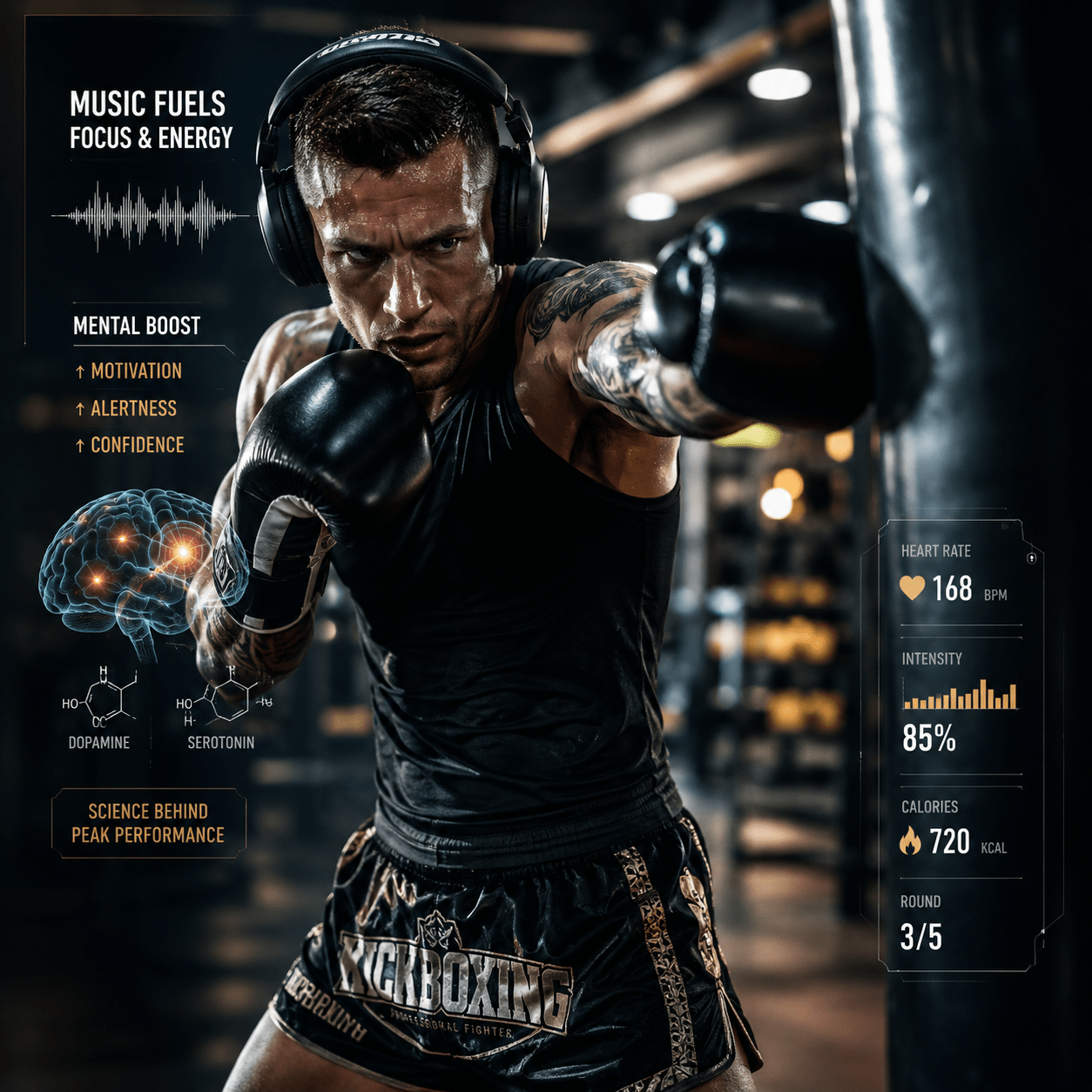
From a statistical perspective, music did not significantly increase the number of strikes. However, individual responses varied: some athletes improved their performance with music, while others showed no change. This suggests that coaches should adopt an individualized approach when incorporating music into training. Interestingly, from a psychological standpoint, athletes reported feeling more energized when training with music. This motivational effect may be explained by the activation of specific brain regions and increased release of excitatory neurotransmitters, such as serotonin and dopamine.
Reference
Da Silva Duarte, J. D. R., Robalino, J., Franchini, E., Kons, R. L., Kulpe, A., Andreato, C. C., & Fett, C. A. (2026). Effect of self-selected music on psychological state and performance in high-intensity intermittent exercise in kickboxing. Sport Sciences for Health, 22(1), 1-10. https://doi.org/10.1007/s11332-026-01669-x