Think of the Renaissance and you probably picture Michelangelo on his back painting the Sistine ceiling, or Leonardo filling notebooks with flying machines. What we rarely picture is the dense web of professional relationships that made any of it possible: apprenticeships, friendships, rivalries, commissions, copied works and so on. A new study argues that without understanding those relationships, we do not really understand art at all.
The study, recently accepted for publication in the scholarly journal Systems Research and Behavioral Science, draws on one of the most extraordinary documents in Western cultural history: Giorgio Vasari’s Lives of the Painters, Sculptors and Architects, first published in 1550, with an extended, and now standard, edition published in 1568. At roughly 1.2 million words (about one and a half times the length of Tolstoy’s War and Peace) it is the foundational account of Italian Renaissance art.
For Ion Georgiou, it is much more. His research mined Vasari’s Lives not for artistic biography but for something subtler: the social circuitry that connected roughly 1,500 artists across three centuries.
Art is a social system
The philosopher Niklas Luhmann wrote a celebrated book called Art as a Social System, yet Georgiou identifies a striking omission in Luhmann’s treatment of the subject: Luhmann never actually described the human relationships that would make art a social system in the first place. Luhmann discussed how art communicates through perception and how it generates its own meanings, but this is not the same as charting the variables that make art into a social system. Who trained whom? Who competed with whom? Who built on whose work? How did, and how do any and all artists form an art world?
Prior researchers had noticed individual threads, either by taking samples of artists, or by applying artificial intelligence to Vasari’s text. But no peer-reviewed study had attempted a systematic identification of social relations operating within an art world, or described its structural parameters which can guide research into this world. That is exactly what Ion Georgiou set out to do.
Nine types of social relations
Vasari’s Lives is in three Parts – in the words of its author “to distinguish the better from the good and the best from the better”. The renowned scholar Hayden B. Maginnis once wrote:
Readers who once knew their Vasari, knew it as a whole; they read from the beginning and watched the tale unfold chronologically. As biography followed biography and section followed section their understanding of the course of the arts was cumulative. Their sense of history was shaped by the history of their reading … The Prima Parte [Part I of the Lives] was not merely a chronicle of the first artists; it also provided a perspective and a set of contrasts and comparisons for the Vite to follow. It was the foundation of the Lives not merely in the sense that it recorded the lives and accomplishments of the artists of the “first age”, but also in that it provided conceptual parameters for the constructions of the second and third parts. And so the Prima Parte deserves, indeed requires, much more attention than it is normally accorded.
Following Maginnis’ advice, Ion Georgiou worked through Part I. It covers roughly 220 years of Italian art from the thirteenth to the early fifteenth century. Reading and rereading passages upon passages, Georgiou picked up on the nuances and contradictions, the humour and the facts, the literary flushes and the actual history. As a result, he was able to identify nine distinct social relations between artists.
The most familiar is apprenticeship: the passing of skill from master to pupil across generations, forming what Vasari himself treats as artistic genealogies. But friendship matters too, and is analytically distinct from training. Friendship, Vasari suggests, can shape an artist’s development just as powerfully as formal instruction, cutting across the hierarchies of the workshop.
To take some other examples, collaboration covers joint projects but also the less obvious cases such as that of an artist being summoned by another, or being employed on a site where multiple hands are at work. Endowment describes the gifting or bequeathing of objects, such as portraits or tools, from one artist to another, an act that signals both personal connection and professional esteem. Succession concerns one artist completing or continuing another’s unfinished work, which Vasari treats as an act of obligation to the wider fraternity of art. Portraiture functions similarly: to paint a fellow artist is to declare a relationship, even across death.
Then there is duplication, copying another’s work, whether to learn, to pay homage, or to preserve it. It is not to be confused with imitation, which requires working in another’s style to produce something new. And Vasari shows how competition is multifaceted, ranging from generous sportsmanship to darker impulses of envy and hostility (for example, Michelangelo had his nose broken and was permanently disfigured by a jealous rival).
Visualising an art world
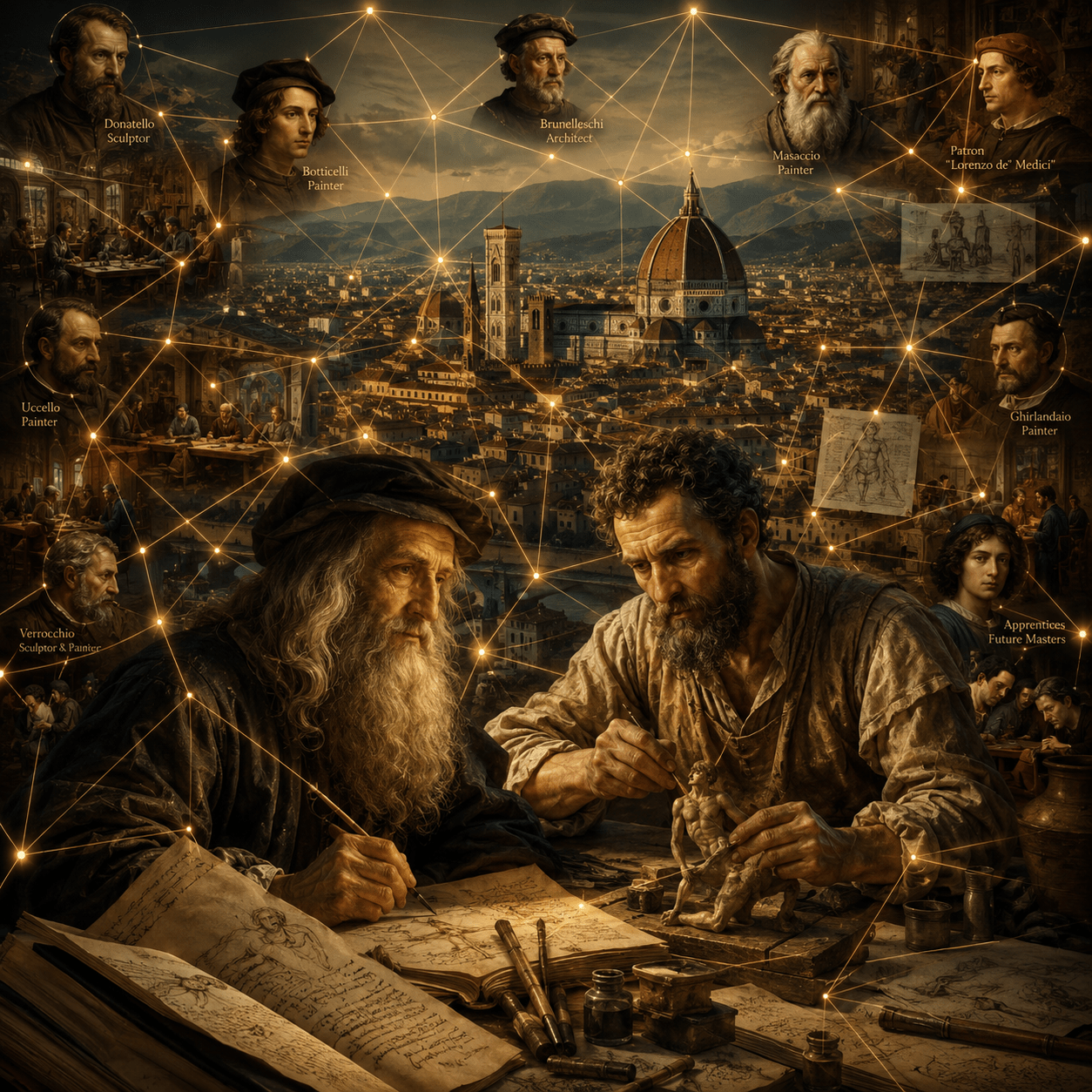
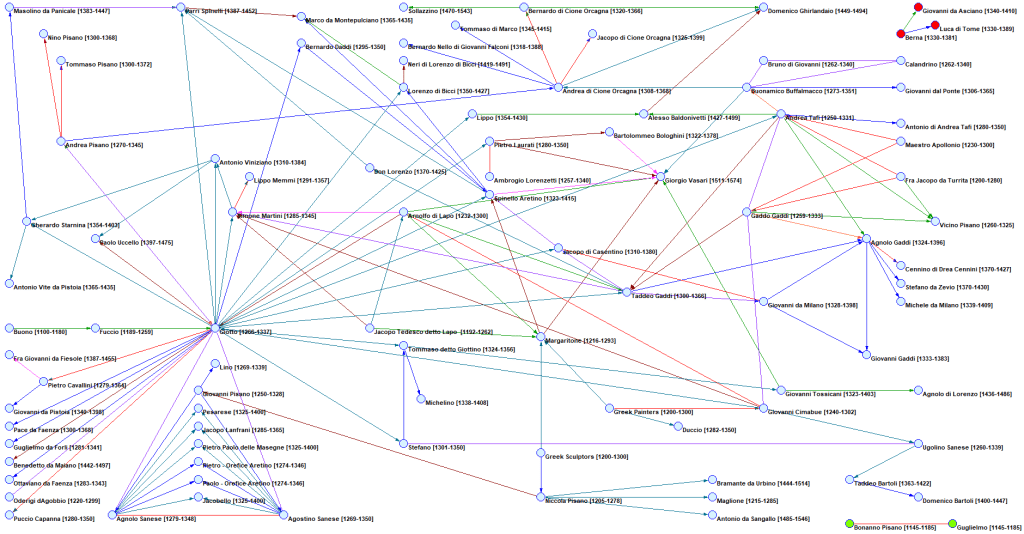
Ion Georgiou does not merely list these relations: he maps them. The paper includes what is most probably the first-ever formal network diagram of the complete nexus of relations between artists in Part I of Vasari’s Lives. The resulting visualisation is a striking web of directed and undirected connections linking dozens of artists. Upon analysis, it reveals clusters, lineages, connections between the worlds of painting, sculpture and architecture, disappearing traditions and much more.
The structural parameters of this networked world matter as much as the individual connections. The network is what researchers call “multiplex”: a pair of artists may be linked through multiple types of relations, such as apprenticeship, friendship, and imitation. The network is “multimodal”: artists connect not only to each other but to specific sites, such as churches and palaces which in turn imply connections to patrons, creating a three-way nexus of artist, place, and sponsor. And the network is also “longitudinal”: it evolves across time. Indeed, Ion Georgiou’s paper demonstrates that accounting for time in a network model of an art world provides clarity and exactness which may not be forthcoming from art scholarship, particularly when tracing professional genealogies, and unveiling evolutionary patterns of relationships.


Why this matters beyond art history
The implications reach well beyond Renaissance studies. Ion Georgiou’s paper offers a methodological cornerstone, that is, a replicable approach for studying any art world: contemporary art markets, creative industries, cultural ecosystems of any era or geography.
There is also a broader lesson about data. Vasari’s Lives has been read for centuries as biography and art criticism. Ion Georgiou’s paper shows it is simultaneously a massive, largely untapped social dataset. And if similar archival sources, such as guild records, correspondence networks, and patronage documents were subjected to the same formal treatment, researchers could reconstruct the social architecture of cultural production across history with a precision that impressionistic accounts simply cannot achieve.
As Ion Georgiou puts it, the exploration of art as a social system and the appreciation of what that means for one of humanity’s most fundamental pursuits remain in their nascent stages. His paper provides the platform.
Reference
Georgiou, I. (2025). Networked Lives: The Emergence of Art as a Social System. Systems Research and Behavioral Science. https://doi.org/10.1002/sres.70001