
Every year, millions of people apply sunscreen before stepping outdoors, often without considering where those chemicals eventually end up. When swimmers enter oceans, lakes, or even swimming pools, a portion of these products washes off and enters water systems. Over time, this seemingly harmless daily habit contributes to a growing environmental concern. Scientists have now begun to closely examine the ecological consequences of one such widely used compound, benzophenone-3, commonly known as BP-3.
A recent study led by Bhavana Raju Dhawad and colleagues, published in the International Journal of Environmental Research, sheds light on both the environmental risks posed by this chemical and a promising biological solution. Titled Ecotoxicity Assessment and Microalgae Assisted Bioremediation of benzophenone 3, the research was conducted at the ICAR Central Institute of Fisheries Education, Mumbai, India. The findings highlight a dual narrative: while BP-3 poses measurable toxicity to aquatic organisms, certain microalgae may provide an effective means of removing it from contaminated water.
A growing environmental contaminant
Benzophenone-3 is an organic ultraviolet filter widely used in personal care products such as sunscreens and cosmetics, as well as in food packaging. Its primary function is to absorb harmful ultraviolet radiation, protecting both human skin and product integrity. However, its chemical stability and widespread usage have contributed to its classification as an emerging contaminant in environmental science.
The study notes that approximately 14,000 tones of BP-3 are released into aquatic environments annually. These releases occur through recreational activities, wastewater discharge, and incomplete removal in wastewater treatment plants. As a result, BP-3 has been detected in seawater, surface water, groundwater, and even drinking water sources.
Environmental monitoring studies have reported concentrations ranging from nanograms to micrograms per liter, with particularly high levels found in wastewater. This widespread presence raises concerns about long-term ecological exposure, particularly for organisms that form the foundation of aquatic food chains.
Why microalgae matter in aquatic ecosystems
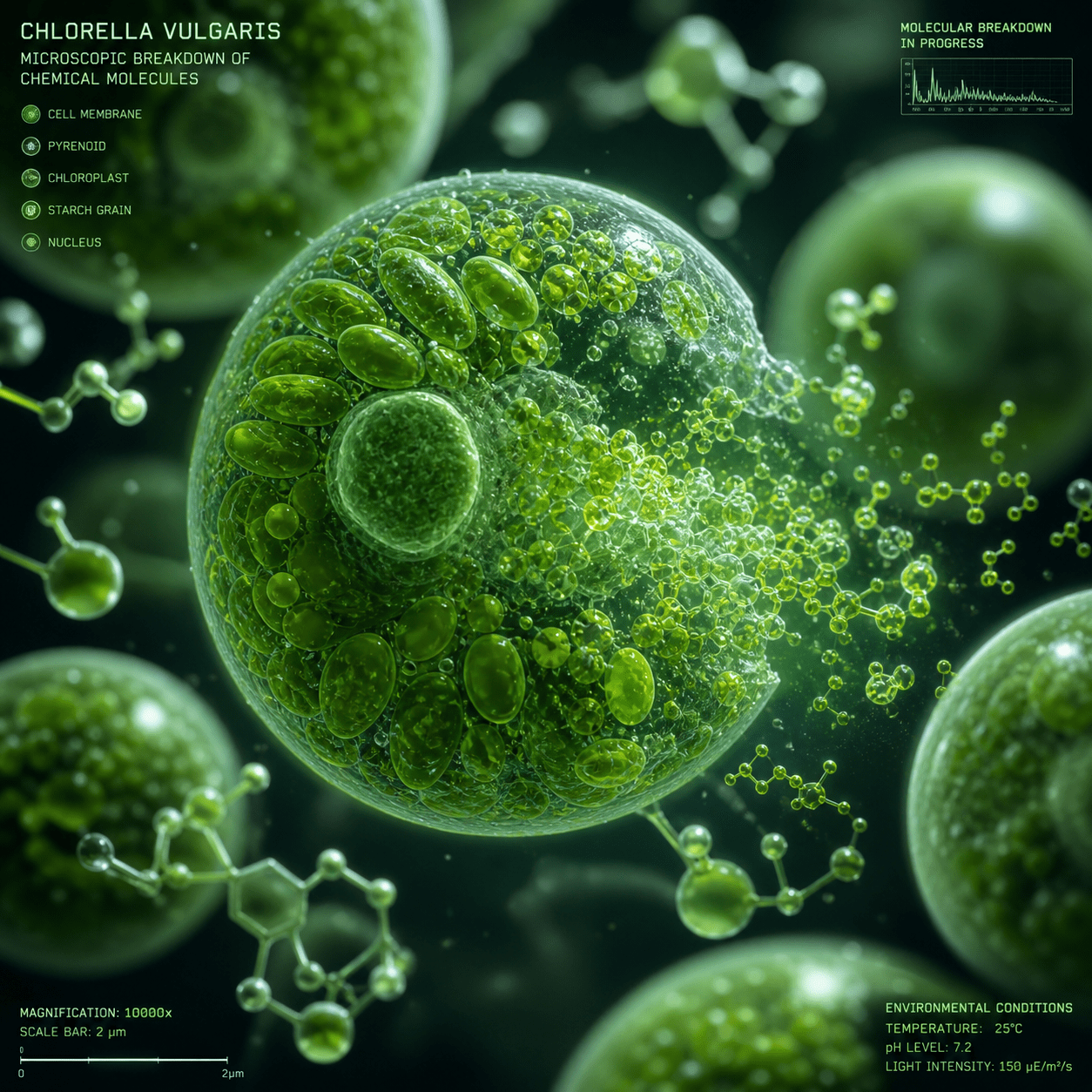
Microalgae, such as Chlorella vulgaris, play a critical role in aquatic ecosystems. They serve as primary producers, converting sunlight into chemical energy through photosynthesis and supporting higher trophic levels. Because of their sensitivity to pollutants, microalgae are often used as model organisms in ecotoxicological studies.
In this research, Chlorella vulgaris was selected not only for its ecological relevance but also for its known resilience and capacity to remove pollutants. The study explored how exposure to varying concentrations of BP-3 affects the growth, pigment composition, and protein content of these microalgal cells.
The results revealed a clear pattern. As BP-3 concentration increased, the algal growth rate declined significantly. At the highest tested concentration, growth inhibition reached over 69 percent after 96 hours. This indicates that BP-3 interferes with fundamental biological processes, limiting the organism’s ability to proliferate.
Disrupting photosynthesis and cellular health
One of the most striking findings of the study relates to the impact of BP-3 on photosynthetic pigments. Chlorophyll a, chlorophyll b, and carotenoids are essential for capturing light energy and facilitating photosynthesis. The research demonstrated a concentration-dependent decrease in all these pigments when the algae were exposed to BP-3.
At higher concentrations, chlorophyll levels decreased by more than 50%, suggesting severe impairment of photosynthetic activity. This reduction can be attributed to oxidative stress and disruption of photosystem II, a critical component of the photosynthetic machinery. When electron transport is hindered, energy production declines, ultimately affecting growth and survival.
Protein content also showed a marked decrease across all exposure levels. This indicates that BP-3 not only affects energy production but also interferes with protein synthesis and cellular metabolism. The study links this decline to both reduced synthesis and increased degradation, potentially triggered by stress responses such as programmed cell death.
Toxicity classification and ecological implications
Using internationally recognized guidelines, including the European Union Directive 93 67 EEC, the study classified BP-3 as toxic to aquatic organisms. The median inhibitory concentration (IC50) values were calculated at different time points. At 96 hours, the IC50 value was 3.09 milligrams per liter, confirming significant toxicity.
As primary producers, algae form the base of aquatic food webs. Any disruption at this level can cascade through the ecosystem, affecting zooplankton, fish, and ultimately higher predators. Previous studies have also linked BP-3 exposure to coral bleaching, developmental abnormalities in aquatic species, and endocrine disruption.
In addition, the compound’s lipophilic nature allows it to bioaccumulate in living organisms. This means that even low environmental concentrations can lead to higher internal concentrations over time, increasing the risk of chronic toxicity.
Every chemical we use leaves a footprint, and our aquatic ecosystems are currently bearing the brunt of invisible cosmetic pollutants like Benzophenone-3. Our research aims to turn the tide by using microalgae to quietly but effectively erase that footprint, restoring safety to fragile water habitats.
—Bhavana Raju Dhawad
Turning to nature for a solution
While the toxic effects of BP-3 are concerning, the study also offers a hopeful perspective. The researchers investigated whether Chlorella vulgaris could be used to remove BP-3 from contaminated water via bioremediation.
Bioremediation involves using living organisms to degrade or remove pollutants from the environment. In this case, the algae were exposed to BP-3 for 10 days, and the chemical concentration was monitored at regular intervals.
The results were encouraging. The algae removed up to 88.2% of BP-3 at lower concentrations and over 85% at higher concentrations. This level of removal efficiency underscores the potential of microalgae-based systems for wastewater treatment.
How the removal process works
The study identified several mechanisms through which BP-3 was removed from the water. The dominant process was biodegradation, accounting for more than 80 percent of the total removal. This means that the algae actively broke down the chemical into simpler compounds.
Other processes included bioadsorption, in which the chemical attaches to the surface of algal cells, and bioaccumulation, in which it is taken up into the cells. However, these contributed only a small fraction of the overall removal.
During the degradation process, BP-3 was converted to an intermediate, benzophenone-1. Importantly, this metabolite was found to be less toxic than the parent compound, suggesting that the degradation pathway reduces overall environmental risk.
The identification of benzophenone-1 was confirmed by high-performance liquid chromatography, providing robust evidence for the biochemical transformation occurring within the algal system.
Implications for wastewater treatment
The findings of this study have significant implications for the development of sustainable wastewater treatment technologies. Conventional methods for removing organic contaminants often involve chemical oxidation or advanced filtration, which can be costly and energy-intensive.
In contrast, microalgae-based systems offer a cost-effective and environmentally friendly alternative. They rely on natural processes driven by sunlight, making them suitable for large-scale applications. Additionally, microalgae can produce valuable byproducts such as biofuels and biomass, adding economic value to the treatment process.
However, the study also acknowledges certain limitations. The experiments were conducted under controlled laboratory conditions, and further research is needed to assess performance in real-world environments. Factors such as fluctuating pollutant concentrations, temperature variations, and interactions with other contaminants may influence efficiency.
A delicate balance between protection and pollution
The widespread use of UV filters like benzophenone-3 reflects a growing emphasis on personal health and sun protection. Yet, as this research demonstrates, these benefits may come at an environmental cost. The challenge lies in balancing human needs with ecological sustainability.
Microalgae-based bioremediation offers a promising pathway forward, harnessing the natural capabilities of microscopic organisms to address modern pollution challenges. While not a complete solution, it represents an important step towards more sustainable water management practices.
As research continues to evolve, it is becoming increasingly clear that solutions to environmental problems may already exist within nature itself. The task for scientists and policymakers is to identify, refine, and implement these solutions effectively and at scale.
Reference
Dhawad, B. R., Sudarshan, S., Sarkar, P., Savaliya, B. D., Bharti, V. S., Kumar, K., Shukla, S.P., & Bhuvaneswari, G. R. (2026). Ecotoxicity assessment and microalgae assisted bioremediation of benzophenone 3. International Journal of Environmental Research, 20, 14. https://doi.org/10.1007/s41742-025-00975-5
Coauthors
Dr. Rathi Bhuvaneswari is a Senior Scientist at the ICAR–Central Marine Fisheries Research Institute (CMFRI), India. She holds M.F.Sc. and Ph.D. degrees in Aquatic Environmental Management from the ICAR–Central Institute of Fisheries Education (CIFE), Mumbai, where she also served as a Scientist before joining CMFRI. With over a decade of research experience, her areas of expertise include microalgal bioprospecting, downstream processing of high value algal pigments, ecotoxicology, bioremediation, marine ornamental fish breeding, and live feed production. Her notable contributions include a patented device for plastic waste mitigation in aquatic environments and the world’s first successful breeding and larval rearing of lemon damselfish. She currently serves as the In-charge of the Sagarika Marine Research Aquarium at Vizhinjam Regional Centre of ICAR-CMFRI.
Dr. Satya Prakash Shukla is a Principal Scientist in the Aquatic Environment & Health Management Division at the Central Institute of Fisheries Education (CIFE). He holds M.Sc. and Ph.D. degrees in Botany from Banaras Hindu University, specializing in Algal Physiology and Biochemistry. His professional expertise also includes extensive research and project work focused on pigment production from algae. Over his distinguished career, he has published 90 papers in international journals, 10 in national journals, and edited five books. His notable honors include an international Best Paper Award from THE INTER (Japan) for an original hypothesis on ozone layer destruction, a DBT overseas fellowship, and serving as a member of the 15th Antarctic expedition. Through these diverse research projects and high-impact publications, Dr. Shukla continues to drive significant advancements in the field of aquatic environmental management and algal research.