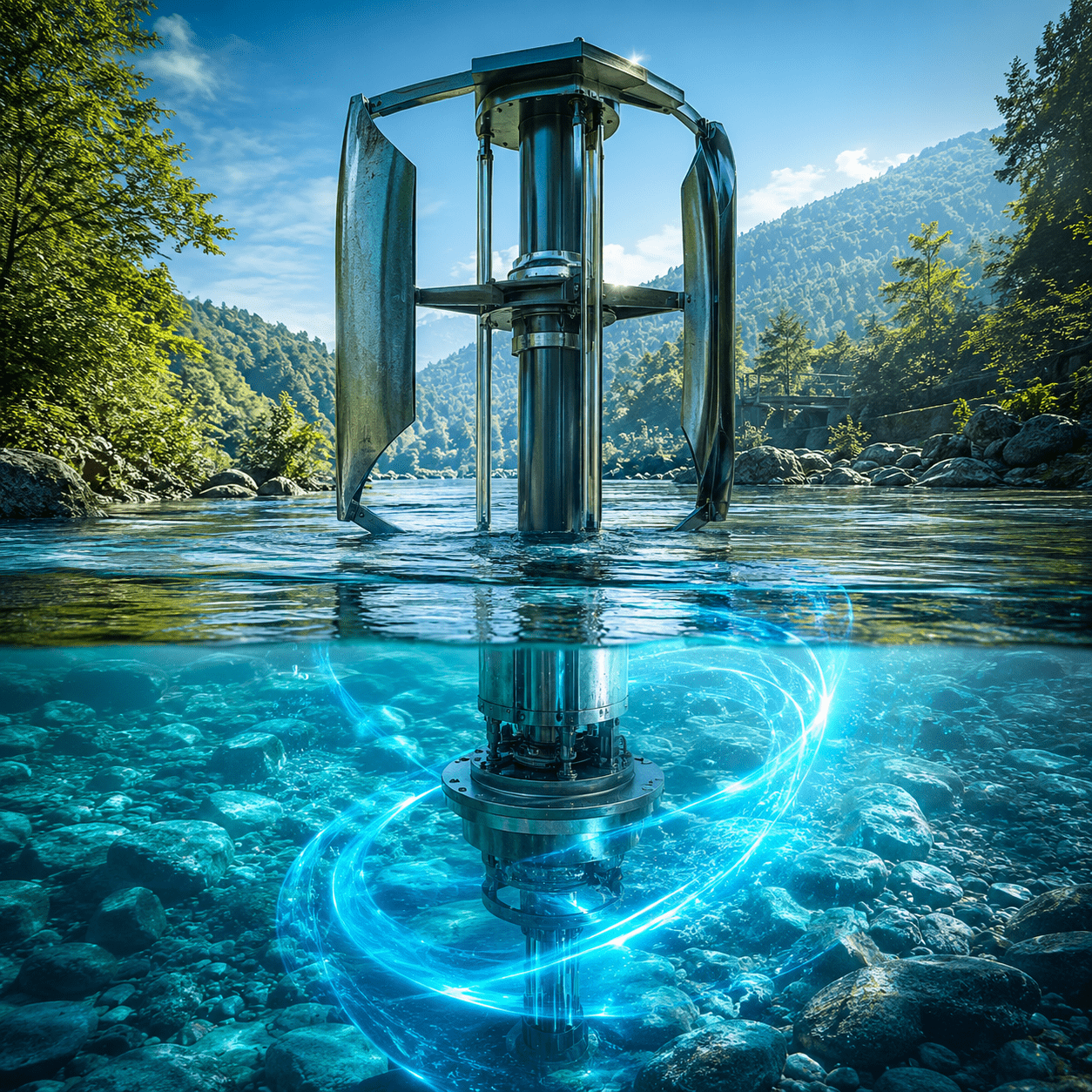
Most renewable energy discussions focus on bigger turbines, stronger winds, or faster water currents. But sometimes the solution is simple: make the turbine spin more steadily.
That is exactly what our recent research explored. Published in the Journal of Offshore Mechanics and Arctic Engineering (ASME – American Society of Mechanical Engineers), we investigated whether adding rotational inertia, i.e., the tendency of a spinning object to resist changes in motion, could improve the performance of a vertical-axis hydrokinetic turbine operating in slow-moving water.
Under the right conditions, the turbine generated more stable motion and harvested over 60% more power. The findings may help improve low-cost renewable energy systems designed for rivers, tidal currents, and remote communities where conventional turbines are often impractical.
Why slow water currents matter
Hydrokinetic turbines generate electricity directly from flowing water without the need for dams. They can be installed in rivers, estuaries, irrigation canals, or tidal environments with relatively low environmental impact.
However, many conventional turbines struggle in slow or turbulent flows. Horizontal-axis turbines, the underwater equivalent of wind turbines, usually require higher flow velocities to operate efficiently. At low-speed conditions, their efficiency drops sharply.
Vertical-axis turbines offer an alternative. Because they rotate around a vertical shaft, they can receive water from any direction without reorientation. They are also mechanically simpler and often cheaper to manufacture and maintain.
Our work focused on a specific design known as the Vertical Axis Autorotation Current Turbine (VAACT), a concept patented and developed at the Federal University of Rio de Janeiro (UFRJ/Brazil). Unlike traditional drag-based turbines, the VAACT combines drag and lift effects using an S-shaped blade profile. This hybrid behaviour allows the turbine to self-start while still achieving reasonable energy efficiency.
The overlooked role of inertia
Most turbine research focuses on blade geometry, flow conditions, or aerodynamic optimization. But rotational inertia is rarely discussed. In simple terms, inertia determines how difficult it is to accelerate or decelerate a rotating object. A heavy flywheel, for example, tends to keep spinning smoothly even when external forces fluctuate.
This idea is important in vertical-axis turbines because the forces acting on the blades change continuously during rotation. As a blade moves around the rotor, its angle relative to the incoming flow changes constantly. That produces oscillating torque and unstable rotational speeds.
A turbine with very low inertia responds immediately to these fluctuations. It speeds up and slows down repeatedly, leading to unstable operation and inefficient power extraction. We wanted to know whether increasing inertia could smooth this behaviour.
The additional inertia works almost like an energy buffer. It stores rotational energy and helps the turbine maintain a more stable motion, even when the hydrodynamic forces fluctuate during rotation.
— Antonio Carlos Fernandes
Testing the idea in the laboratory
The experiments were conducted at the Laboratory of Waves and Currents (LOC) at COPPE/UFRJ in Brazil. We tested an S-shaped vertical-axis turbine inside a 22 m long water channel under controlled flow conditions.
Rather than redesigning the turbine blades, we modified the turbine’s rotational inertia directly. Additional masses were attached to rotating bars connected to the turbine shaft, allowing us to create several different inertia configurations.
The turbine operated under water velocities between 0.25 and 0.45 m/s, conditions representative of low-speed hydrokinetic environments. To measure power generation, we used a mechanical power take-off system based on weight lifting. As the turbine rotated, it lifted a suspended mass through a pulley arrangement. By measuring the lifting speed, we estimated the turbine’s mechanical power output. Although simple, this method allowed precise analysis of the turbine’s dynamic behaviour without requiring expensive electrical generators or torque sensors.
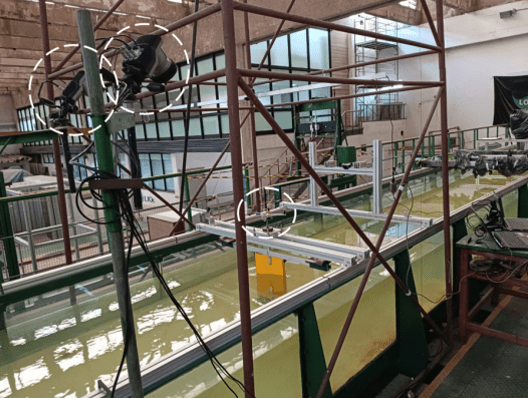
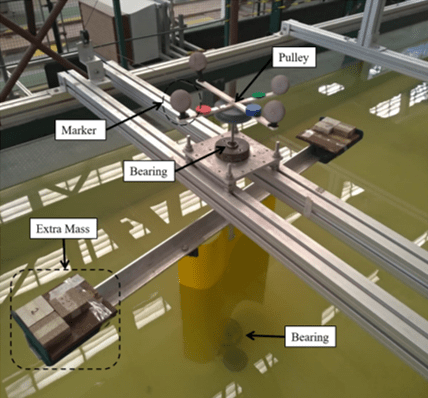
Figure 1: Experimental setup; Credit: Author
A more stable turbine performs better
When the turbine operated with low inertia, its rotational motion was unstable. The efficiency fluctuated strongly with blade position during each revolution. At some azimuthal angles, the turbine extracted energy effectively, while at others, performance dropped sharply.
As inertia increased, the rotational behaviour became much smoother.
The turbine maintained a more constant angular velocity and operated closer to its optimal tip speed ratio, the relationship between blade speed and incoming water velocity. Under these conditions, energy extraction improved significantly. The experiments showed that the turbine’s efficiency increased by more than 60% compared with the baseline low-inertia configuration.
We also observed a strong reduction in cyclic fluctuations. In practical terms, smoother operation may reduce structural fatigue, mechanical stress, and vibration, all of which are important factors in long-term turbine durability.
Interestingly, the study found that there appears to be a threshold value for inertia. Below this threshold, the turbine became highly sensitive and unstable. Above it, performance stabilized considerably. This suggests that rotational inertia is not simply a secondary design parameter. It directly influences how the turbine interacts with the surrounding flow.
Understanding the physics of energy loss
The study also revealed an important fluid dynamics effect. At higher flow velocities, the turbine generated stronger vortex-shedding swirling flow structures that carried energy away from the rotor. These vortices increase energy losses and reduce overall efficiency.
Under lower Reynolds number conditions, vortex formation became less intense, allowing more of the flow energy to be converted into useful rotational motion. This helps explain why the turbine performed best in relatively slow-flow conditions. In this operating range, the additional inertia stabilized the turbine without excessive energy loss to turbulent wake structures. In other words, the turbine benefited from both smoother rotational dynamics and more favorable flow physics.
Why this matters beyond the laboratory
At first glance, adding mass to a turbine may sound counterintuitive. Engineers often try to reduce weight to lower manufacturing costs and simplify installation. But lightweight turbines can also become dynamically unstable.
This issue is becoming increasingly relevant as many modern prototypes are produced using polymers, composite materials, or 3D printing. These materials naturally reduce structural inertia. Our findings suggest that carefully increasing and optimizing inertia may improve the performance of such systems, particularly in low-speed environments. Small hydrokinetic turbines could provide decentralized electricity generation for isolated riverside communities without requiring large infrastructure projects.
Because vertical-axis turbines are mechanically simple and omnidirectional, they may also reduce installation and maintenance costs compared with more complex turbine designs.
Looking ahead
Renewable energy technologies are often evaluated using large-scale metrics such as megawatts generated, turbine size, or installation capacity. Yet small improvements in stability and efficiency can have major long-term impacts, especially for emerging technologies. Our work shows that inertia deserves far more attention in turbine design.
Instead of treating rotational inertia as a passive structural property, engineers may begin using it as an active design strategy to improve performance, stability, and durability. Future studies will likely investigate how inertia interacts with blade geometry, turbulence, flow variability, and real electrical generators. Understanding these interactions could help develop more efficient turbines for rivers, tides, and urban water systems.
In many renewable energy applications, the challenge is not simply generating power, but generating power consistently and reliably. Sometimes, helping a turbine spin more steadily may be just as important as making it spin faster.
Reference
Soares, R. B., Fernandes, A. C., and Sales Junior, J. S. (September 16, 2025). “The Effect of the Mass Moment of Inertia on Vertical Axis Current Turbines.” ASME. J. Offshore Mech. Arct. Eng. February 2026; 148(1): 012007. https://doi.org/10.1115/1.4069636