Artificial intelligence is rapidly reshaping education, but few areas have attracted as much debate as writing instruction. From grammar checking to content generation, generative artificial intelligence tools are increasingly being used by students who write in a second language. Yet an essential question remains unresolved. Can AI genuinely support learning, or does it risk weakening the very skills it aims to improve?
A new peer reviewed study published in ECNU Review of Education takes a close look at this question by examining how students experience AI generated feedback on their writing. Led by first author Yudan Mi of Huaihua University, alongside colleagues from Central South University and the National University of Defense Technology, under the guidance of Xuchuan (Winnie) Chen, the research explores both the promise and the limitations of generative AI feedback in comparison to traditional peer review.
Titled “Exploring the affordances and challenges of GenAI feedback in L2 writing instruction: A comparative analysis with peer feedback”, the study offers timely insight into how AI tools are reshaping second language writing education and what educators should be cautious about as adoption accelerates.
Why writing feedback has become a bottleneck in modern education
Feedback plays a critical role in writing development, particularly for learners writing in a second language. Effective feedback helps students notice grammatical errors, refine structure, and develop clarity and coherence. However, in many educational settings, delivering high-quality feedback remains a persistent challenge.
Large class sizes, heavy teaching workloads, and limited instructional time often result in delayed, inconsistent, or superficial feedback. Peer feedback is widely used as a partial solution, but it comes with its own limitations. Students often share similar language proficiency levels, and their feedback may lack depth, confidence, or accuracy.
Generative AI tools have emerged as a potential alternative. Powered by large language models, these systems can analyse text instantly, respond interactively, and adapt to user feedback. The question is no longer whether students are using these tools, but how their use affects learning outcomes, motivation, and writing development.
How researchers examined AI feedback in real classrooms
The study was conducted in a compulsory advanced English writing course at a public university in China. Over a sixteen-week semester, students completed multiple essay assignments that covered various writing genres, including descriptive, evaluative, and argumentative writing.
Each essay went through two feedback stages. First, students exchanged drafts with peers and provided traditional peer feedback. Second, they submitted their original drafts to ERNIE Bot, a Chinese generative AI chatbot developed by Baidu, and received AI-generated feedback. Students then revised their work based on both sources.
The analysis was guided by a useful theoretical framework, which evaluates educational technologies through three lenses: technological affordances, educational affordances, and social affordances. This framework allowed the researchers to examine not only what the AI tool could do, but also how students experienced and interpreted its role in learning.
Why students valued AI feedback
One of the most consistent findings was the value students placed on the immediacy of AI-generated feedback. Unlike peer review, which often required waiting for classmates to complete their evaluations, ERNIE Bot delivered responses within seconds.
Students reported that this timeliness made the revision process more efficient. Errors could be identified and corrected immediately, allowing for iterative improvement rather than delayed reflection. In large classes where teacher feedback is limited, this speed was seen as a major advantage.
Personalization was another highly valued feature. Students noted that the AI responded differently depending on the quality and characteristics of their writing. When drafts contained frequent grammatical errors, feedback focused on basic corrections. As writing improved, feedback shifted toward vocabulary sophistication, sentence structure, and overall organization.
Educational affordances of GenAI
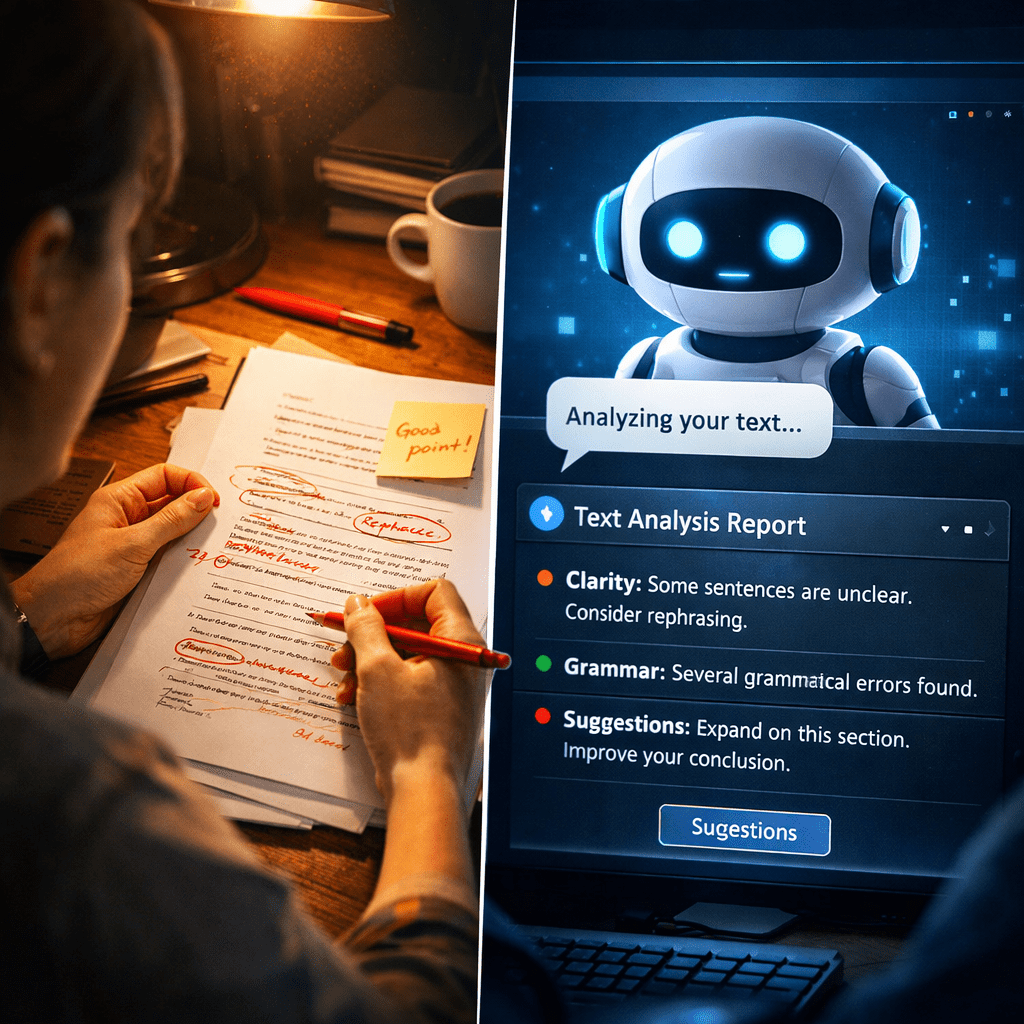
Beyond surface-level editing, students reported that AI feedback played a broader educational role. ERNIE Bot was frequently described as a competent essay editor, capable of identifying grammatical errors, lexical problems, and even subtle logical inconsistencies that peers sometimes overlooked.
More importantly, many students perceived AI as a responsive tutor. When learners asked why a sentence was incorrect or how a paragraph could be improved, the system provided explanations and examples rather than simple corrections. This interactive dimension supported deeper understanding of language rules and writing conventions.
Several participants also highlighted AI’s ability to comment on content structure and idea development. While peers often focused on obvious errors, the AI evaluated essays from multiple perspectives, including coherence, clarity, and organization. This multidimensional feedback was seen as particularly valuable for developing academic writing skills.
Social and emotional dimensions of AI feedback
An unexpected finding was the impact of AI feedback on students’ emotional experience of writing. Many participants reported feeling less anxious when interacting with the AI than when receiving feedback from classmates.
Because AI feedback was perceived as objective and nonjudgmental, students felt more comfortable making mistakes and revising their work. This reduced fear of embarrassment and increased willingness to experiment with language. Some students described AI as a supportive presence that helped them regain confidence in their writing abilities.
The interactive nature of the chatbot also made the writing process feel more engaging. Continuous dialogue, instant responses, and the absence of social pressure contributed to a more relaxed learning environment. For learners who struggle with confidence in second language writing, this social affordance may be as important as linguistic accuracy.
Challenges and unintended consequences
Despite its advantages, the study also identified significant challenges associated with AI-generated feedback. One of the most prominent issues was students’ limited AI literacy. Many participants used the chatbot only for basic grammar checking, unaware of its broader capabilities for analysing structure, argumentation, or style.
This limited use was not due to technological constraints, but to a lack of understanding about how to craft effective prompts and interpret feedback critically. Without guidance, students risk underutilizing the tool and missing opportunities for deeper learning.
Another concern was the potential risk of dependency. Several students worried that relying too heavily on AI feedback could weaken their ability to think independently and develop their own writing strategies. When revisions become effortless, the cognitive effort required for learning may diminish.
Finally, students consistently noted that AI struggled to recognize emotional nuance and authorial voice. While the chatbot could identify technical issues, it could not fully appreciate the emotions, personal experiences, or stylistic intentions embedded in human writing. Peer feedback remained superior in responding to tone, sentiment, and individuality. A balanced approach that combines AI feedback with peer and teacher input appears most promising.
Reference
Mi, Y., Rong, M., & Chen, X. (2025). Exploring the affordances and challenges of GenAI feedback in L2 writing instruction: A comparative analysis with peer feedback. ECNU Review of Education, 1–26. https://doi.org/10.1177/20965311241310883