Cancer is a group of diseases in which abnormal cells in your body divide and grow uncontrollably, invading nearby organs and disrupting their normal function. Cancer is the second-leading cause of death worldwide, responsible for about 1 in every 6 deaths in 2020 (~10 million deaths). It is also the eighth-leading cause of childhood death worldwide, and cancer incidence among children is rising. Thankfully, cancer is very rare in children, and cancer deaths among children have been decreasing since the 1990s; according to the American Cancer Society, the most common cancer type in children is leukemia (blood cancer), and 85% of kids diagnosed with leukemia live 5 years or longer.
Not all children get cancer at the same rate. Some things can make a child more or less likely to develop cancer. For example, some studies suggest that catching certain viruses, being exposed to ionizing radiation, being immunosuppressed, and certain birth defects and genetic traits are all associated with increased risks of childhood cancers, while being breastfed, eating many fruits and vegetables, and receiving vaccines against the cancer-causing viruses are all associated with decreased risks of childhood cancers.
Similarly, not all children who get cancer will die at the same rate. Children whose parents have higher levels of education are less likely to die from cancer, and children who are Black and Hispanic are more likely to die from cancer than children who are White non-Hispanic.
Rural childhood cancer
Geography also plays an important role in cancer outcomes. People living in rural areas have a slightly higher likelihood of developing cancer, as well as a higher likelihood of developing a preventable cancer (one that likely developed because of a lifestyle choice, like smoking, instead of an unpreventable inherited trait, like a gene. And, rural residents have a higher risk of dying from cancer; rural cancer patients have 15% lower odds of survival. Researchers believe this is due to many factors, including fewer oncologists in rural areas, less access to health providers in general, longer transportation times to hospitals, and higher rates of underlying issues like obesity and smoking.
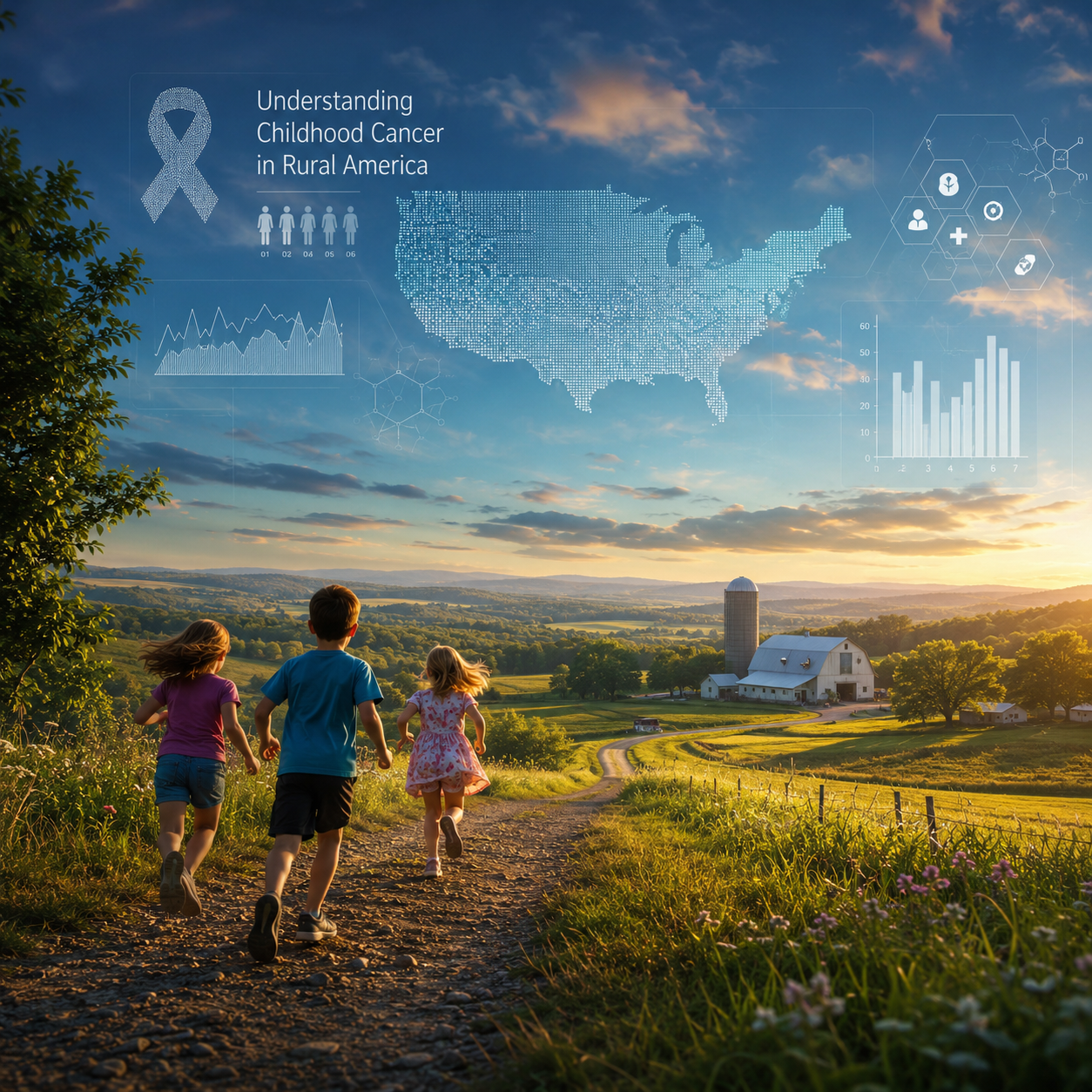
In summary, rurality is associated with cancer incidence and outcomes. Yet despite extensive research on rural cancer, almost all studies have focused on adults. This is because childhood cancer is rare, as mentioned earlier, which makes it difficult to generate reliable estimates for sparsely populated rural areas. In addition, privacy protections often require data suppression when only a small number of cases occur. As a result, rural pediatric cancer remains understudied. In our study, we used publicly available 2022 data from the National Cancer Institute to investigate cancer incidence rates among United States (U.S.) children ages 0-19 in nonmetropolitan counties.
Nonmetropolitan childhood cancer incidence results
29 nonmetropolitan counties had available data for us to examine. These counties had median populations of 105,851. Of the median population, most identified as White non-Hispanic (86.2%), and around 1/5th of the population (20.8%) were children (under 18). The counties averaged a median child poverty rate of 16%, slightly above the national average of 14.3%; a school funding gap of $1,787 (the estimated amount needed per student to reach the national average test score); and 51% of students were enrolled in free or reduced-price school lunches. Additionally, there was 1 doctor for every 1,885 residents, and an all-cause childhood mortality rate of 48.9 per 100,000 children under 20.
Across the 29 included counties, we found a median childhood cancer incidence rate of 23.9 cases of cancer per 100,000 nonmetropolitan children, falling within the range reported in previous national studies of childhood cancer: 18.2 per 100,000 children (2001-2022) and 18.7 per 100,000 children (1992-2018). The highest rate was 39.6 per 100,000 (Windsor County, VT), and the lowest rate was 11.2 per 100,000 (Hawai’i County, HI).
What it can (and can’t) tell us
We found a median childhood cancer incidence of 23.9 per 100,000 children in nonmetropolitan counties. While this estimate is somewhat higher than previously reported national rates (~18.5), the difference should be interpreted with caution, given the small number of counties available for analysis and the study’s descriptive nature.
We also saw substantial variation – rates ranged from 11.2 to 39.6 per 100,000. Previous research has reported higher pediatric cancer incidence rates in the Northeastern United States than in other regions of the country, which is consistent with our observation that Windsor County, VT, had the highest rate, aligning with our findings. The lowest rate was in Hawai’i County, HI, which aligns well with Hawai’i’s lower-than-average childhood cancer incidence rates.
The data had limitations. Most rural counties did not meet the minimum case count required for public reporting and, therefore, had their data suppressed. There are almost 2,000 rural counties in the U.S., but only 29 nonmetropolitan counties had data available for analysis. And our small sample is likely unrepresentative of the entire rural U.S. For example, our sample appears healthier: the 29 investigated counties had lower all-cause child mortality rates (48.9 per 100,000, compared with 63.6 per 100,000 across all rural counties). This means that although we found a pediatric cancer incidence rate, it may not apply to all rural areas.
What people should do with the data
Our findings highlight a challenge facing researchers and policymakers: there is currently very little publicly available information about childhood cancer in rural America. Because most rural counties have too few reported cases to meet disclosure thresholds, it is difficult to monitor trends, identify disparities, or evaluate interventions. In our study, this meant that most counties (~98%) had suppressed childhood cancer data. Alternative reporting thresholds (such as lowering the reporting suppression threshold from 16 to 10) or increasing the number of years included in pooling (from 5 to 10) could help improve data availability.
Childhood cancer remains rare, but it is on the rise and carries profound consequences for children, families, and communities, including high rates of mortality. Our study suggests that publicly available data can provide some insight into childhood cancer in nonmetropolitan areas, but substantial gaps remain. Improving access to rural pediatric cancer data and conducting additional research on both incidence and mortality will be essential for understanding whether rural children experience unique cancer burdens and how those burdens can best be addressed.
Reference
Jacobson, I. (2025). Childhood cancer incidence in nonmetropolitan U.S. counties. Rural Cancer Institute. https://doi.org/10.1002/1545-5017.70407