
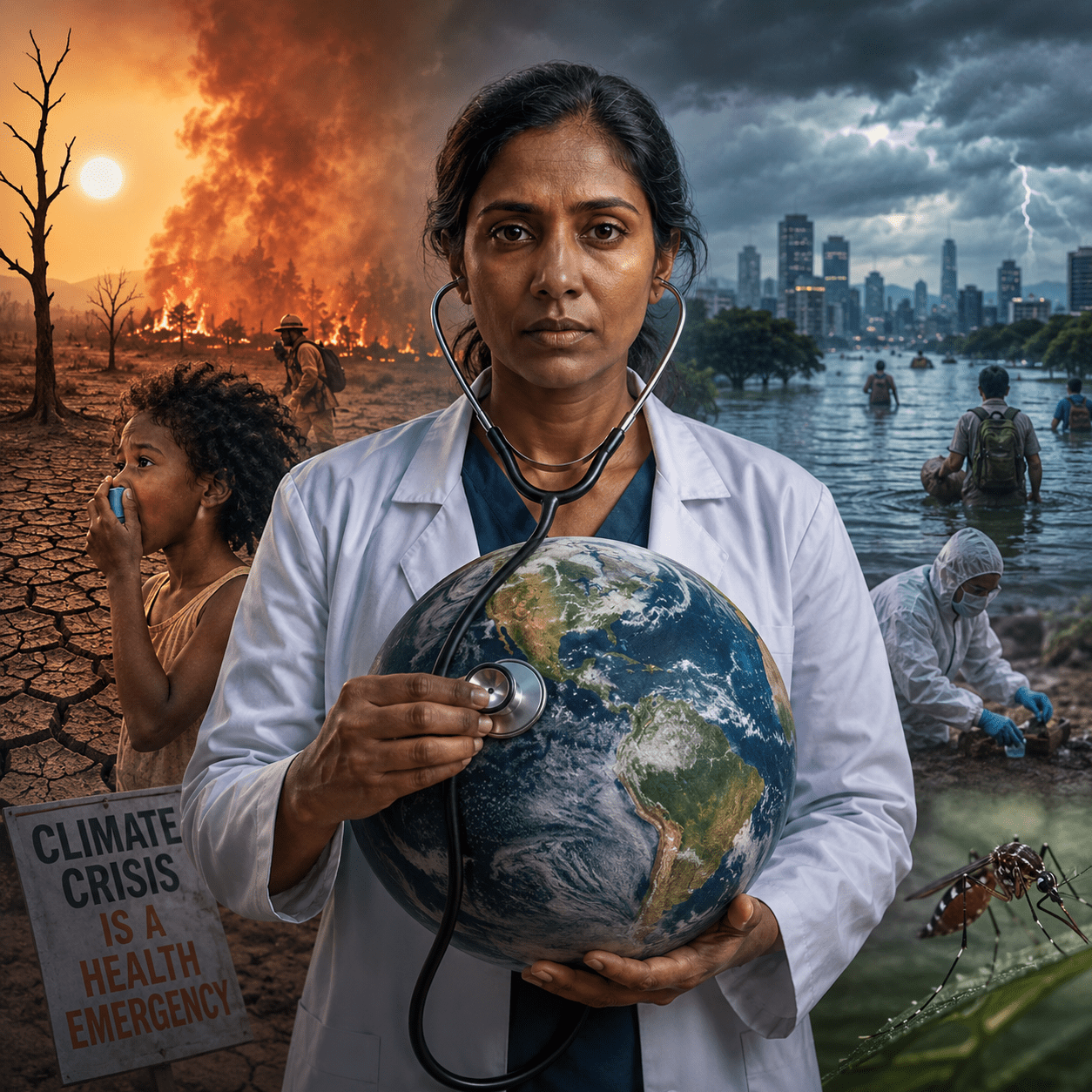
Climate change is often portrayed through images of melting glaciers, rising sea levels, raging wildfires, and extreme weather events. While these environmental consequences are undoubtedly important, they represent only part of the story. Increasingly, scientists argue that climate change should also be understood as a major public health challenge, affecting everything from respiratory diseases and mental health to infectious disease transmission and maternal wellbeing.
The findings come from a study led by Rory Smith from the Brown University School of Public Health and published in the journal Health Communication, the article title “The Climate-Health Communication Gap: Connecting the Dots to Drive Climate Health Action”. The research provides one of the most comprehensive examinations to date of how climate change and health are communicated across social media platforms and online news outlets. The results reveal a significant communication gap that may be limiting public understanding and slowing support for climate action.
The missing connection
Public engagement plays a critical role in addressing climate change. Policymakers, governments, industries, and communities are more likely to act when citizens recognise the seriousness of a problem and understand how it affects their daily lives. Previous research has shown that framing climate change as a health issue can strengthen public engagement and increase support for climate policies.
Health-focused climate communication has particular advantages because it makes an otherwise distant and abstract issue feel immediate and personal. Most people may never directly witness melting polar ice caps or rising ocean levels, but they can understand the consequences of heat exhaustion, asthma, food insecurity, mosquito-borne diseases, and mental health challenges.
Despite this potential, the new study found that health remains largely missing from climate conversations. According to the researchers, only 3.1 percent of climate-related social media posts and online news headlines mentioned any health impacts associated with climate change. This finding suggests that millions of people may be consuming climate information without understanding how environmental changes could directly affect their own health and well-being.
“The scale of this finding is striking: 96.9 percent of news headlines and social media posts that mention climate change currently do not touch on health. We are missing a major opportunity to engage people in climate conversations and solutions”, said Stefanie Friedhoff, Professor of the Practice and co-founder of the Information Futures Lab at the Brown University School of Public Health.
“Health-framed messaging is incredibly effective at engaging audiences across partisan lines on climate change-related issues, yet we are barely using it,” said Rory Smith, Research Manager at the IFL and a lead author of the new report.
Analysing millions of online conversations
To investigate the prevalence of climate health communication, the research team analysed approximately 2.4 million English-language social media posts and online news headlines published between January 2023 and July 2024. The dataset included content from Facebook, Instagram, TikTok, Twitter/X, YouTube, and online news sources.
The researchers employed advanced machine learning techniques, including a support vector machine classifier combined with sentence-embedding models, to identify content that discusses both climate change and health. This large-scale computational approach enabled the team to systematically assess how often climate-related discussions referenced human health.
The study found notable differences across platforms. Online news outlets contained the highest proportion of climate health content at 4.91 percent, followed by Instagram, Facebook, and YouTube. Twitter/X and TikTok demonstrated particularly low levels of climate health communication, with only 1.59 percent and 1.1 percent of climate-related content, respectively, mentioning health impacts.
These findings suggest that while climate change is frequently discussed online, its implications for public health remain significantly underrepresented across major information channels.
The health risks people hear about
Among the climate health posts that were identified, some health topics appeared far more frequently than others. The most commonly discussed issues involved diseases, infections, and illnesses linked to changing environmental conditions. Extreme heat emerged as another dominant theme, reflecting growing concerns over heatwaves and temperature related health risks.
Mental health also featured prominently. Increasing evidence suggests that climate anxiety, stress associated with extreme weather events, displacement, and uncertainty about the future are becoming significant public health concerns. The researchers found that mental health impacts were among the most frequently discussed health dimensions of climate change.
However, several important health topics received comparatively little attention. Respiratory health impacts associated with worsening air quality and increased allergen exposure were rarely highlighted. Even more striking was the near-absence of discussion of maternal, fetal, and neonatal health risks. Emerging evidence indicates that extreme heat exposure can increase the risk of adverse pregnancy outcomes, including preterm birth and stillbirth, yet these issues were scarcely represented in online climate discussions.
Why fear dominates the conversation
Perhaps the most striking finding from the study was not simply the lack of climate health communication but the way such information was presented when it did appear.
The researchers examined the most highly engaged climate health posts across major social media platforms and discovered that nearly 60 percent relied primarily on fear-based messaging. These posts focused heavily on catastrophic consequences, alarming projections, and negative outcomes while offering little guidance about solutions or actions that individuals and communities could take.
Instagram demonstrated the highest prevalence of such “doom and gloom” communication, followed by Twitter/X and YouTube. Although fear can attract attention and increase content sharing, previous communication research suggests that excessive reliance on fear may ultimately reduce engagement and discourage constructive action.
The study notes that fear-based approaches often leave audiences feeling overwhelmed or powerless. When people perceive a threat but do not see realistic pathways to address it, they may disengage from the issue altogether.
This finding is particularly important because climate communication increasingly occurs within digital environments where emotionally charged content is often rewarded by algorithms and audience behaviour.
This finding shows a challenging dynamic: The ways in which social media platforms prioritize and reward negative content incentivises “doom and gloom” messaging and may discourage the creation and sharing of hopeful, solution-based messages—even though such content is more effective in inspiring action.
—Rory Smith
The power of stories and solutions
Communication experts have long argued that effective climate communication requires more than simply highlighting risks. Messages that combine scientific evidence with personal stories, practical solutions, and examples of successful action are often more persuasive and memorable.
However, the researchers found that these evidence-based communication strategies were relatively uncommon. Fewer than 15 percent of the most popular climate health posts included personal narratives or storytelling. Similarly, only a small proportion provided actionable solutions that individuals, communities, or policymakers could implement.
Personal stories can help bridge what psychologists call “psychological distance”. Climate change is often perceived as a problem affecting distant places or future generations. Narratives featuring real people experiencing health impacts make the issue more tangible and relatable.
Likewise, actionable solutions can enhance public confidence and encourage engagement. When people understand what can be done to reduce risks, they are more likely to support policies and adopt behaviours that contribute to climate resilience and mitigation.
The researchers argue that expanding the use of solution-focused communication could substantially improve public engagement with climate health issues.
A challenge for public health communication
The study also explored who is driving climate health communication online. News organisations and journalists accounted for the largest share of popular climate health posts. However, these sources were also among the most likely to employ fear-based framing.
Health institutions and climate organisations generally communicated differently. Their posts were less likely to rely solely on alarming narratives and more likely to present solutions alongside problems. Nevertheless, even among these organisations, relatively few posts provided detailed, actionable guidance or utilized personal storytelling techniques.
The findings highlight an important challenge for public health communication. Scientific institutions possess substantial expertise on climate-related health risks, yet their messages often struggle to achieve the visibility and engagement levels of media organisations, influencers, and other online content creators.
As social media increasingly shapes public understanding of scientific issues, improving the reach and effectiveness of evidence-based climate health communication has become a critical priority.
Reference
Smith, R., Chen, K., Winner, D., & Friedhoff, S. (2025). The Climate-Health Communication Gap: Connecting the Dots to Drive Climate Health Action. Health Communication, 1-23. https://doi.org/10.1080/