
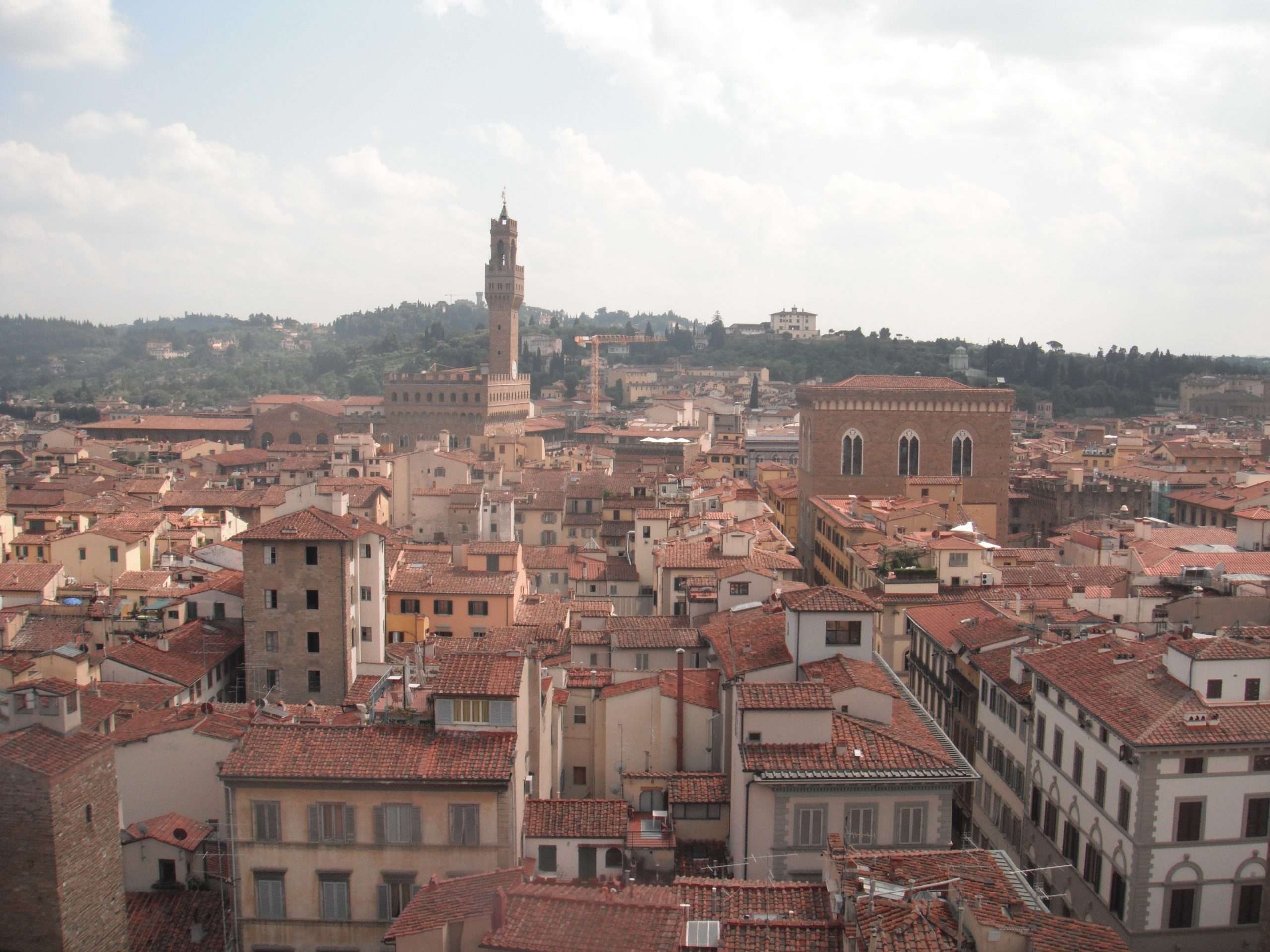
Renaissance Florence is famous for its art and architecture, but medieval Florence was an economic, political, and social marvel in its own right, providing roots for the Renaissance and modern times. Between 1100 and 1300, Florence transformed from a quiet, sparsely populated territory into an economic powerhouse of 100,000 inhabitants. Merchants and a business-led government formed the basis of this environment. Some merchants became wealthy through long-distance trade in grain, wool, and bulk commodities, while participating in governmental leadership. Others conducted regional and local business in a variety of goods and foodstuffs. Still others scraped by, working in the shadows of established businesses.
Early Florence and its leading guilds
From the early 1100s and into the 1200s, many wealthy families moved from their countryside estates to the city, while continuing to own outlying properties, which produced agricultural and market revenue. Some originally had strong connections to the emperor and his officials, and others supported the pope and were associated with the bishop of Florence, who also held vast estates in the countryside. While building fortified palaces with towers in the city, a number of families started to engage in civic governance, operating virtually independently of the emperor, and they began commercial and financial operations, forming trade associations known as guilds.
The wealthiest guilds included the international cloth dealers (Calimala), finance and currency exchange (Cambio), medicine and spice dealers (Medici e Speziali), judges and notaries (Giudici e Notai), silk dealers (Seta), and woollen cloth manufacturers (Lana). These guilds attracted ambitious non-aristocratic merchants and those with elite or even noble roots who turned to commerce and finance. The power of these guilds was perhaps only matched by the wealth of the longstanding landed nobility who lived in the city but continued to focus on outlying manorial enterprise. Over time, the commercial sector outperformed the landed nobility and gained political control, creating deep friction between the two groups.
Thirteenth-century expansion
During the thirteenth century, Florence transformed dramatically. Roads were paved from 1237; three new bridges were built over the river Arno to supplement the Ponte Vecchio; and new markets flourished across the city. From 1250 onward, a popular government replaced the older aristocratic leadership and sought to subdue many of the traditional nobility. By the 1260s, Florentine merchants had a significant presence in the south of Italy and Sicily, financing operations of the pope and the new Angevin (French born) king there, which enabled the Florentines to export vast amounts of wheat and grain back to Florence and across the Mediterranean. Some Florentine merchants were so pragmatic that they supported the Ghibelline imperial faction when living in Florence, while financing and benefitting from the Guelf papacy when in the southern peninsula.
Florentines similarly financed wars and operations of the English kings, while exporting large cargoes of wool for cloth manufacturing back in Florence. Florentines financed and traded an abundance of commodities across the known world during this time, and their wealth became reflected in Florentine palaces, fine clothing, loans and investments, and the acquisition of outlying estates, among other assets. By 1282, the leading guilds controlled the government and provided wide representation and self-determination as a virtually sovereign territory. Even Dante was a part of the legislature at this time (1301).
The political success of this regime was continually monitored and challenged by certain noble families, who carried out violent attacks against the commercial leadership and the guild-led government. In 1304, a rebellious noble-led faction burned wealthy guild member homes and businesses, and even their new, grand grain loggia at Orsanmichele, with its invaluable image of the Madonna.
Increased wealth, new structures, and markets
During the thirteenth century, wealth increased. Buildings across Florence were renovated, and new structures were erected to modernize and compete with other Tuscan cities. Additional walls were built to encompass the growing city. The Dominicans and Franciscans, famed for their preaching, built Santa Maria Novella and Santa Croce, which were later decorated with extraordinary works of art. There was new religious energy at a popular level, with confraternities, worship, processions, and images of the Madonna in both ecclesiastical and lay settings.
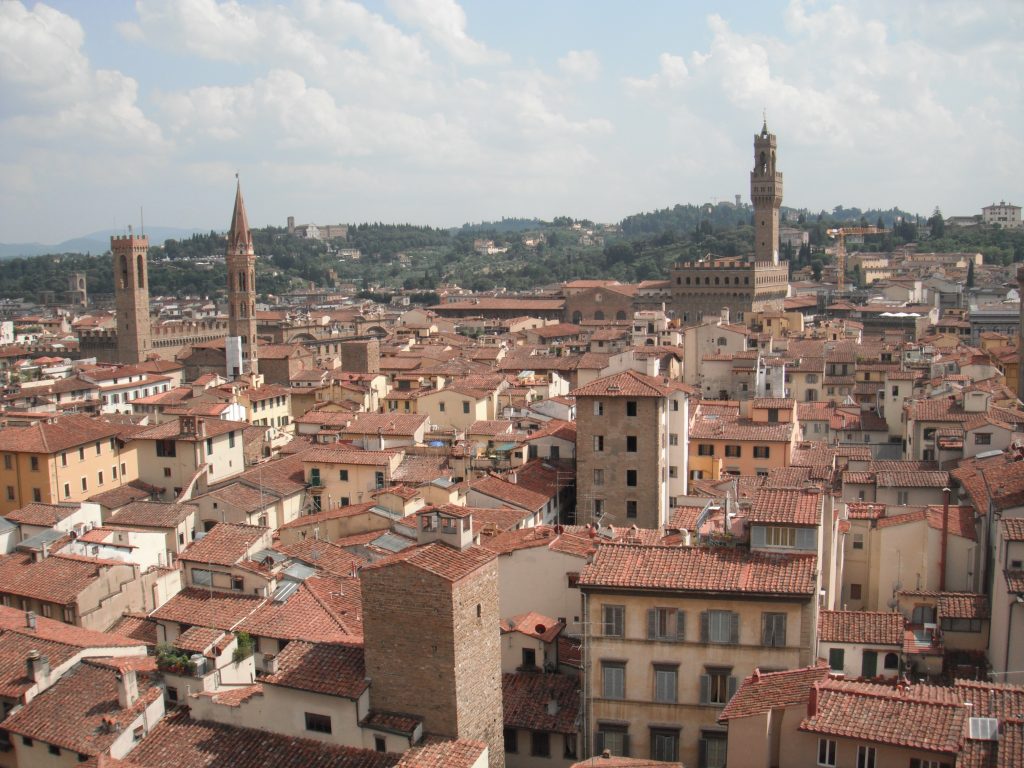
Large markets flourished: the grain market of Orsanmichele, the financial center at the Mercato Nuovo, and the food and provisions market at the Mercato Vecchio (now the Piazza della Repubblica), with many smaller markets, shops, and workshops across the city. In 1296, the old cathedral of Santa Reparata gave way to the start of the majestic cathedral of Santa Maria del Fiore (which was completed over centuries), with its famous bell tower by Giotto. In 1298, the government, which had years earlier suppressed the rebellious Uberti family’s fortress in the southeast section of the city, transformed the family’s properties into the Palazzo and Piazza della Signoria, which still stand today.
Agricultural worker migration to the city
The urban population also expanded. Agricultural workers moved to the city to work in woollen cloth production, construction, and a myriad of other labor-intensive industries. The outlawing in 1289 of the buying and selling of servile workers in the fields further encouraged migration to the city, but the harsh agricultural labor was replaced by equally harsh or worse conditions in urban manufacturing. By 1338, about one-third of the Florentine population worked in woollen cloth production, with the cloth sold locally and exported to other markets. The laborers were poor, called the sottoposti (those placed low), and toiled in grimy work, such as dyeing cloth.
Mid-level trading groups
On the other hand, as the city expanded, middling trade groups, many made up of family businesses, supported daily life in the city and included butchers, vintners, bakers, millers, innkeepers, and the oil and provisions dealers, among many, the latter of which covered a myriad of food products and housewares. The variety of goods handled by these guilds was extraordinary, including cheese, dairy products, meat, fish, lard, wax, soap, candles, nuts, figs, pears, oranges, apples, and ashes, among a vast range of goods. In 1338 alone, the city imported 114,000 livestock for meat and, for July, 400 carts of melons each day. Bulk imports were generally handled by well-financed merchants of senior guilds, but the merchants within the middle tier handled such products, and, protected by their guilds, they generally experienced financial stability if not great wealth.
The poorest merchants
Yet, like the poor wool workers, there were those who lived and worked in the shadows of great commerce. The trecchi, likely without guild membership or protection, scraped by economically through reselling food purchased along roadsides, at various markets, or wherever they could do business. Florentine statutes harshly restricted them from selling items such as mushrooms, chickens, cheese, eggs, and produce purchased along roads outside of the city. The government restricted their operations at the markets and other locations where they were allowed to appear. Meat in particular was highly regulated for health and safety, with butcher-guild and governmental prohibitions against the use of ill animals and the dumping of animal innards on the streets, among other provisions. The butchers and other guilds also did not want competition from wandering hawkers who could undercut their business through quick, low-priced purchases and resales.
The poorest merchants often had no stable place in the commercial world, and likely served equally poor consumers who may also have turned to charity for sustenance. They generally worked outside, without cover, exposed to the wind and rain, heat and cold, with the heat likely affecting meat and other products they sold. Although on the margins of commerce, they were still taxed as a group, and, like others, had to pay taxes to use city gates and taxes on numerous products and services. The chronicler Villani noted that the poorest could not afford a bushel of wheat, the grain of choice at the time. This meant that they were reduced to the least of grains, such as spelt, and likely relied on charitable handouts of bread or coins to buy grain or bread.
Challenges to the wealthiest businesses and staggering events
Over time, however, even large guilds succumbed to their success. In 1293, the Florentine government enacted ordinances that banned certain of the wealthiest merchants and brash nobles, deemed “magnates,” from serving in government or even entering governmental buildings. Still, this action did not generally affect their status in society or reduce them to a lower tier of commerce. Then, during the 1340s, several leading Florentine firms went bankrupt due to defaults on loans made to the English king and other borrowers. This collapse affected grain imports to Florence and broader international trade, and led to severe dearths, almost to the point of famine, for example, in 1347. The situation was exacerbated by the Plague in 1348, during which Florence lost about half of its population. A cycle of renewal commenced thereafter, but population regrowth remained slow, and Florence faced economic challenges for some time. From c. 1350, we move into what is considered the Renaissance.
Conclusion
Medieval Florence provided a vibrant social, economic, and political environment, with stability and abundance for many. The wealthy certainly flourished, but so did many in the middling trades, even if they were more restricted and varied in their fortunes than elite traders. The poor were largely left to their own resources, doing what they could to survive and turning to the government and charities for handouts. Florence devised its own civilization steeped in commerce and republican government. While the Renaissance city provided treasures of art and culture, medieval Florence established a unique and commercial basis for its emergence.
References
Ito, M. D. (2026). The Trecchi: Marginalised Merchants of Medieval Florence. The Medieval History Journal, 09719458261436498. https://doi.org/10.1177/09719458261436498
Ito, M. D. (2023). Orsanmichele: A Medieval Grain Market and Confraternity (Leiden: Brill), https://brill.com/display/title/59743
Featured image credit: Author (copyright Marie D. Ito 2010)