Subscribe For More!

Get the latest creative news from us about politics, business, sport and travel

 
Subscription Form
Edit Template

Paul F. Hoffman

A native of Toronto, Hoffman was a Senior Research Scientist with the Geological Survey of Canada (1969-92), Sturgis Hooper Professor of Geology at Harvard University (1994-2008), and Professor of Geology at The University of Victoria (1992-94) where he has been an Adjunct Professor since 2008. He was an early proponent of Precambrian plate tectonics, based on field research in northern Canada (1961-91), and the leading advocate of Snowball Earth, based on field research in northern Namibia (1993-2023). He is a recipient of career-achievement awards from learned societies on four continents, most recently the 2024 Kyoto Prize for Basic Sciences from the Inamori Foundation of Japan.


[publishpress_authors_box layout="ppma_boxes_1988"]

Authored Articles

  • All Post
  • Culture & Curiosity
  • Discovery & Nature
  • Essay
  • Face of Science
  • Legacy & History
  • Opportunities & Fellowships
  • Quantum Technology
  • Society & Policy
  • Tech & Health
    •   Back
    • Governance
    • Citizenship
    • Policy
    • Family
    • Economics
    • Ethics
    • Education
    • Public Health
    • Politics
    • Psychology
    • Behaviour
    • Communication
    • Market Behaviour
    • Agriculture
    • Climate Change
    • Social Media
    • Ageing
    • Defence
    • Migration
    • Crime
    • Conflict
    • Labour Market
    • Public Administration
    • Geopolitics
    • Security
    • Well-being
    • Gender
    • Urban Planning
    • Finance
    • Digital Inclusion
    • Social Science
    • Organisational Behaviour
    • Open Science
    • Justice
    • Technology Adoption
    • Sociology
    • Philosophy of Science
    • Culture
    • Epidemiology
    •   Back
    • Health Care
    • Mental Health
    • Artificial Intelligence
    • Neuroscience
    • Kidney
    • Autism
    • Genetics
    • Biotechnology
    • Biochemistry
    • Catalysis
    • Waste Management
    • Aviation
    • Analytical Chemistry
    • Construction Engineering
    • Nutrition and Dietetics
    • Medicine
    • Machine Learning
    • Bioinformatics
    • Proteomics
    • Business
    • Water Technology
    • Mathematical Modelling
    • Robotics
    • Digital Health
    • Paediatric Care
    • Nanotechnology
    • Virtual Reality
    • Computer Science
    • Cancer Research
    • Dermatology
    • Cognitive Science
    • Telecommunications
    • Optics
    • Transportation
    • Astrophysics
    • Space Science
    • Computational research
    • Semiconductor
    • Science Communication
    • Operations Research
    • Materials Science
    • Electrochemistry
    • Diseases
    • Molecular Simulation
    • Management
    • Gerontology
    • Horticulture
    • Agronomy
    • Digital Learning
    • Information Technology
    • Music
    •   Back
    • Ecosystems
    • Environment
    • Geology
    • Water
    • Air
    • Astronomy
    • Glacier
    • Palaeontology
    • Sustainability
    • Climate Resilience
    • Biodiversity
    • Origins of Life
    • Ocean Dynamics
    • Renewable Energy
    • Earth Science
    • Evolution
    • Microbiology
    • Remediation
    •   Back
    • Nobel Laureates
    • Environmental Milestones
    • Medicine
    • Surgery
    • Physics
    • Chemistry
    • Literature
    • Peace
    • Economics
    • History
    • Archaeology
    •   Back
    • Movie
    • Series
    • Pop Culture
    • Sports
    • Fitness
    • Art
    •   Back
    • PhD
    • Bachelors
    • Masters
    • PostDoc
    • Fellowship
    • Funding
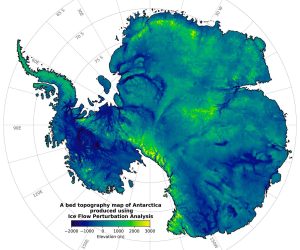
Figure 5. Subglacial topography of the Antarctic continent inferred from Ice Flow Perturbation Analysis (IFPA) of ice sheet surface morphology mapped by orbiting satellites (Ockenden et al. 2026). Bedrock relief of 4−6,000 m (13,000−20,000 ft) is widespread beneath the Antarctic Ice Sheet, including tectonically stable East Antarctica. Preglacial bedrock topography was enhanced by erosion of steep-walled valleys (dark blue) by fast-flowing ice streams, while mountains (yellow) that project upward into colder ice have been little eroded. The bedrock surface would rise hundreds of meters in elevation if the load of the ice sheet was removed by melting. Image courtesy: American Association for the Advancement of Science.

May 11, 2026

The first part of the article is titled “Part I: All Living Things Descended From The Survivors Of Snowball Earth”. This second article in the series is based on a new scientific perspective titled "Ecosystem relocation on Snowball Earth: a polar–alpine ancestry for the extant surface biosphere?", published by geologist...

Subscription Form

© 2025 all rights received by thesciencematters.org