For decades, physicists have pursued one of the most ambitious goals in science: unifying Einstein’s theory of gravity with quantum mechanics. The effort has inspired entire fields of research, from string theory to loop quantum gravity, and has motivated generations of scientists to search for a deeper description of reality.
In the article Why Geometry Should Not Be Quantized: A Causal-Medium Unification of Gravity and Quantum Mechanics in quantum reports journal, researcher Bin Li of Silicon Minds Inc. argues that the long-standing quest for quantum gravity may be built upon an assumption that has never been experimentally confirmed. According to the paper, spacetime geometry may not be a fundamental component of nature. Instead, it could emerge from a deeper causal structure that gives rise to both gravity and quantum behaviour.
If correct, the proposal would not merely offer another route towards quantum gravity. It would fundamentally change the way physicists think about space, time, matter and the foundations of reality itself.
The assumption that few people question
Modern theoretical physics rests on two extraordinarily successful frameworks. General relativity explains gravity, black holes and the large-scale evolution of the Universe. Quantum mechanics governs atoms, particles and the microscopic world.
The difficulty is that the two theories rest on different conceptual foundations. General relativity describes gravity as the curvature of spacetime, while quantum theory treats physical systems as probabilistic wave functions subject to quantisation. Bringing the two frameworks together has proven remarkably difficult.
Most attempts to solve this problem begin with a shared assumption: spacetime itself must be quantised. In other words, the geometry of the Universe is assumed to possess quantum properties in the same way that electromagnetic fields give rise to photons.
This assumption underlies many of the best-known approaches to quantum gravity. However, Li argues that there is no direct experimental evidence that spacetime geometry exhibits quantum behaviour. No graviton has ever been detected, no discrete structure of spacetime has been observed, and no confirmed evidence for spacetime foam has emerged from modern experiments.
Thinking about spacetime differently
A central theme of the study is the distinction between fundamental entities and emergent phenomena.
In many areas of physics, macroscopic properties arise from underlying microscopic processes. Temperature, pressure and fluid flow are familiar examples. These quantities are essential for describing the behaviour of large systems, yet they are not fundamental building blocks of nature. They emerge from the collective interactions of atoms and molecules.
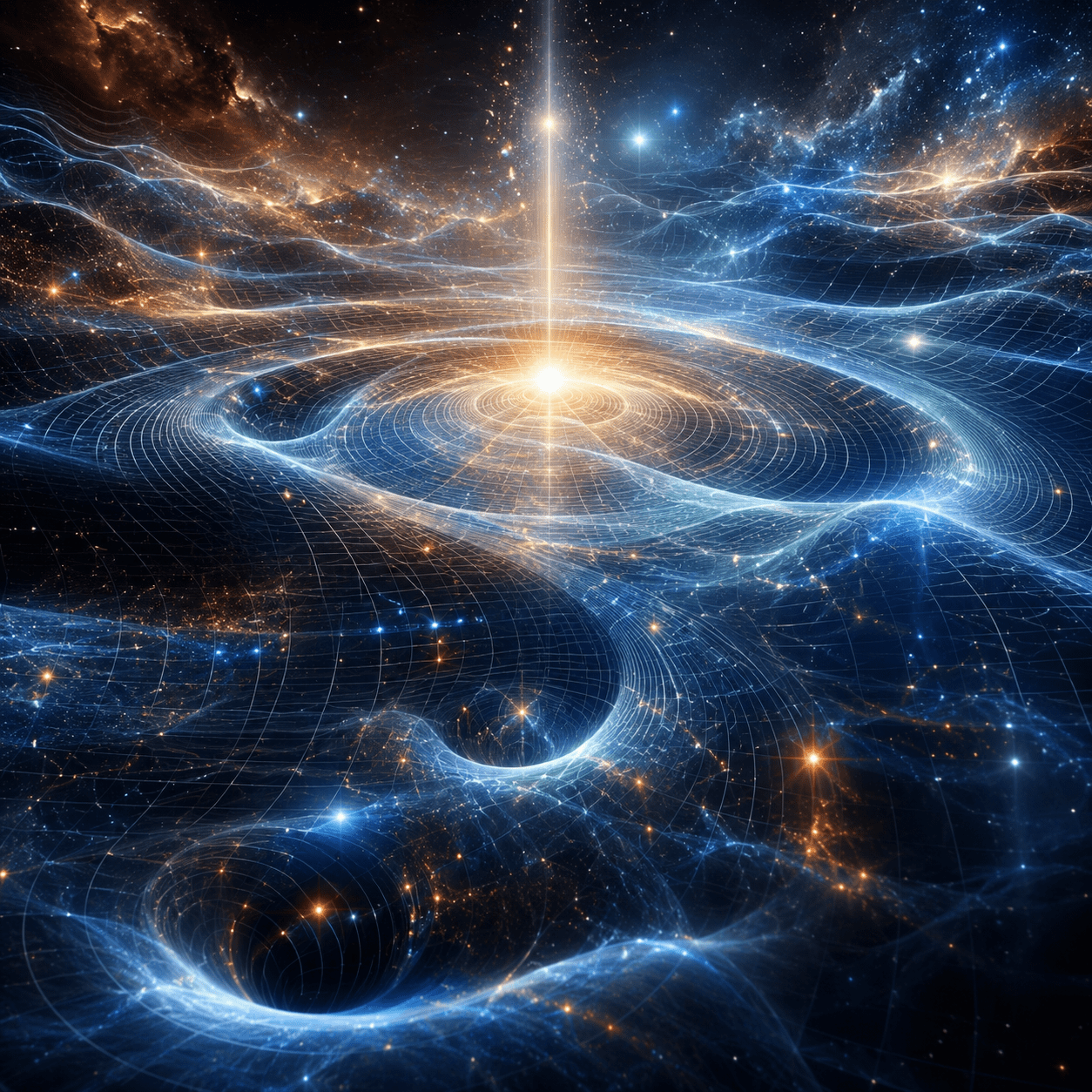
From this perspective, the metric used in general relativity is not a fundamental field that requires quantisation. Instead, it is a large-scale description of deeper physical processes. Curvature becomes analogous to a collective response of an underlying system rather than a primary ingredient of reality.
This viewpoint is not entirely new. Several influential approaches, including emergent gravity, thermodynamic gravity and analogue gravity models, have explored similar ideas. What distinguishes the new proposal is its attempt to derive both gravitational and quantum phenomena from a single causal framework.
Enter the chronon field
At the centre of the theory lies a new concept known as the Chronon Field Theory, or ChFT.
The theory introduces a smooth time-like covector field called the chronon field. Rather than representing particles or a physical substance moving through space, the field serves as an order parameter that describes causal alignment throughout the Universe.
The fundamental idea is that neighbouring causal directions naturally tend to align with one another. This tendency is governed by the author’s Temporal Coherence Principle.
According to the theory, local misalignments carry an energetic cost. As the system evolves, regions of causal structure organise themselves into coherent configurations. It is from this organised state that familiar spacetime geometry emerges. In this framework, spacetime is not a preexisting stage upon which physics unfolds. Instead, spacetime itself is a consequence of deeper coherence dynamics.
A new origin story for gravity
One of the paper’s most significant claims concerns the origin of gravity.
Within Chronon Field Theory, Einstein’s field equations emerge naturally from the large-scale behaviour of the chronon field. Gravity is interpreted as the hydrodynamic response of an underlying causal medium rather than as a fundamental interaction requiring independent quantisation. The theory suggests that distortions in causal alignment generate effective curvature, just as stresses and deformations appear in an elastic material.
Under specific long wavelength conditions, the mathematical structure of the theory reproduces the Einstein-Hilbert action, the foundation of general relativity. Newton’s gravitational constant is interpreted as a parameter related to the stiffness of the causal medium. This interpretation provides a fresh perspective on gravity. Instead of viewing curvature as fundamental, curvature becomes a macroscopic manifestation of deeper organisational processes occurring within the chronon field.
Why does everything share the same speed limit?
Another intriguing aspect of the theory concerns one of the most basic facts of modern physics: the existence of a universal speed limit. Photons, gravitational waves and other effectively massless excitations all appear to respect the same invariant speed. In conventional relativity, this speed is built directly into the geometry of spacetime. Li argues that a deeper explanation may exist.
Within the chronon framework, the universal speed limit arises from the dynamical properties of the causal medium. Small disturbances propagate through the medium at a characteristic speed determined by the underlying coherence equations.
This means that the universal speed associated with relativity is not imposed as a geometric axiom. Instead, it arises as a constitutive property of the medium from which spacetime emerges. The theory therefore attempts to explain not only why a universal speed exists, but also why different physical phenomena appear to share it.
Can quantum mechanics emerge, too?
Perhaps the most ambitious aspect of the proposal is its treatment of quantum mechanics. Rather than introducing quantum behaviour through traditional quantisation procedures, the theory suggests that quantum phenomena emerge from coherent wave dynamics within the chronon field.
Small perturbations propagate as chronon waves possessing a well-defined phase structure. Through a mathematical procedure known as an eikonal expansion, these waves produce equations equivalent to the Hamilton-Jacobi formulation of classical mechanics. Under suitable conditions, the same framework yields a Schrödinger-type equation, one of the cornerstones of quantum theory.
The author argues that quantum behaviour originates from stable topological structures and coherent phase dynamics rather than from fundamental quantum postulates.
The challenge of Lorentz invariance
Any theory proposing an underlying medium immediately encounters a major obstacle. If such a medium exists, why has no preferred reference frame ever been observed?
Historically, attempts to describe space as a physical medium encountered serious difficulties because they predicted measurable effects associated with motion through it. Experiments repeatedly failed to detect such signatures. Li addresses this concern through what the paper calls the Co Moving Concealment Principle.
According to this principle, all observers, measuring devices, clocks and particles emerge from the same underlying chronon medium. Because every physical system is constructed from the same causal structure, no observer can stand outside the medium and measure motion relative to it.
A bold challenge to conventional thinking
Chronon Field Theory remains highly speculative and sits outside the current mainstream of quantum gravity research. Many physicists will likely remain sceptical until the framework generates clearer predictions, develops its treatment of matter and gauge fields, and demonstrates advantages over established approaches.
Nevertheless, the paper raises a provocative question that strikes at the heart of one of physics’ greatest challenges.
What if spacetime is not fundamental? What if gravity and quantum mechanics are not separate theories waiting to be unified, but different manifestations of a deeper causal order?
Whether Chronon Field Theory ultimately succeeds or fails, its significance lies in forcing researchers to reexamine assumptions that have guided quantum gravity research for decades. Scientific progress often begins with questioning ideas that have become so familiar they are rarely scrutinised.
By challenging the necessity of quantising geometry itself, the theory invites physicists to consider a radically different route towards understanding reality. In a field where definitive answers remain elusive, such conceptual challenges continue to play an important role in expanding the boundaries of scientific thought.
Reference
Li, B. (2026). Why geometry should not be quantized: A causal-medium unification of gravity and quantum mechanics. Quantum Reports, 8(1), Article 2. https://doi.org/10.3390/quantum8010002