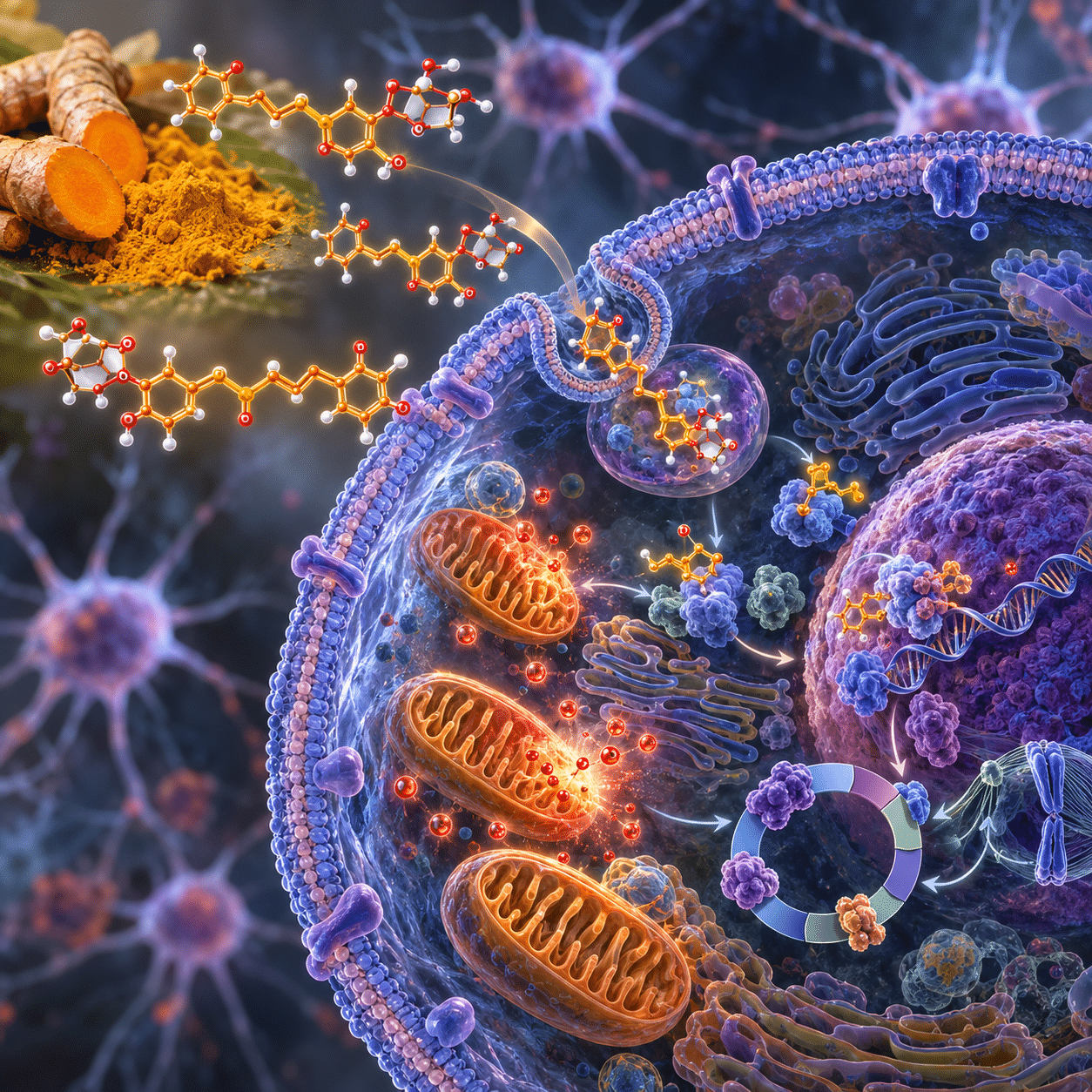
The golden yellow compound curcumin, best known as a major bioactive component of turmeric, has attracted sustained scientific interest because of its antioxidant, anti-inflammatory and anticancer properties. Yet curcumin also presents a familiar challenge in drug research. Its poor water solubility limited cellular uptake, and low bioavailability can restrict its usefulness as a therapeutic molecule.
A research team led by Lakshmi Sowmya Emani has now investigated whether a small chemical redesign could alter this behavior. Published in the Journal of Alzheimer’s Disease Reports, the study, titled “Studies on the effect of curcumin and its glucoside derivatives on IMR 32 neuroblastoma cell lines”, examined native curcumin alongside newly prepared curcumin monoglucoside and curcumin diglucoside in cultured IMR 32 cells.
The research team included scientists from KLEF Deemed to be University, Vijayawada, the ICMR National Institute of Nutrition, Hyderabad, and the CSIR Central Food Technological Research Institute, Mysore.
Why curcumin needs a molecular rethink
Curcumin has been investigated across a wide range of biomedical applications, including cancer biology and neurodegenerative disease research. However, its physicochemical characteristics can make translation from laboratory observations to therapeutic applications difficult. The researchers note that curcumin has low water solubility, limited blood brain barrier permeability, poor cellular uptake and restricted overall bioavailability.
One approach is to modify the chemical structure of curcumin. In this study, the researchers used glycosylation, a process in which glucose units are attached to the molecule. The intention was to improve water solubility, chemical stability and cellular uptake, while potentially changing how the compound is processed within cells.
The researchers produced two derivatives, curcumin monoglucoside and curcumin diglucoside. In chemical terms, the compounds contain one or two glucose groups attached to the curcumin structure. This creates a useful experimental comparison between the original molecule and its modified forms.
Inside the neuroblastoma cell model
The researchers used the human IMR 32 neuroblastoma cell line as an in vitro experimental model. The study was designed to examine how curcumin and its derivatives affect several aspects of cellular behaviour, rather than relying on a single measure of toxicity.
The team assessed cytotoxicity using MTT and Trypan blue assays, investigated cell cycle distribution through flow cytometry, examined apoptosis and necrosis using Annexin V and propidium iodide staining, and studied cellular and nuclear morphology through microscopy. The researchers also measured reactive oxygen species, antioxidant activity and 8 hydroxy guanosine, a marker associated with oxidative DNA damage.
A glucose tag changes cellular uptake
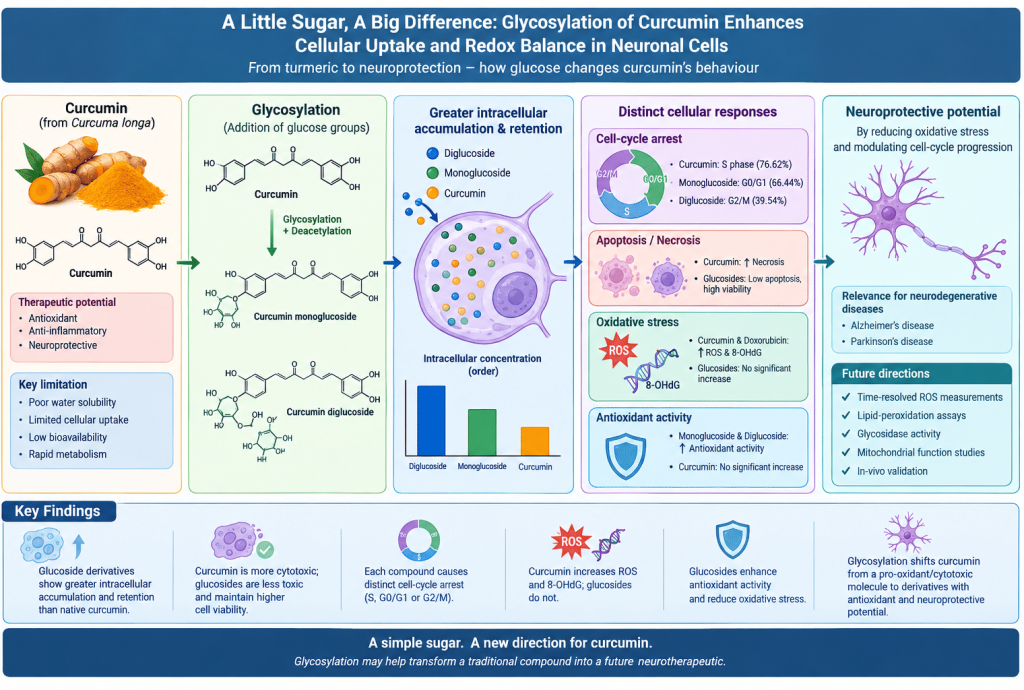
One of the clearest findings concerned intracellular accumulation. After exposure to the compounds, the researchers found that curcumin diglucoside accumulated inside IMR 32 cells to a greater extent than curcumin monoglucoside, while native curcumin showed the lowest intracellular levels.
At approximately two hours, intracellular curcumin reached a reported peak of about 60 ng/mg, compared with about 130 ng/mg for the monoglucoside and about 210 ng/mg for the diglucoside. The concentration subsequently declined over the 24-hour observation period.
Different compounds, different cellular checkpoints
The researchers next examined the cell cycle, the sequence of stages through which cells progress as they grow and divide. The results showed distinct patterns for the three curcumin-based compounds.
Untreated IMR 32 cells showed 39.68 percent of cells in G0/G1, 48.15 percent in S phase and 12.17 percent in G2/M. Curcumin treatment increased the S phase population to 76.62 percent. Curcumin monoglucoside increased the G0/G1 population to 66.44 percent, while curcumin diglucoside produced a G2/M population of 39.54 percent.
In biological terms, these observations suggest that the compounds interfere with cell cycle progression at different checkpoints. Curcumin was associated predominantly with S phase accumulation, while the two glycosylated derivatives produced different patterns of cell cycle arrest. Such differences can provide clues about how chemical structure influences intracellular targets and signalling pathways. The study also included doxorubicin as a positive control. In the reported experiment, doxorubicin produced strong S phase accumulation, with 69.08 percent of cells in that phase.
Cell death is not one single process
Another important part of the study was the analysis of apoptosis and necrosis. Apoptosis is a regulated form of cell death, whereas necrosis is associated with loss of membrane integrity and cellular damage.
Untreated cells were predominantly viable. Doxorubicin produced a marked apoptotic response, with the live cell population falling to about 69 percent. Curcumin produced a different pattern, with increased necrosis and comparatively little apoptosis at the tested concentration. The monoglucoside and diglucoside maintained high proportions of viable cells and showed relatively low apoptotic activity under the experimental conditions.
These findings reinforce a central theme of the study: changing the molecular structure of curcumin changes the biological response. The researchers did not simply observe a stronger or weaker version of the same effect. The compounds produced different patterns of cell cycle behaviour, cell death and oxidative responses.
The oxidative stress connection
Reactive oxygen species, commonly abbreviated as ROS, are chemically reactive molecules that participate in normal cellular processes but can contribute to oxidative damage when present at excessive levels. The researchers found that curcumin and doxorubicin increased ROS in the IMR 32 model, whereas the glucoside derivatives did not produce the same significant increase.
The antioxidant measurements showed a contrasting pattern. Curcumin monoglucoside and diglucoside increased antioxidant activity, while curcumin and doxorubicin did not show the same change. Measurements of 8 hydroxy guanosine also indicated increased levels following curcumin and doxorubicin treatment, whereas the glucoside derivatives did not show the same increase.
Taken together, these observations led the researchers to characterise native curcumin as more pro oxidant and cytotoxic under the tested conditions, while describing the glucosylated derivatives as more antioxidant and cytostatic. Cytostatic refers to an ability to restrain cell growth or proliferation rather than directly causing extensive cell death.
A laboratory finding, not yet a treatment
The results are scientifically interesting, but they need to be placed in context. This was an in vitro study using IMR 32 neuroblastoma cells. The findings therefore cannot be interpreted as evidence that turmeric, dietary curcumin or curcumin supplements can prevent or treat neuroblastoma.
Similarly, the study does not establish a treatment for Alzheimer’s disease or Parkinson’s disease. Although the introduction discusses neurodegenerative diseases and the potential neuroprotective properties of curcumin, the experiments reported in this paper were conducted in a neuroblastoma cell model.
The value of the research lies in understanding how molecular structure can influence cellular behaviour. By comparing native curcumin with mono and diglucoside derivatives, the researchers have shown that adding glucose can substantially alter intracellular accumulation and biological responses.
Reference
Emani, L. S., Mahesha, H., Mullick, S., Kempaiah, B. B., Ajumeera, R., & Koagisharaf, J. R. (2026). Studies on the effect of curcumin and its glucoside derivatives on IMR 32 neuroblastoma cell lines. Journal of Alzheimer’s Disease Reports, 10, 1–15. https://doi.org/10.1177/25424823261461480