
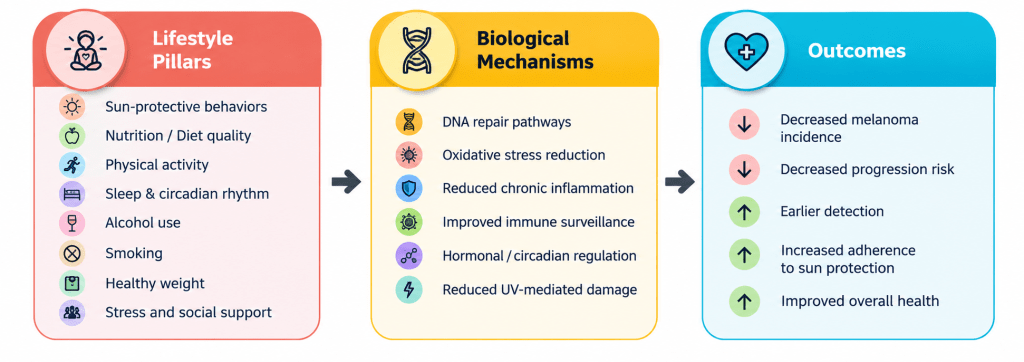
Melanoma is often discussed as a disease of excessive sun exposure, and for good reason. Ultraviolet radiation remains the most important modifiable environmental risk factor. Yet a new review argues that prevention may need a wider lens. The analysis brings together evidence on sun protection, smoking, alcohol, diet, physical activity, obesity, sleep and circadian rhythm, while also examining occupational and socioeconomic influences on melanoma risk.
The review, titled “Lifestyle Medicine Strategies for Reducing Risk of Melanoma: Modifiable Factors and Clinical Implications”, authored by Layla Alaswad, Panagis Galiatsatos and Gautam Srivastava. The paper involved researchers from the University of South Wales, the Johns Hopkins University School of Medicine, and the Johns Hopkins Bloomberg School of Public Health. Published in the American Journal of Lifestyle Medicine in 2026, the review explores how lifestyle medicine could complement dermatological approaches to melanoma prevention.
Why melanoma prevention needs a broader lens
Melanoma develops in melanocytes, the pigment-producing cells responsible for melanin synthesis. Its development reflects a complex interaction between environmental exposure, genetic susceptibility and immune function. Although melanoma represents a minority of skin cancer cases, it accounts for a disproportionate share of skin cancer-related deaths because of its aggressive biological behaviour.
The review notes that melanoma incidence has risen over several decades in a number of high-income countries, particularly regions with predominantly fair-skinned populations and high ambient ultraviolet radiation. While surgery and modern immunotherapy have improved outcomes for advanced disease, these treatments can be costly, resource-intensive, and associated with substantial toxicity. Prevention, therefore, remains an important public health strategy.
UV exposure remains the central target
Among the lifestyle-related factors examined, ultraviolet exposure has the strongest evidence base. UVB radiation can produce direct DNA damage, while UVA contributes to indirect damage through oxidative stress and reactive oxygen species. When DNA damage is not adequately repaired, mutations can accumulate in pathways involved in tumour suppression and cellular regulation. The review specifically discusses mutations affecting genes such as TP53 and CDKN2A as part of the biological pathway linking UV exposure to melanoma development.
The review cites epidemiological evidence suggesting that a substantial proportion of melanoma cases could potentially be prevented through effective reduction of UV exposure. Sun protection, therefore, remains the foundation of melanoma prevention. Broad-spectrum sunscreen with SPF 30 or higher, protective clothing, wide-brimmed hats, UV-blocking sunglasses, shade, and sensible timing of outdoor activities all form part of the prevention strategy.
Sunscreen is important, but behaviour makes the difference
The review highlights evidence from an Australian randomised controlled trial in which regular sunscreen use was associated with a 50 percent reduction in melanoma incidence compared with discretionary use. It also discusses evidence that higher SPF formulations can provide greater protection under intense UV conditions, particularly when sunscreen is applied less thickly than recommended.
However, prevention is not simply a matter of purchasing sunscreen. The review emphasises behavioural science, noting that intention, self-efficacy, perceived personal risk and social norms can influence sun protective behaviour more strongly than knowledge alone. This means that effective counselling may need to focus on how protective habits are built and maintained.
Simple strategies can make sun protection more consistent. Applying sunscreen at a routine time, using protective clothing for prolonged outdoor activity, seeking shade and checking the UV index can turn advice into repeatable behaviour. The review also recommends reducing exposure during periods of high UV intensity and treating indoor tanning as a high-risk behaviour.
Smoking may affect melanoma outcomes
Smoking occupies a more complicated position in the evidence. The review notes that some observational datasets have produced apparently inconsistent findings regarding melanoma incidence. However, the overall evidence discussed by the authors indicates that smoking can adversely affect melanoma biology and clinical outcomes.
Tobacco exposure can impair immune surveillance, increase oxidative DNA damage and influence angiogenic pathways. Among people with melanoma, smoking has been associated with tumour ulceration, higher rates of sentinel lymph node metastasis, poorer responses to immunotherapy and targeted therapy, and increased overall mortality.
The implication for lifestyle medicine is clear, even though smoking should not be described as equivalent to UV exposure in melanoma causation. Tobacco use is a major modifiable health behaviour, and smoking cessation can form part of a broader cancer prevention strategy. The review supports routine screening, brief interventions, and referral to evidence-based cessation support.
Alcohol presents a more modest association
Alcohol consumption is another modifiable factor examined in the review. Meta-analyses discussed by the authors indicate a dose-dependent association between alcohol intake and melanoma risk, although the strength of this association is more modest than that observed for UV exposure.
Several biological mechanisms have been proposed, including acetaldehyde-related DNA damage, oxidative stress, altered photosensitivity, and effects on DNA repair. The review also discusses observational findings involving different alcoholic beverages, but these associations should not be interpreted as proof that a particular drink directly causes melanoma.
Could diet influence melanoma biology?
Diet appears to have a potentially important but less definitive role. The review discusses how nutritional patterns may influence inflammation, oxidative stress and DNA repair, all of which are biologically relevant to cancer development. It pays particular attention to Mediterranean-style and plant-predominant dietary patterns.
Fruits, vegetables, legumes, whole grains, nuts and seeds provide carotenoids, flavonoids, vitamins and polyphenols that may support antioxidant and cellular defence pathways. However, the authors distinguish whole food dietary patterns from isolated antioxidant supplementation. Evidence for supplements has been inconsistent, and some trials have reported harmful outcomes.
This distinction matters because it prevents the discussion from becoming another story about a supposed “superfood” for cancer prevention. The review supports individualised whole food recommendations rather than claims that a specific food or supplement can prevent melanoma.
Exercise is beneficial, but outdoor UV exposure matters
Physical activity presents an interesting contradiction. Exercise itself does not appear to independently increase melanoma risk when sun exposure is taken into account. Instead, outdoor exercise can create additional opportunities for incidental UV exposure, particularly when activities take place around midday or involve prolonged time outdoors.
The review recommends adapting rather than avoiding physical activity. Outdoor exercise can be shifted towards lower UV periods, while sunscreen, UV protective clothing, shade and indoor or sheltered alternatives can reduce unnecessary exposure. Physical activity also contributes to weight management, psychological well-being, metabolic health, and immune function.
Weight and melanoma present a complex relationship
Obesity is another area where the evidence is not straightforward. The review describes obesity as a state associated with chronic low-grade inflammation, altered immune responsiveness, and changes in insulin and IGF-1 signalling, all of which can influence tumor biology.
At the same time, the authors acknowledge the so-called obesity paradox, in which some studies have reported improved immunotherapy responses among people with higher body mass index. The finding remains poorly understood and does not provide a justification for elevated body weight.
In lifestyle medicine, the emphasis is therefore on sustainable health rather than on restrictive dieting. Plant predominant nutrition, enjoyable physical activity, adequate sleep and stress management can contribute to healthier metabolic function and overall cancer prevention without presenting weight loss as a standalone melanoma treatment.
Sun protection is the bedrock of melanoma prevention, but it shouldn’t be the end of the conversation. When we look at the daily behaviours and lifestyle factors that influence overall health, we can empower people to make practical, high-impact choices every day.
—Gautam Srivastava
Sleep and circadian rhythm emerge as a research frontier
Sleep and circadian health may be among the less familiar issues in melanoma prevention. The review discusses evidence linking circadian rhythm disruption, particularly among night shift workers, with increased melanoma risk and potentially more aggressive disease biology.
Possible mechanisms include altered melatonin secretion, impaired DNA repair, dysregulated cell cycle control and increased oxidative stress. However, the authors classify circadian rhythm disruption as an emerging area rather than an established melanoma risk factor, with the same level of evidence as UV exposure. The evidence table specifically identifies circadian rhythm as an emerging area of research.
This distinction is important. Consistent sleep-wake schedules and appropriate light exposure may support overall health, but the evidence does not yet justify presenting sleep optimisation as a proven melanoma prevention intervention. Further research is needed to establish whether targeted circadian interventions can reduce melanoma incidence or improve outcomes.
Reference
Alaswad, L., Galiatsatos, P., & Srivastava, G. (2026). Lifestyle medicine strategies for reducing risk of melanoma: Modifiable factors and clinical implications. American Journal of Lifestyle Medicine. https://doi.org/10.1177/15598276261428425