
These questions sit at the heart of one of particle physics’ longstanding puzzles. The Standard Model successfully describes the electron, muon and tau as charged leptons and connects their masses to the Higgs mechanism through Yukawa couplings. Yet the theory does not explain why their masses have the hierarchy observed in nature.
A new study proposes a possible structural clue. Published in the journal Symmetry, the article “A Structural Origin of the Charged-Lepton Hierarchy” by Bin Li explores whether the striking numerical relationships between the charged-lepton masses could emerge from a deeper mathematical architecture rather than being independent parameters. The research was conducted through the Research Department of Silicon Minds Inc., Clarksville, Maryland, USA. The proposal is highly theoretical and should not be regarded as an established replacement for the Standard Model. Instead, it presents a conditional framework with specific numerical predictions that can, in principle, be challenged by future experimental and theoretical work.
The particle mass puzzle
The three charged leptons are familiar names in particle physics: the electron, the muon and the tau. They have the same fundamental electric charge, but their masses are extraordinarily different.
The electron is the lightest, while the muon is about 207 times heavier. The tau is heavier still, with a mass more than 3,400 times that of the electron. The Standard Model accommodates these differences through Yukawa couplings, but those couplings do not explain why nature selects these particular values.
The new study asks whether the observed charged-lepton mass hierarchy could instead be the visible consequence of a common underlying structure. The paper describes this as a charge-neutral parent carrier-defect architecture, existing conceptually before the usual Higgs and Yukawa description becomes the effective physical read-out.
The strange clue called the Koide relation
One of the reasons the charged-lepton masses have attracted so much attention is a mathematical relationship known as the Koide relation. The relationship is remarkably accurate when applied to the measured charged-lepton masses. Its numerical success has prompted physicists to search for an underlying explanation rather than simply treating it as an intriguing coincidence.
The new paper offers a different interpretation of the relation. It does not regard the familiar Koide geometry as a fundamental physical structure. Instead, it interprets the relation as the observable representation of an equal-sector-power condition within a proposed internal structural space.
In the paper’s terminology, a charged-lepton root vector is decomposed into a democratic component and an orthogonal-branch-splitting component. If these two sectors possess equal primitive power, the Koide relation follows mathematically.
A neutral parent behind different particle behaviours
The proposal becomes more unconventional when it introduces the idea of a neutral parent structure. The framework suggests that charged and neutral particle channels may be different carrier-readable manifestations of a common underlying organisation. The paper uses neutron beta decay as a familiar physical analogy, where a positive proton, a negative electron and a neutral antineutrino appear together in a correlated process. The author stresses that this does not prove the existence of a neutral parent, but uses the pattern as motivation for this structural interpretation.
Within the proposed architecture, the neutral parent resolves into different branches. One is described as a lepton-facing branch, while another forms a positive closure branch. The lepton-facing branch can subsequently support charged and neutral read-outs, corresponding conceptually to charged leptons and neutrino-related structures.
Why the electron is so light
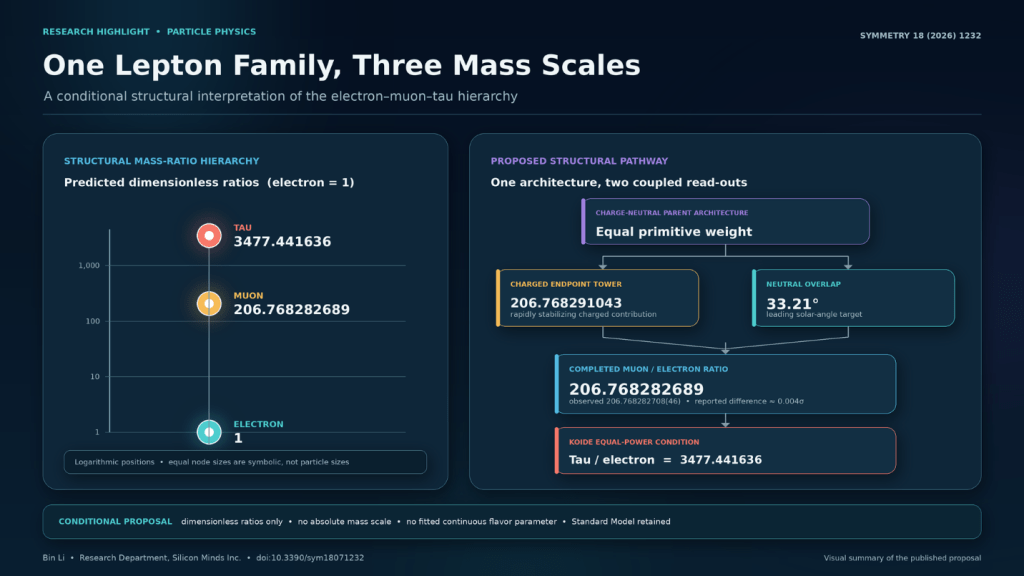
One of the most interesting aspects of the proposal concerns the enormous difference between the electron and muon masses. The paper interprets the electron as a small endpoint leakage from the proposed lepton-facing branch. The first exposed non-protected chamber is associated with a structural count. A projection factor then produces a leading numerical contribution associated with 207. This is important because the observed muon-to-electron mass ratio is approximately 207.
The proposed calculation does not stop at that integer. It introduces higher-order corrections through nested structural refinements. These corrections rapidly become smaller, producing a charged tower with a value of 206.768291043. The paper notes that the deeper charged terms become many orders of magnitude too small to account for the remaining discrepancy.
The missing fraction comes from the neutral sector
According to the paper, the remaining difference cannot naturally be explained by continuing the charged sequence indefinitely. Instead, the framework proposes that the residual belongs to a neutral compensational branch associated with the neutrino sector.
The significance of this result lies in the fact that the solar neutrino mixing angle is not inserted into the calculation as an experimental fitting parameter. According to the paper, it emerges from the proposed neutral overlap counting.
The completed calculation yields a predicted muon-to-electron mass ratio of 206.768282689, which differs from the observed central value by 0.004 standard deviations at the quoted experimental precision. The same construction then yields predicted tau ratios of 3477.441636 for tau-to-electron and 16.8180612 for tau-to-muon. These numbers form the quantitative centre of the paper.
What makes the result interesting is that the muon, tau, and one neutrino-mixing quantity emerge from the same structural assumptions. The framework is conditional, and future measurements and mathematical uniqueness tests can directly challenge it.
—Bin Li
A possible connection to neutrino mixing
The proposed connection between charged-lepton masses and neutrino mixing is particularly noteworthy because these are usually discussed as related but distinct areas of particle physics. The paper argues that the residual left after the charged-endpoint calculation provides a rationale for introducing a neutral compensational component. The resulting overlap gives a solar mixing target of 33.21 degrees.
The paper compares this with current neutrino oscillation analyses. It cites a solar mixing value around 33.68 degrees from NuFIT 6.0, with uncertainties that currently allow the proposed 33.21 degree value. The author is careful to state that the present experimental data do not force the value of exactly 3/10. Instead, the agreement is presented as a potentially testable consequence of the proposed structural framework.
Where the proposal remains incomplete
Despite its numerical results, the study makes no claim to have produced a complete theory of particle physics. The framework does not derive the absolute scale of the charged-lepton masses. It focuses on dimensionless mass ratios. It also does not derive the complete PMNS matrix, which describes neutrino mixing.
In particular, the present work does not derive the atmospheric mixing angle, reactor mixing angle, CP-violating phase, neutrino mass ordering or complete neutrino mass spectrum. These remain outside the scope of the calculation.
The importance of being testable
The author identifies several possible failure conditions. Future measurements could exclude the predicted tau mass ratios. More precise neutrino oscillation measurements could exclude the proposed solar mixing value. A different mathematical counting scheme could also undermine the claim that the numerical factors are uniquely determined by the stated structural assumptions.
The framework would face an even deeper challenge if a microscopic Standard Model matching calculation showed that the proposed mass ratios could not be obtained without effectively reintroducing continuous fitting parameters. The author also acknowledges that the framework must eventually extend coherently to the remaining neutrino observables.
This makes the distinction between an interesting mathematical pattern and a confirmed physical theory particularly important.
Reference
Li, B. (2026). A Structural Origin of the Charged-Lepton Hierarchy. Symmetry, 18, 1232. https://doi.org/10.3390/sym18071232 (Preprints)