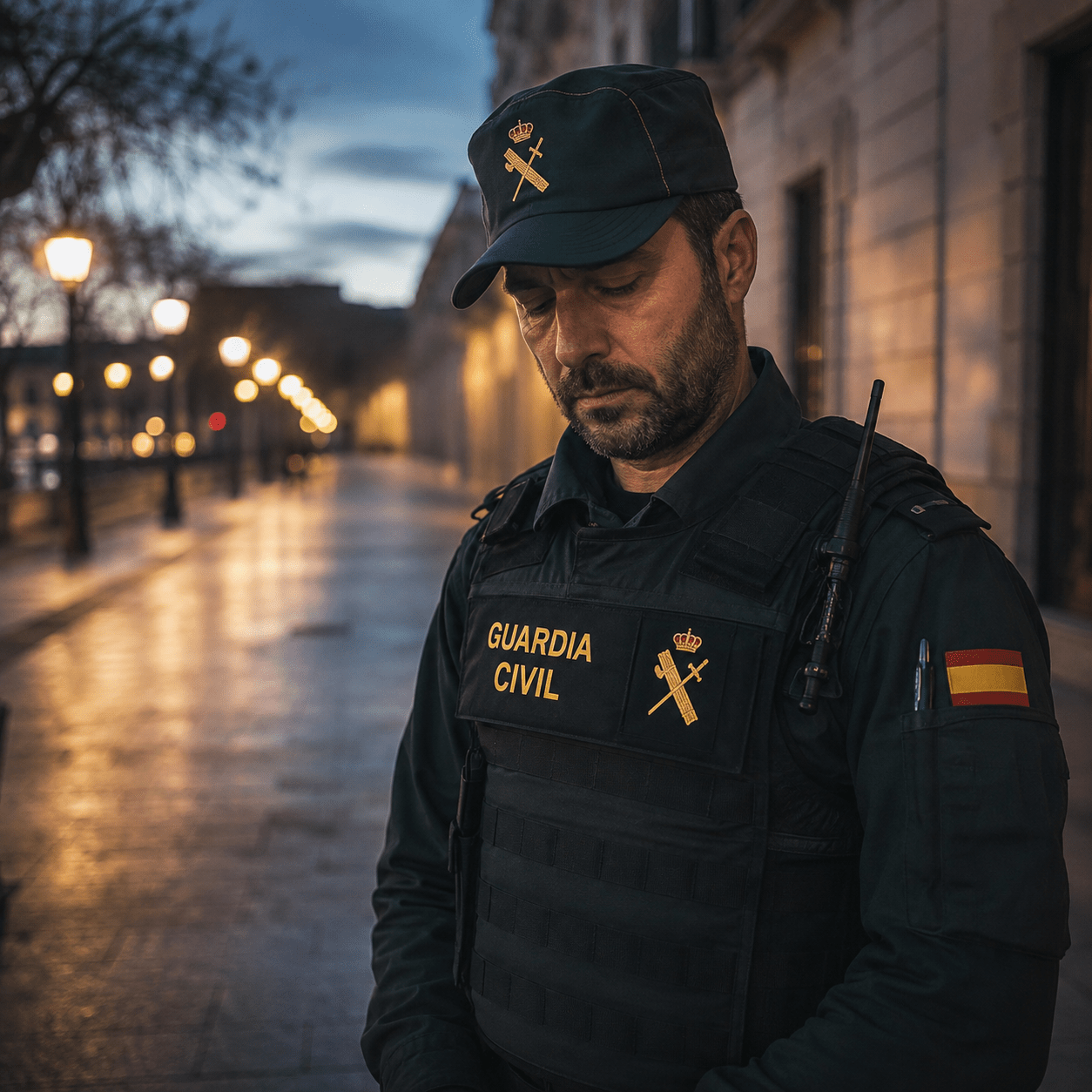
Police officers are expected to remain calm when others panic, make decisions under pressure and step into situations most people would avoid. But what happens when the demands of that role steadily exceed the resources available to cope with them? Our study of Spain’s Civil Guard, published in Police Practice and Research by Taylor & Francis, suggests that the cost can appear as emotional exhaustion, detachment from work, reduced professional confidence, and poorer psychological wellbeing. The findings from research conducted by a team affiliated with the University of Murcia, Universidad Católica de Murcia (UCAM) and Miguel Hernández University matter not only for officers themselves, but also for the communities that depend on their judgement, attention and care.
A demanding job inside a distinctive institution
Spain’s Civil Guard is not an ordinary police organisation. It operates under the authority of both the Ministry of the Interior and the Ministry of Defence, combining police duties with a military structure. Its officers work across rural and suburban security, traffic control, criminal investigation, counterterrorism, maritime and mountain rescue, cybercrime, explosives disposal and environmental protection.
Many of these tasks involve danger, urgency, shift work, night duties, and repeated exposure to conflict or distress. Such pressures are part of the job, but that does not make their psychological consequences inevitable. Research on police work consistently shows that operational pressures and organisational conditions can combine to increase the risk of stress and burnout. The important question is therefore not whether policing is demanding—it clearly is—but whether the organisation provides enough resources to match those demands.
What 604 officers told us
We surveyed 604 active-duty Civil Guard officers in Spain. Their average age was 43, and they had served for an average of 21 years. Participants completed established questionnaires measuring burnout, job satisfaction and psychological wellbeing. The sample was predominantly male, consistent with the male-dominated composition of the force, and most respondents held non-command positions.
Just over 22% met the combined profile used to identify burnout. Thirty-nine per cent reported job dissatisfaction, while 63.4% showed signs of psychological distress. When the three components of burnout were examined separately, around 35% reported high emotional exhaustion, more than half showed high cynicism, and nearly 47% reported low professional efficacy.
These dimensions describe different experiences. Emotional exhaustion is the sense that one’s psychological energy has been depleted. Cynicism is not simply a bad mood; it is a defensive distancing from work, colleagues or the people one serves. Professional efficacy refers to feeling capable and effective in the job. Burnout becomes especially concerning when exhaustion and cynicism are high while professional efficacy is low.
The strongest warning signal was emotional exhaustion
Burnout, job satisfaction and wellbeing were closely connected. Officers reporting greater emotional exhaustion and cynicism also tended to report lower satisfaction and poorer wellbeing. By contrast, stronger professional efficacy was associated with better outcomes. In the final statistical model, age, emotional exhaustion, professional efficacy and job satisfaction together accounted for about 47% of the differences in wellbeing scores.
Emotional exhaustion was the strongest predictor. Job satisfaction added further explanatory value even after accounting for burnout. This matters because satisfaction is sometimes dismissed as a ‘soft’ workplace issue. In reality, it may reflect whether people experience fair conditions, supportive relationships, useful recognition and enough control to do their work well.
The study was cross-sectional, so it cannot prove that exhaustion causes poorer wellbeing or that dissatisfaction causes burnout. The relationships may reinforce one another over time. Even so, their strength makes them difficult to ignore—and gives organisations practical places to begin.
Resilience alone is not the answer
The findings fit the Job Demands–Resources model. This framework proposes that wellbeing depends on the balance between what a job requires and the resources workers can draw upon. In policing, demands may include trauma exposure, workload, unpredictable schedules and emotional control. Resources include supportive leadership, autonomy, adequate staffing, recognition, psychological support and confidence in one’s professional skills.
This distinction prevents a familiar mistake: treating burnout as evidence that an individual officer is not resilient enough. Personal resources such as coping skills, optimism and resilience certainly help. But they cannot permanently compensate for excessive demands, poor work design or an unsupportive culture. Teaching someone to breathe more calmly is useful; expecting breathing exercises to repair a chronically unhealthy system is rather optimistic.
Police wellbeing is not a private matter hidden behind the badge. It is an occupational and organisational issue, and it ultimately affects the quality of public service.
—José Manuel de Haro García
What police organisations can do now
A useful response begins with primary prevention: reducing risks at their source. Organisations can monitor workload and schedules, improve staffing and recovery time, strengthen supervisor support, increase participation in decisions and ensure that psychological services are confidential and genuinely accessible. Regular assessment can identify problematic patterns before they become crises, provided that data are used to improve conditions rather than label individuals.
Secondary prevention can build officers’ personal resources. Evidence-informed programmes may include stress-management skills, peer support, resilience training and mindfulness training. Leaders also need training to recognise warning signs, respond without stigma and create psychologically safer teams. Support after traumatic incidents should be routine, not dependent on an officer reaching breaking point.
Finally, tertiary support is essential for those already experiencing serious difficulties. This includes treatment, recovery plans and a safe, sustainable return to work. Interventions should be evaluated across all three levels. A wellbeing programme is not successful because it exists or looks impressive in a brochure; it is successful if it measurably reduces risk and improves officers’ working lives.
A healthier force serves the public better
Our study has limitations. Participants volunteered through professional associations, which may have introduced self-selection bias. The findings rely on self-reports and capture one moment in time. Longitudinal research is needed to understand how burnout and wellbeing develop, and intervention studies are needed to establish what works in this distinctive setting.
Nevertheless, the results provide a rare view inside a large and socially important police force. They suggest that protecting officers’ wellbeing should be treated as part of operational effectiveness, not as an optional benefit. Civil Guard officers protect the lives, rights and safety of others under exceptional conditions. A healthy organisation should make sure that the people behind the uniform are protected too.
Reference
García-Guirao, N. M., García-Izquierdo, M., Giner-Alegría, C. A., & de Haro García, J. M. (2026). Relationship between burnout, job satisfaction and psychological wellbeing in Spanish Civil Guard. Police Practice and Research, 27(1), 1–17. https://doi.org/10.1080/15614263.2025.2521503