

A scientific collaboration between Brazilian and Portuguese researchers investigated an increasingly relevant question in the context of health and physical exercise: can practicing kickboxing be associated with a better quality of life?
The study, conducted by researchers from the Federal University of Mato Grosso (UFMT), State University of Mato Grosso (UNEMAT), University of Porto, Mato Grosso State Department of Health (SES-MT), and University of São Paulo (USP), compared the quality of life of kickboxing practitioners with that of sedentary individuals. Among the practitioners, different characteristics were considered, including competitive athletes, recreational practitioners, black belts, and colored-belt practitioners.
The research involved Jonatas Deivyson Reis da Silva Duarte, Johan Robalino, Victor Hugo V. Carrijo, Camilla Andreato, Ruberlei Godinho de Oliveira, Carlos Alexandre Fett, and Emerson Franchini, and was published in 2026 in the international journal Frontiers in Psychology.
What is quality of life?
Quality of life is a broad and complex concept that encompasses different aspects of a person’s life. After World War II, the term was initially associated mainly with economic conditions, purchasing power, and opportunities for leisure. Over the decades, however, this understanding expanded to encompass physical and mental health, social relationships, and the environments in which people live.
Early studies on quality of life focused primarily on people with conditions that could significantly affect their health and well-being, such as cancer, Parkinson’s disease, osteoporosis, and sarcopenia, as well as older adults. As research progressed, however, it became clear that quality of life should not be assessed only in people with diseases, but also in healthy individuals and across different life contexts.
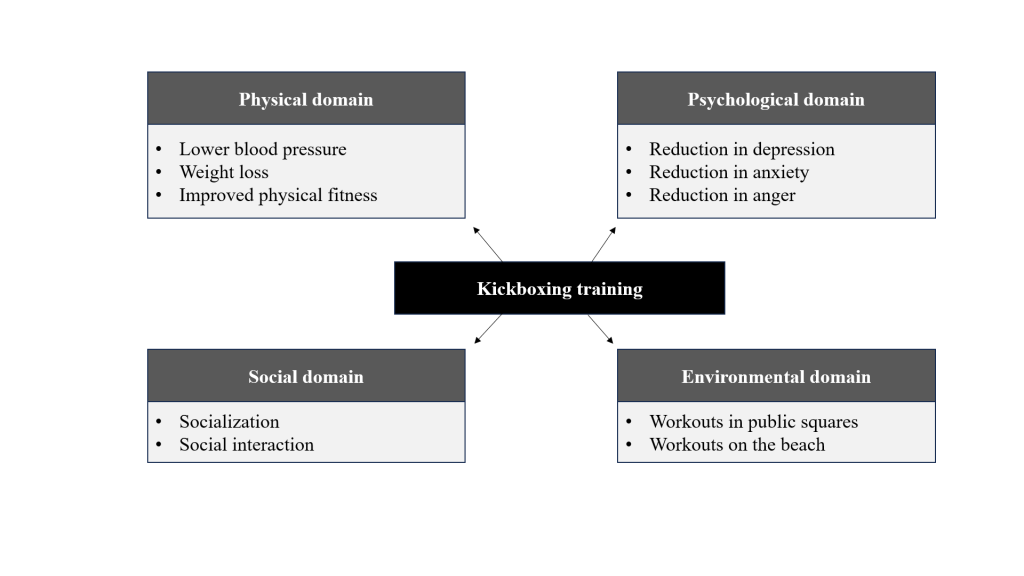
In the 1990s, the World Health Organization (WHO) developed the World Health Organization Quality of Life (WHOQOL) project, which contributed to a broader and multidimensional assessment of this important health indicator. The instrument considers different aspects of life, organized into four main domains:
- Physical domain: includes aspects such as pain, energy, sleep, mobility, ability to perform daily activities, and the need for medications or medical treatment.
- Psychological domain: relates to aspects such as positive and negative feelings, self-esteem, concentration, memory, and self-perception.
- Social domain: considers personal relationships, social support, and intimate relationships.
- Environmental domain: includes factors such as safety, housing conditions, access to health services, transportation, financial resources, opportunities for leisure, and characteristics of the environment in which a person lives.
Thus, quality of life does not simply mean being free from disease. Rather, it represents a broader perception of how individuals evaluate their own lives, considering different dimensions that may contribute to their health and well-being.
Why is quality of life important?
Quality of life is a goal pursued by people from different countries, cultures, and social backgrounds. For this reason, it is frequently addressed in discussions about public health. Rather than acting only when diseases are already established, investing in disease prevention and health promotion can help reduce health risks and improve people’s living conditions. Improving quality of life, therefore, means not only increasing life expectancy but also promoting better health, autonomy, well-being, and life experiences throughout the lifespan.
This goal involves the work of different health professionals, including physicians, nurses, nutritionists, psychologists, physiotherapists, and physical education professionals. Each professional contributes according to their area of expertise. While physicians, nurses, and physiotherapists play fundamental roles in the treatment and management of various health conditions, nutritionists and physical education professionals also play important roles in disease prevention and in promoting healthier lifestyles.
In this context, a healthy diet, regular physical exercise, sports such as kick boxing, adequate sleep, mental health, social relationships, and access to appropriate living and leisure conditions are among the factors that can contribute to a better quality of life. Therefore, talking about quality of life also means talking about prevention, health, and the promotion of habits that allow people not only to live longer, but to live better.
What is kickboxing?
Kickboxing is a combat sport that emerged between the late 1960s and early 1970s from the combination of different fighting techniques. Depending on the rules adopted, the sport allows punches, kicks, and, in some cases, knees. Like other combat sports, kickboxing can be practiced for various reasons, including competition, self-defense, physical fitness, health, and leisure. Therefore, its practitioners are not necessarily athletes: many people practice the sport simply as a different, dynamic way to exercise.
Training sessions generally take place in gyms and may involve equipment such as mats, punching bags, focus mitts, kick pads, and medicine balls. In addition to developing specific fighting skills, training sessions may include exercises targeting strength, endurance, speed, coordination, and physical conditioning. Another interesting aspect is that many activities are performed in pairs, such as exercises with focus mitts and kick pads. This characteristic promotes interaction among practitioners and makes training an experience that goes beyond individual exercise.
Kickboxing is an interesting option for people seeking a better quality of life.
—Jonatas Deivyson Reis da Silva Duarte
What is the relationship between kickboxing and quality of life?
Several studies have already reported benefits associated with kickboxing practice, including possible improvements in cognition, mood, lipid profile, and bone mineral density, as well as reductions in blood pressure and body fat percentage. These findings suggest that kickboxing may be an interesting alternative for health promotion. But do these benefits also translate into better quality of life?
This was precisely the question that Da Silva Duarte and colleagues sought to investigate. The researchers compared the quality of life of different groups of kickboxing practitioners (competitive athletes, recreational practitioners, black belts, and colored belts) with that of sedentary individuals.
Until then, evidence regarding this relationship was still quite limited. One study investigated kickboxing practitioners with multiple sclerosis but found no significant association between kickboxing and quality of life. Another study compared kickboxing practitioners and yoga practitioners and found better quality-of-life indicators among kickboxing practitioners.
Da Silva Duarte and colleagues assessed quality of life using the WHOQOL-BREF questionnaire, which was made available to participants through Google Forms links shared on the social media profiles of kickboxing practitioners and sedentary individuals. The researchers also assessed physical activity using the International Physical Activity Questionnaire. Among the 153 kickboxing practitioners, 87% were classified as having a high level of physical activity, while 13% had a moderate level. In contrast, 86.5% of sedentary participants were classified as having low physical activity.
The results showed that all subgroups of kickboxing practitioners (black belts, colored belts, recreational practitioners, and competitive athletes) reported higher quality-of-life scores than sedentary individuals. Among practitioners, black belts had higher scores in the psychological domain than colored belts. In addition, competitive athletes had higher scores in the physical and psychological domains compared with recreational practitioners.
Conclusions
The study suggests that kickboxing practice is associated with a better perceived quality of life than a sedentary lifestyle. Recreational practitioners, competitive athletes, black belts and coloured belt practitioners all reported higher quality of life, while black belts showed better psychological scores than coloured belts. Competitive athletes also reported higher physical and psychological scores than recreational practitioners. These findings highlight the potential of kickboxing as a form of physical activity that may support physical health, psychological wellbeing and an active lifestyle.
However, the observational nature of the study means that the findings demonstrate associations rather than cause and effect. Further longitudinal and experimental research is needed to determine whether regular kickboxing directly improves quality of life and to understand the mechanisms behind these relationships. Nevertheless, the study provides encouraging evidence that kickboxing may be a valuable approach to promoting health, wellbeing and quality of life.
Reference
Da Silva Duarte, J. D. R., Robalino, J., Franchini, E., Carrijo, V. H. V., Andreato, C. C., de Oliveira, R. G., & Fett, C. A. (2026). Quality of life and physical activity levels in kickboxing practitioners: a comparative study. Frontiers in Psychology, 17, 1-10. https://doi.org/10.3389/fpsyg.2026.1810181