This article is developed based on Judith Butler’s theory of gender performativity, which explains how repeated visual and textual practices construct gendered meanings. In this study, Butler’s framework is used to analyze how Instagram representations of Indonesian athletes reproduce masculine and feminine stereotypes through framing, activity context, and caption narratives.
Social media has transformed modern sport into a visual spectacle. Athletes are no longer represented only through television broadcasts or newspaper headlines. Today, Instagram plays a central role in shaping how audiences understand sporting success, athletic identity, and national pride. Yet a new academic study suggests that even official sports organisations may still be reinforcing long-standing gender stereotypes through the images and narratives they publish online.
A recent study led by Rama Kertamukti of Sunan Kalijaga State Islamic University in Yogyakarta, Indonesia, has found significant gender disparities in how male and female athletes are represented on the official Instagram accounts of Indonesia’s largest sports federations. Published in the Howard Journal of Communications, the research article titled Gender Discrimination in the Visual Representation of Athletes on the Official Instagram Accounts of Sports Federations in Indonesia analysed more than 1,000 Instagram visuals posted across a full competition season.
The findings reveal that male athletes were overwhelmingly portrayed through competition, action, strength, and achievement. Female athletes, by contrast, were more likely to appear in formal poses, emotional contexts, and close-up visual framing that emphasised personality or appearance over athletic performance.
The study raises important questions about gender representation in sports media and digital communication, and about the role of social media platforms in shaping public perceptions of female athletes.
The patterns inside sports Instagram accounts
The researchers examined 1,025 visuals drawn from 624 Instagram posts published between June 2024 and June 2025. The study focused on the official accounts of three major Indonesian sports federations: PSSI for football, PBVSI for volleyball, and PBSI for badminton.
Table 1. Visual Distribution of Athletes Based on Federation and Gender
|
Federation |
Male Visuals |
Female Visuals |
Total Visuals |
% Male |
Percentage of Females |
|
PSSI |
265 |
25 |
290 |
91.4% |
8.6% |
|
PBVSI |
208 |
115 |
323 |
64.4% |
35.6 |
|
PBSI |
249 |
163 |
412 |
60.4% |
39.6% |
|
Total |
722 |
303 |
1,025 |
70.4% |
29.6 |
χ² (df = 2, N = 1,025) = 301.72, p < .001.
Using quantitative content analysis, the researchers coded each image according to athlete gender, visual framing style, activity context, and caption tone. The analysis was grounded in Judith Butler’s theory of gender performativity, which argues that gender is not simply an inherent identity but something repeatedly constructed and reinforced through social practices, symbols, language, and representation.
The data showed that 70.4 percent of all visuals featured male athletes, while only 29.6 percent featured female athletes. Football demonstrated the strongest imbalance. On the official PSSI Instagram account, 91.4 percent of visuals featured male athletes, compared with just 8.6 percent for women.
Researchers concluded that this imbalance was not merely coincidental or reflective of participation rates. Instead, the findings suggest that official sports media channels actively contribute to constructing gendered narratives around sport and athletic legitimacy.
Why visual framing matters
One of the study’s most revealing findings involved visual framing techniques. Male athletes were most commonly depicted in mid- and wide-shot photography. These framing styles typically capture movement, competition, and physical performance. Images often depicted athletes during matches, training sessions, or moments of victory.
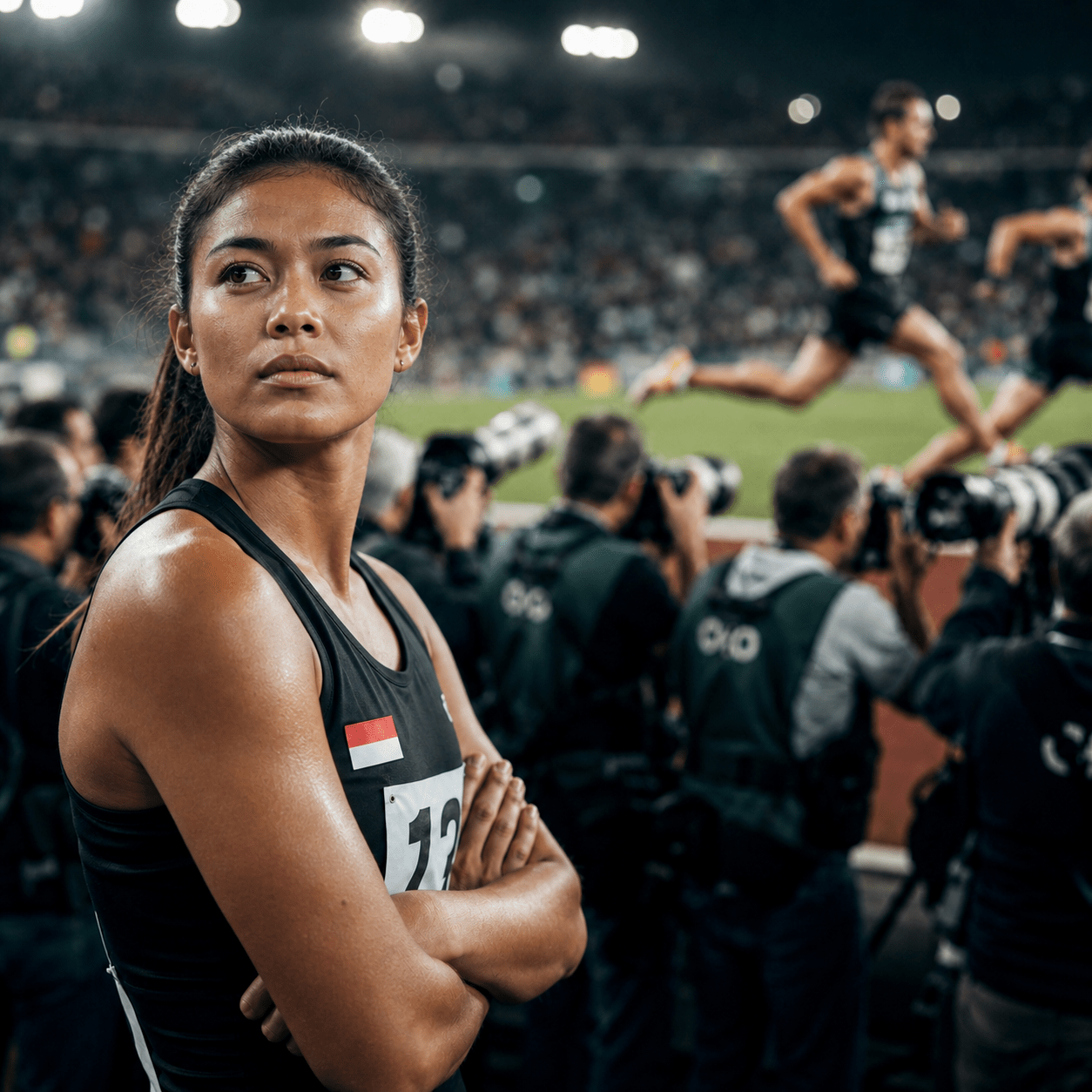
Female athletes, however, were predominantly shown through close-up imagery. According to the study, 57.4 percent of visuals featuring women used close-up framing, compared with only 14.5 percent for men.
In media studies and sports communication research, framing is not considered a neutral artistic choice. Framing determines what viewers focus on and which social meanings attach to athletes. Wide shots highlighting physical action tend to reinforce narratives of competitiveness and strength. Close-up shots, meanwhile, often direct attention toward emotion, attractiveness, or personal identity.
The researchers argue that these patterns subtly reproduce traditional gender norms. Male athletes become symbols of performance and public achievement, while female athletes are framed as emotional or aesthetic subjects.
This distinction matters because visual representation directly influences public recognition, sponsorship opportunities, audience engagement, and perceptions of sporting authority. Female athletes who receive less action-based representation may struggle to achieve the same level of legitimacy as male competitors.
Competition for men, personality for women
The study also analysed the contexts in which athletes appeared. Images were categorised into competitive action, training, and formal poses.
Male athletes were primarily represented through competitive activity. Nearly 64 percent of visuals featuring men showed athletes engaged in competitive action, while 26 percent depicted training. Only a small proportion showed formal or posed imagery.
Female athletes experienced the opposite pattern. Almost half of all visuals featuring women consisted of formal poses rather than sporting action. Women were significantly less likely to appear during moments of competition or physical exertion.
The accompanying captions revealed a similar trend. Posts featuring male athletes overwhelmingly used achievement-oriented language focused on performance, victory, resilience, and competition. Female athletes were far more likely to be associated with personal narratives, emotional themes, or interpersonal warmth.
This narrative imbalance reflects a wider issue identified across global sports media. Researchers in communication studies have long argued that female athletes are frequently represented through narratives that prioritise personality, beauty, or emotional accessibility rather than athletic excellence.
In practical terms, such representation may influence how audiences evaluate sporting competence. When women are repeatedly framed outside competitive contexts, viewers may unconsciously associate elite athleticism with masculinity.
Football, volleyball, and badminton tell different stories
Although the overall findings revealed gender bias across all three federations, the severity of the bias differed by sport.
Football displayed the strongest masculine bias. According to the study, male football athletes dominated nearly every representational category, including visual distribution, framing style, activity context, and caption tone. Women associated with football were significantly more likely to appear in close-ups and formal imagery than in active sporting contexts.
Volleyball showed a more moderate imbalance. Male athletes still received greater visibility, but female athletes appeared more frequently than in football-related content. The study found an increasing use of achievement-oriented narratives for women in volleyball, suggesting a partial shift towards more balanced representation.
Badminton emerged as the most balanced sport among the three federations analysed. Researchers noted that the distribution of male and female visuals was comparatively equitable, while competitive imagery and achievement-based captions were more evenly shared between genders.
The authors suggest that cultural context plays a major role in these differences. Football in Indonesia has historically been associated with masculinity and nationalism, whereas badminton has long celebrated successful male and female athletes alike on the international stage.
This distinction demonstrates that representation is shaped not only by institutional choices but also by broader sporting traditions and cultural expectations.
Social media is not as neutral as it appears
One of the most important contributions of the research lies in its challenge to the assumption that social media platforms are inherently democratic or inclusive. Instagram is often seen as a space where athletes can connect directly with audiences without the limitations of traditional journalism. However, the study argues that official social media accounts can still reproduce institutional biases through visual and textual repetition.
The researchers describe Instagram as a “performative arena” where gender identities are repeatedly constructed through images, captions, and storytelling conventions.
This process may appear subtle, but repeated exposure shapes collective perceptions about who deserves visibility, admiration, and authority in sport. Over time, audiences may internalise the idea that male athletes embody competitiveness and achievement, while female athletes represent emotion, beauty, or personal identity.
Such representation carries consequences beyond online engagement metrics. Media visibility affects sponsorship opportunities, commercial investment, athlete branding, and participation rates among younger generations. Research in sports sociology has repeatedly shown that unequal representation can discourage girls and women from pursuing professional sport by limiting visible role models.
The findings are also particularly relevant as global sporting organisations increasingly promote gender equality initiatives. The International Olympic Committee has spent recent years encouraging federations to improve gender equity in both participation and media representation. The Indonesian study suggests that substantial gaps still remain within digital sports communication strategies.
Reference
Kertamukti, R., & Budiasa, M. (2026). Gender discrimination in the visual representation of athletes on the official Instagram accounts of sports federations in Indonesia. Howard Journal of Communications. https://doi.org/10.1080/10646175.2025.2610487
Coauthor

Dr. Meistra Budiasa is a communication scholar and lecturer at Universitas 17 Agustus 1945 Jakarta, affiliated with the undergraduate Communication Science program. His academic interests include cultural studies, media and sports, communication and sports, digitalization, and mediatization. He has contributed to research on sport communication and gender representation, including a co-authored study in Howard Journal of Communications examining gender discrimination in athletes’ visual representation on Indonesian sports federations’ Instagram accounts. He is listed in Indonesia’s SINTA database with ID 116980 and maintains an academic profile associated with Universitas 17 Agustus 1945 Jakarta and verified scholarly work in communication studies research.