
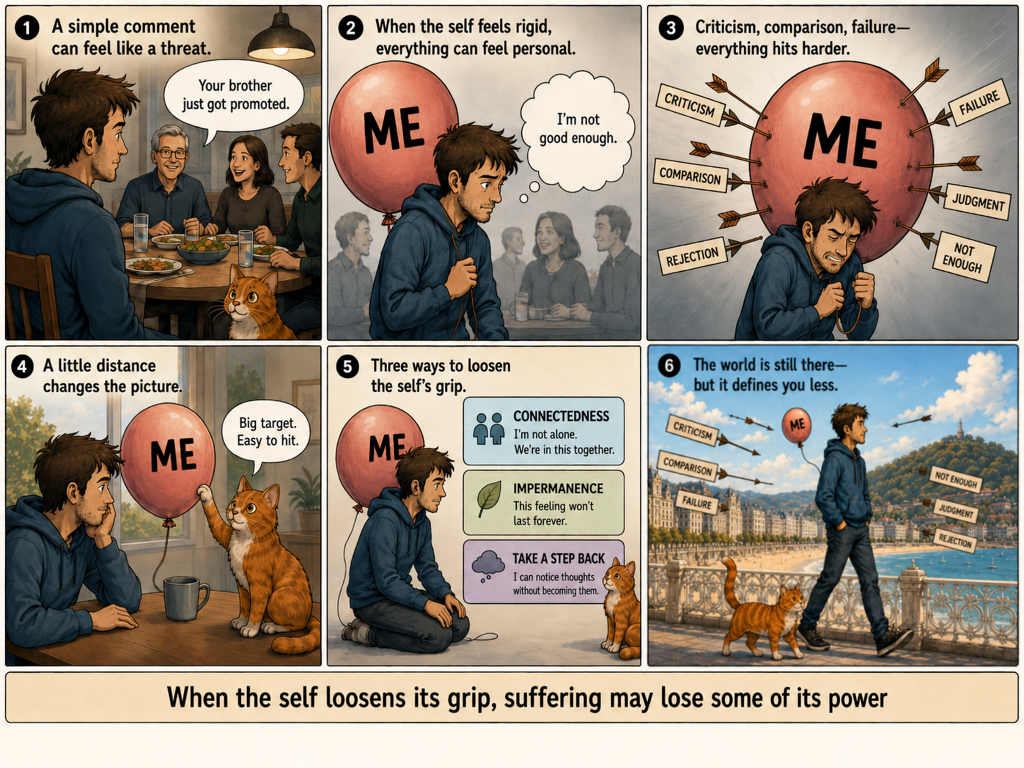
Imagine this: you’re sitting at a family dinner. Someone casually compares you to a more successful sibling. Within seconds, a flood of thoughts arises: “I’m not good enough.” “I’ll never measure up.” The evening continues, but something has shifted. What was just a comment now feels like a threat, not just to your mood, but to who you are.
For many people, this is not a fleeting moment. It is a recurring pattern that gradually shapes how they see themselves and their place in the world. This kind of experience lies at the heart of depression. Beyond sadness or fatigue, many individuals struggle with something deeper: a fragile and painful relationship with the self. Here, the “self” does not refer to a single, fixed entity, but to the many experiences through which we recognize ourselves: our thoughts, emotions, bodily sensations, memories, social roles, and the stories we tell about who we are. This insight led me to a simple but powerful question: What if depression is not only about what we think, but also about how we relate to the experiences that make up our sense of self? Published in Psychology of Consciousness Theory Research and Practice, our recent study explores how selflessness — a more flexible, less rigid way of relating to the self — could help protect against depression by loosening rigid self-beliefs and making every day experiences feel less threatening to who we are.
Rethinking depression: When the self feels under attack
Depression is often described in terms of negative thoughts, but these thoughts do not arise in isolation. They are often rooted in deeper psychological patterns. Many people develop rigid, negative beliefs about themselves, such as “I am a failure” or “Nothing will ever change.” At the same time, they may become highly sensitive to how they are perceived by others, interpreting everyday situations (a comment, a look, a comparison) as personal attacks.
In these moments, life does not simply feel difficult. It feels threatening. The self itself seems at stake. Over time, this creates a powerful filter through which even neutral or positive situations can be interpreted negatively, reinforcing emotional distress and maintaining depressive states.
A different perspective: what if the self could be more flexible?
Most psychological approaches aim to change the content of thoughts — for example, by challenging negative beliefs. While this is effective, another possibility is emerging: changing the way we relate to the self itself.
This is where the concept of selflessness comes in. Here, selflessness does not mean self-sacrifice or losing one’s identity. Instead, it refers to a more flexible, less rigid way of experiencing the self — one that is less fixed, less isolated, and less easily threatened. This perspective draws on both contemporary psychology and contemplative traditions, suggesting that suffering may arise not only from what we think, but also from how tightly we hold to a fixed sense of who we are.
Three ways to loosen the grip of the self
In this research, selflessness is understood through three key processes.
The first is connectedness to others — the sense that we are deeply linked to others rather than separate individuals. When this sense of connection is present, other people’s success or judgment may feel less like a personal threat and more like part of a shared human experience.
The second is impermanence — the recognition that thoughts, emotions, and life situations are constantly changing. What feels overwhelming today may not feel the same tomorrow. This perspective can counter the impression, common in depression, that suffering is permanent and unchangeable.
The third is disidentification — the ability to observe thoughts and emotions without being completely defined by them. Instead of being the thought “I am a failure,” one can begin to see it as a mental event that arises and passes. Together, these processes point toward a more fluid and less rigid experience of the self.
Testing the idea: Could selflessness help protect against depression?
To explore this question, we conducted a study with 357 participants. The results revealed a clear pattern: people who felt more connected to others, more aware that experiences change, and more able to step back from their thoughts also reported fewer depressive symptoms. More importantly, this relationship was not simply direct, it operated through two key processes.
First, individuals with a more flexible sense of self tended to hold fewer rigid negative beliefs about themselves. Second, they were less likely to perceive situations as threats to their identity. In other words, when the self becomes less rigid, the mind may become less vulnerable.
Why impermanence matters
One of the most important findings concerns impermanence. Depression often creates the feeling that suffering is endless—that painful thoughts and emotions will last forever. This sense of permanence can be deeply discouraging.
Recognizing that experiences are constantly changing may help break this illusion. Emotions, thoughts, and situations are not fixed; they evolve, even when they feel overwhelming. This does not eliminate pain, but it can transform how we relate to it. Instead of thinking, “This is who I am, and it will never change,” a person might begin to think, “This is what I am experiencing right now—and it may pass.”
The protective power of connection and disidentification
Connectedness to others also plays a key role. People who feel connected to others may be less likely to interpret social situations as personal threats. A comparison or criticism may feel less like a judgment of their worth and more like part of a shared human experience. This sense of connection can soften the intense self-focus often present in depression and reduce feelings of isolation.
Disidentification offers another important pathway. In depression, thoughts often feel absolute and defining. “I am worthless” does not feel like a thought—it feels like reality. Learning to step back from these thoughts can weaken their impact. When thoughts are seen as mental events rather than truths, they lose some of their power. They may still arise, but they no longer define the self as strongly.
A useful metaphor comes from Matthieu Ricard. He compares the ego to an inflated balloon. The more inflated it is, the easier it is to wound. Every criticism, comparison, or failure can feel like an arrow piercing the self.
But when the sense of self becomes less rigid—less inflated—these arrows have less to hit. The person may still experience pain, but their entire identity is no longer at stake.
Depression is not only about what we think, but also about how tightly we hold on to the thoughts, emotions, identities, and stories that shape our sense of self.
— Céline Stinus
What this means for therapy
Beyond the present study, my broader research suggests that cultivating a more flexible relationship with the self may have practical implications for therapy. Clinicians often help patients understand the situations that trigger distress. Integrating the three dimensions of selflessness into this process may offer new perspectives.
For example, a person who feels humiliated after being compared to a sibling might initially interpret the situation as proof of personal failure. Through the lens of selflessness, alternative interpretations become possible: the sibling’s success does not necessarily diminish one’s worth, the painful emotion may be temporary, and the thought “I am a failure” can be recognized as a passing mental event rather than a defining truth about oneself. This does not mean denying suffering, but creating space around it.
Beyond depression
Although this study focused on depression, this perspective may extend to other forms of psychological distress, such as anxiety, burnout, addiction, or borderline personality disorder. Many of these difficulties involve rigid beliefs about the self, strong attachment to identity, or the feeling that the self is constantly under threat. Developing a more flexible relationship with the self may therefore represent a promising direction for future research and therapeutic approaches.
Overall, this broader line of research invites us to rethink mental health. Well-being may not depend only on having positive thoughts or eliminating negative ones, but also on how strongly we cling to the idea of a fixed, separate, and permanent self.
When the self becomes less rigid, less isolated, and less easily threatened, suffering may begin to lose its grip. And in that space, new possibilities for resilience and change can emerge.
Perhaps, then, the question is not only how to change our thoughts, but how to loosen the hold of the self that makes those thoughts feel so real.
References
Dambrun, M., & Ricard, M. (2011). Self-Centeredness and Selflessness: A Theory of Self-Based Psychological Functioning and Its Consequences for Happiness. Review of General Psychology, 15(2), 138–157. https://doi.org/10.1037/a0023059
Stinus, C., & Berjot, S. (2024). Threat to the self at the heart of depression: Mediating role and depressogenic prism hypothesis: Amenaza del yo en el núcleo de la depresión: Papel mediador e hipótesis del prisma depresógeno. Revista de Psicopatología y Psicología Clínica, 29(3), 227–238. https://doi.org/10.5944/rppc.41391
Stinus, C., Robion, M., Shankland, R., & Berjot, S. (2025). Connectedness to Humanity and Nature: Common Source but Distinct Mental Health and Mindfulness Outcomes – Validation of the Connectedness to Humanity Scale. Journal of Psychopathology and Behavioral Assessment, 47(2), 36. https://doi.org/10.1007/s10862-025-10211-1
Stinus, C., & Berjot, S. (2026). Selflessness as a potential buffer against depression: Investigating its impact on depressogenic schemas and identity threat. Psychology of Consciousness: Theory, Research, and Practice. https://doi.org/10.1037/cns0000456