
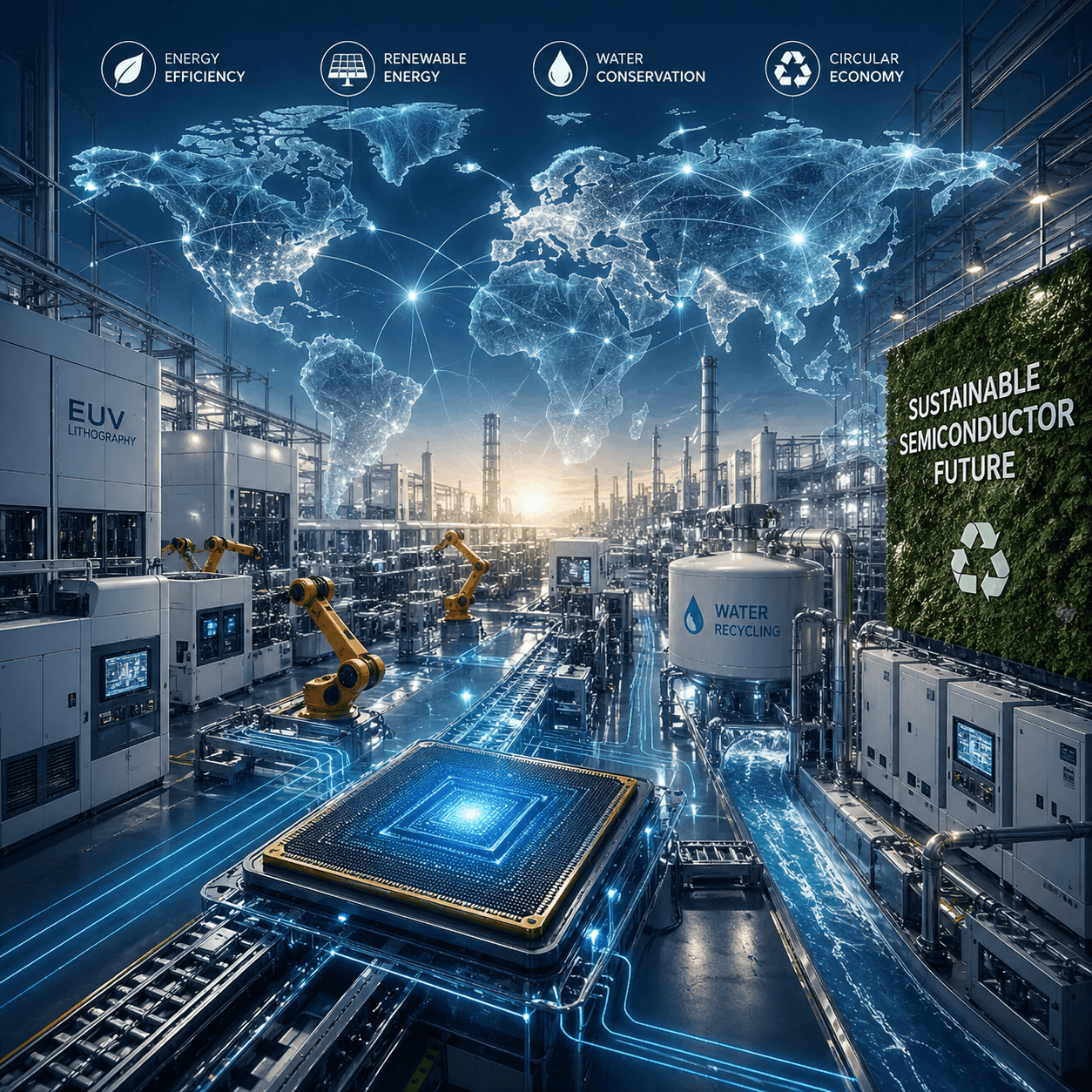
Semiconductors sit quietly at the centre of modern life. They power smartphones, electric vehicles, satellites, hospital equipment, advanced manufacturing systems, and the artificial intelligence tools increasingly shaping economies and research agendas. Yet the supply chains behind these tiny components remains largely invisible to the public. A new integrative review led by Irita Mishra of the University of Wisconsin River Falls, together with Senali Amarasuriya of Middle Tennessee State University and Mojan Naisani Samani of the University of Wisconsin–River Falls, argues that the global semiconductor sector now faces a critical turning point where sustainability and supply chain resilience must be addressed together rather than separately.
Published in Corporate Social Responsibility and Environmental Management, the article, titled Chips and Challenges: An Integrative Review on Sustainability and Risk Management in Semiconductor Supply Chains synthesises findings from 46 influential studies and proposes a new research agenda for managing risks across semiconductor supply chains. Its central warning is clear. Without integrated sustainable supply chain risk management, the technologies driving digital transformation may themselves become vulnerable to disruption.
Why semiconductor supply chains matter more than ever
Semiconductors underpin nearly every strategic industry, from defence and healthcare to renewable energy and advanced computing. Global demand continues to surge as artificial intelligence systems, electric vehicles, and next generation telecommunications expand rapidly. At the same time, the industry operates within tightly interconnected and highly specialised global production networks that are unusually sensitive to disruption.
Recent supply shocks have demonstrated how fragile these networks can be. Fires, geopolitical tensions, pandemic related shutdowns, demand surges, and raw material shortages have collectively caused losses worth hundreds of billions of dollars across industries dependent on chip availability. According to the review, single disruption events in semiconductor supply chains can trigger cascading effects across automotive manufacturing, medical equipment production, consumer electronics markets, and national security systems.
The environmental footprint behind advanced chips
Although semiconductors enable energy efficient technologies and digital innovation, their manufacturing processes remain highly resource intensive. One of the most striking insights highlighted by Mishra and colleagues concerns water consumption. A single semiconductor fabrication facility can use more than ten million gallons of ultrapure water each day, roughly equivalent to the daily consumption of tens of thousands of households.
Energy use presents another sustainability challenge. Semiconductor fabrication requires extremely controlled environments with continuous power supply and specialised chemical processing systems. These facilities contribute significantly to global industrial greenhouse gas emissions, placing the sector under increasing regulatory and investor scrutiny.
The review emphasises that environmental sustainability in semiconductor manufacturing cannot be treated as a secondary issue. Instead, water stewardship, emissions reduction, and circular material recovery must become central components of long-term industry strategy.
A geographically concentrated industry with global consequences
Semiconductor production is unusually concentrated in a few regions, particularly East Asia. Advanced wafer fabrication is dominated by a handful of foundries that supply chips to manufacturers worldwide. This geographic clustering creates systemic vulnerability.
Export controls on critical minerals such as gallium, natural disasters affecting fabrication plants, and geopolitical tensions between major economies can all destabilise supply chains rapidly. The review highlights how these risks have intensified alongside the emergence of techno national industrial policies such as the United States CHIPS and Science Act and similar initiatives in Europe and Asia.
These policy interventions aim to strengthen national semiconductor capacity, but they also introduce complex sustainability trade-offs. Expanding fabrication infrastructure in multiple regions increases resilience, yet it can simultaneously increase carbon emissions and resource consumption unless renewable energy integration and water recycling strategies are prioritised.
Bridging sustainability and supply chain risk management
A central contribution of the study lies in its integration of two previously separate research traditions. Scholars have long examined sustainable supply chain management and supply chain risk management independently. Mishra and colleagues argue that the semiconductor industry now requires a unified approach known as sustainable supply chain risk management (SSCRM).
To understand this intersection, the authors screened more than 1,500 studies from leading supply chain and management journals. These journals were drawn from the UTD24 journal list, a widely used set of premier business research journals maintained by the Naveen Jindal School of Management at The University of Texas at Dallas, and the Supply Chain Management Journal List, a field-specific list supported by supply chain scholars affiliated with institutions such as Oxford University, Auburn University, Michigan State University, Arizona State University, ETH Zurich, and MIT among others.
From this broad pool, the authors identified 46 relevant studies focused on sustainability, risk, or their overlap in the semiconductor context. This relatively small number of studies reveals a major research gap: despite the strategic importance of semiconductors, focused scholarship on sustainable supply chain risk management in this sector remains limited.
This integrated perspective recognises that environmental responsibility, operational continuity, and geopolitical resilience are inseparable. For example, emergency logistics during shortages can increase emissions, while efforts to regionalise production may shift environmental burdens rather than reduce them. Similarly, resource scarcity can simultaneously threaten ecological sustainability and production stability.
The world’s smallest technologies now depend on some of its most fragile supply chains. Sustainability and risk are no longer separate challenges for the semiconductor industry; they are two sides of the same supply chain problem.
—Irita Mishra
The review therefore proposes that semiconductor firms adopt decision frameworks capable of balancing environmental performance with resilience to disruption.
The frameworks shaping future semiconductor strategy
To structure their analysis, the researchers examine four influential conceptual frameworks that are increasingly shaping supply chain governance across high technology sectors. These include the ESG framework, the Triple Bottom Line model, the Triple A framework, and its extension known as Triple A & R.
The Environmental, Social and Governance framework encourages firms to integrate sustainability metrics into procurement decisions, supplier evaluation, and corporate disclosure practices. Within semiconductor manufacturing, ESG strategies can include renewable energy adoption, conflict mineral traceability, and labour standards monitoring across supplier networks.
The Triple Bottom Line framework expands performance measurement beyond profitability alone by incorporating social and environmental indicators. For semiconductor firms, this includes community engagement around fabrication sites, rare material recycling initiatives, and energy efficient production processes aligned with investor expectations.
Meanwhile, the Triple A framework emphasises agility, adaptability, and alignment across supply chain partners. These capabilities allow companies to respond rapidly to demand volatility and regulatory shifts. Its extension, the Triple A & R framework, introduces robustness, resilience, and realignment as additional strategic priorities for managing long term uncertainty.
Artificial intelligence as a tool for resilient supply chains
One of the most forward-looking aspects of the review concerns the potential role of artificial intelligence in enhancing supply chain transparency and sustainability performance. Semiconductor production already depends heavily on advanced analytics for yield optimisation and process control. The authors suggest that similar technologies could support predictive monitoring of resource consumption, emissions patterns, and labour practices across supplier networks.
AI-driven analytics could also improve demand forecasting accuracy, reducing the bullwhip effect that amplifies fluctuations in upstream orders. This phenomenon has historically contributed to inventory instability and inefficient capacity utilisation across semiconductor manufacturing networks.
Integrating machine learning with ESG reporting systems may therefore enable real-time tracking of environmental indicators such as water usage and carbon intensity, strengthening both regulatory compliance and operational resilience.
Power dynamics inside semiconductor supplier networks
The review also highlights an under-examined issue within semiconductor supply chains. Power asymmetries between dominant foundries and smaller upstream suppliers shape how sustainability standards are implemented across production networks.
Large technology firms increasingly require suppliers to meet strict environmental and governance criteria. However, smaller suppliers often lack the technical or financial capacity to implement these changes rapidly. This imbalance can slow the diffusion of sustainability practices beyond first-tier suppliers, where some of the most resource-intensive activities actually occur.
Understanding how procurement strategies influence supplier behaviour represents an important research frontier in sustainable semiconductor supply chain management. The key message of this review paper is clear: semiconductor supply chains must be designed not only to be efficient and innovative, but also resilient, sustainable, transparent, and socially accountable. The chips powering the future should not depend on supply chains that remain environmentally fragile, geopolitically exposed, and unevenly governed.
Note: This article was prepared in-house with input from the authors of the research article.
Reference
Mishra, I., Amarasuriya, S., & Samani, M. N. (2026). Chips and challenges: An integrative review on sustainability and risk management in semiconductor supply chains. Corporate Social Responsibility and Environmental Management. https://doi.org/10.1002/csr.70435
Coauthors

Dr. Senali Amarasuriya is an assistant professor of supply chain management in the Jennings A. Jones College of Business at Middle Tennessee State University. Her research interests include sustainable supply chain management, firm innovation and operations management, and application of AI in supply chain management. Dr. Amarasuriya has industry experience related to procurement and supply chain coordination in Nestle Sri Lanka, and MAS Bodyline, a leading Sri Lankan apparel manufacturer for brands including Victoria’s Secret, Nike and Lululemon.

Dr. Mojan Naisani Samani is an Assistant Professor in the Department of Management and Marketing at the University of Wisconsin-River Falls. Her research focuses on the human experience and impact on the micro-level, with the heart of her work asking the big question: How can we improve employee experience on the job while also increasing organizational competitiveness. Her published work spans topics such as recruitment, people management, work conditions, well-being, and creating a positive workplace and has been published in peer-reviewed journals such as Labour and Industry, Mindfulness, and the Journal of Happiness Studies.