
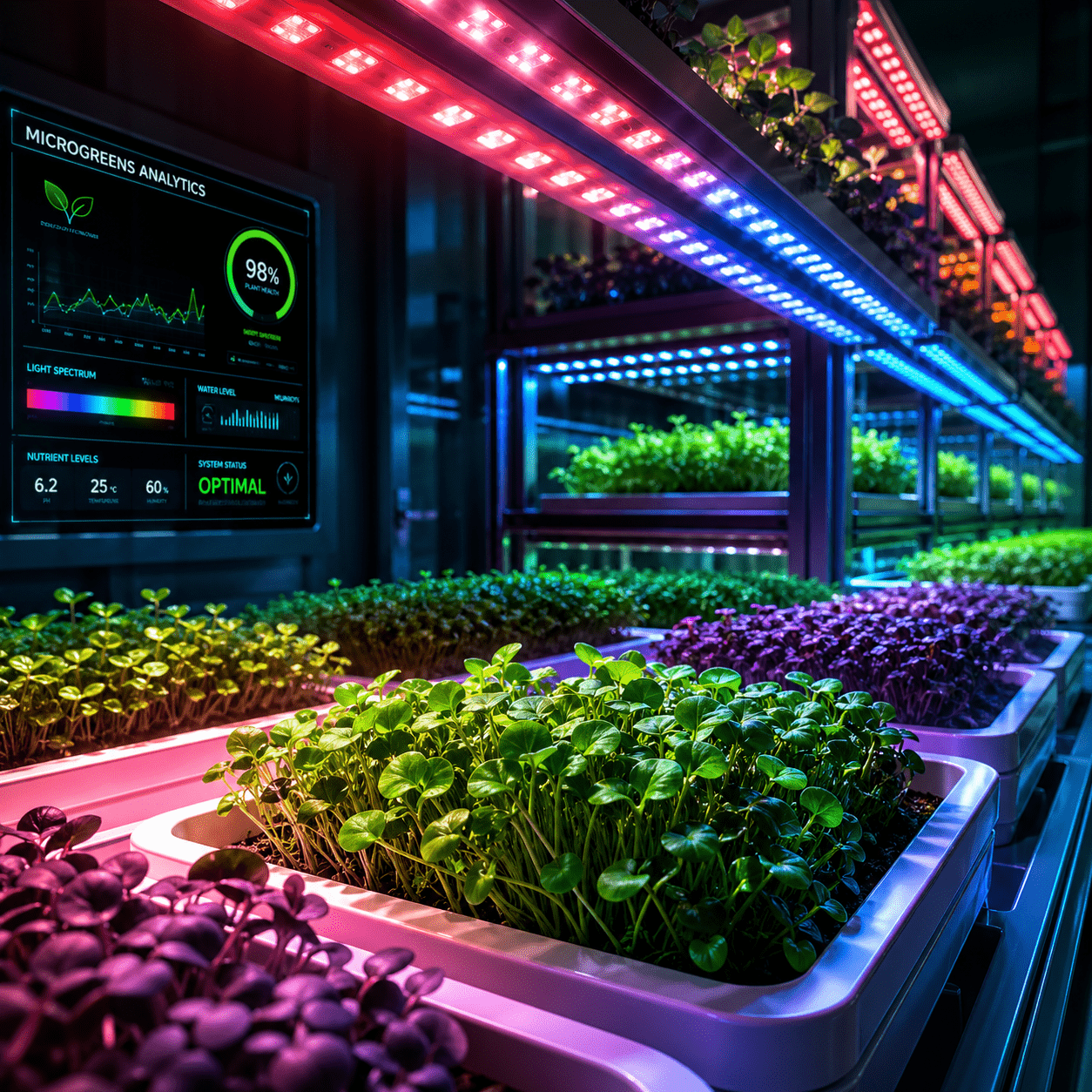
In an era where climate change, urbanisation, and shrinking arable land threaten global food systems, scientists are exploring an unexpected lever of control: light. Not sunlight, but precisely engineered artificial light. What if the nutritional value of food could be enhanced not through genetic modification or chemical inputs, but simply by adjusting the colour of light during growth?
Two studies published in the Journal of Plant Growth Regulation and ACS Agricultural Science & Technology suggest exactly that. The research, titled “Comprehensive Agronomic Analyses of Brassicaceae Microgreens Grown Under Different Light Emitting Diodes”, and “Histological Analyses of Five Brassicaceae Microgreens Grown under Different Light-Emitting Diodes in an Indoor Farming System,” was conducted by Deyvanai Arumugam, Swee Tiam Tan, Kotaro Takayama, Ayyagari Ramlal, and Sreeramanan Subramaniam at Universiti Sains Malaysia, in collaboration with Xiamen University Malaysia, Ehime University, and Toyohashi University of Technology. Their findings point to a future in which light itself becomes a tool for engineering healthier, more productive crops.
Why microgreens are gaining global attention
Microgreens, harvested just days after germination, have rapidly transitioned from gourmet garnishes to nutritional powerhouses. These young plants are known to contain higher concentrations of vitamins, carotenoids, polyphenols, and essential minerals compared to their mature counterparts. Their compact growth cycle and high nutrient density position them as a promising solution for both food security and dietary supplementation.
Yet despite their advantages, microgreens face scalability challenges. Limited consumer awareness, seed availability, and inconsistencies in production systems have slowed their widespread adoption. Controlled environment agriculture, particularly hydroponic systems, offers a pathway forward by enabling year-round production with minimal land use.
This is where light becomes critical. Unlike traditional farming, indoor systems rely entirely on artificial illumination, making light not just an environmental factor but a controllable variable that can directly influence plant growth and biochemical composition.
Growing plants under engineered light
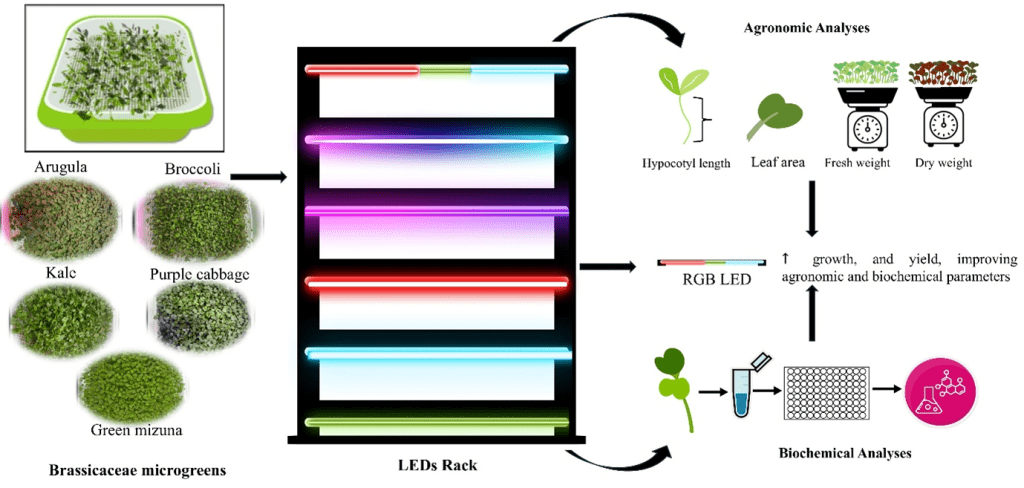
To explore how light influences plant development, the research team cultivated five Brassicaceae microgreens: arugula, broccoli, kale, purple cabbage, and green mizuna. These species were selected for their high nutritional value and market demand.
The plants were grown hydroponically under twelve distinct LED light treatments. These included monochromatic lights such as red, blue, and green, dichromatic combinations like red plus blue, and more complex trichromatic combinations involving red, green, and blue in varying ratios. The goal was to determine how different spectral compositions affect both agronomic traits and biochemical properties.
Over a 12-day growth cycle, the researchers measured key parameters, including hypocotyl length, leaf area, fresh weight, and dry weight. In parallel, biochemical analyses assessed chlorophyll, carotenoids, porphyrins, antioxidant activity, carbohydrate content, and proline accumulation. This multi-scale approach allowed the team to link physical growth with underlying metabolic changes.
When light becomes a growth accelerator
The results were striking. Microgreens grown under combined red, green, and blue LEDs consistently outperformed those grown under single or dual colour spectra. Leaf area expanded significantly, in some cases up to three times that of the control conditions. Fresh and dry biomass also increased markedly, indicating enhanced productivity.
More importantly, these improvements were not limited to physical growth. The plants’ biochemical profile shifted dramatically. Chlorophyll content increased, enabling more efficient photosynthesis. Carotenoid levels, which play a crucial role in human health as antioxidants, were significantly elevated. Total antioxidant activity, measured through DPPH inhibition, showed substantial enhancement, suggesting improved health benefits for consumers.
Carbohydrate content also rose sharply under combined LED conditions, although the study notes that microgreens remain relatively low in carbohydrates compared to other crops. Meanwhile, increased proline levels indicated that the plants were experiencing a form of controlled, light-induced stress, which, in turn, stimulated the production of beneficial secondary metabolites.
Why colour matters
The underlying mechanism lies in how plants perceive and respond to different wavelengths of light. Red and blue light are strongly absorbed by chlorophyll pigments and are essential for driving photosynthesis. Green light, often overlooked, penetrates deeper into plant tissues and influences processes such as stem elongation and canopy light distribution.
When combined, these wavelengths create a synergistic effect. Red and blue light optimise energy capture, while green light enhances internal light distribution and morphological development. This combination appears to fine-tune plant metabolism, leading to both increased growth and enhanced biochemical composition.
Interestingly, the study also observed that monochromatic green light promoted longer hypocotyls, a response linked to shade avoidance mechanisms. However, while this increased stem length, it did not necessarily translate to higher yield or nutritional quality. In contrast, the balanced RGB combinations provided a more holistic improvement across all measured parameters.
From lab to plate: Implications for food systems
The implications of these findings extend far beyond laboratory experiments. Indoor farming systems, including vertical farms and urban agriculture setups, rely heavily on artificial lighting. Optimising LED spectra could significantly improve both yield and nutritional value without increasing resource input.
This is particularly relevant for densely populated cities where space is limited and food demand is high. By tailoring light conditions, it may be possible to produce nutrient-rich crops locally, reducing dependence on long supply chains and minimising environmental impact.
Moreover, the ability to enhance specific phytochemicals through light manipulation opens new avenues for functional foods. Crops could be customised for higher antioxidant content, improved mineral profiles, or targeted health benefits, aligning agriculture more closely with nutritional science.
Towards intelligent agriculture
While the study provides strong evidence for the benefits of combined LED spectra, it also raises new questions. How do different plant species respond to similar light conditions? Can these findings be scaled economically for commercial farming? And how might dynamic lighting systems, capable of adjusting spectra in real time, further enhance plant performance?
Future research will likely focus on integrating light optimisation with other controlled environment variables such as temperature, humidity, and nutrient delivery. The convergence of these technologies could lead to fully automated agricultural systems where every aspect of plant growth is precisely managed.
As the global population continues to rise, the need for efficient and sustainable food production becomes increasingly urgent. Innovations like LED driven spectral engineering offer a glimpse into a future where agriculture is not only more productive but also more adaptable and resilient.
References
Arumugam, D., Tan, S. T., Takayama, K., Ramlal, A., & Subramaniam, S. (2026a). Comprehensive agronomic analyses of Brassicaceae microgreens grown under different light emitting diodes. Journal of Plant Growth Regulation. https://doi.org/10.1007/s00344-026-12060-y
Arumugam, D., Tan, S. T., Takayama, K., Ramlal, A., & Subramaniam, S. (2026b). Histological Analyses of Five Brassicaceae Microgreens Grown under Different Light-Emitting Diodes in an Indoor Farming System. ACS Agricultural Science & Technology, 6(3), 420-433. https://doi.org/10.1021/acsagscitech.5c00510
Coauthors
Ayyagari Ramlal, PhD, holds a doctoral degree from the School of Biological Sciences, Universiti Sains Malaysia, Malaysia, in 2026. He completed his bachelor’s and master’s degrees in Botany from the University of Delhi, Delhi, India, in 2017 and 2020, respectively. He has worked as a Junior Research Fellow at the Division of Genetics, Indian Agricultural Research Institute (ICAR-IARI), Delhi, India, and Banaras Hindu University (BHU), Uttar Pradesh, India. He also worked on an innovation research project initiated by the University of Delhi. He is the recipient of the prestigious Malaysia International Scholarship (MIS) 2024, Ministry of Higher Education (MOHE), Malaysia and the 2025 Student Travel Award for the 2025 In Vitro Biology Meeting, Society for In Vitro Biology (SIVB), VA, US. He has published more than 50 peer-reviewed research and review articles in international journals of repute, along with several book chapters. He served as an editor for the books on Phytohormones in Abiotic Stress (CRC Press, TF) and Soybeans (AAP, TF) and is currently serving as a reviewer for numerous national and international journals of repute. Additionally, he is a Review Editor for the Biodiversity section of Frontiers in Young Minds and an Early-Career Editorial Board Member of Frontiers in Bioscience-Elite (IMR Press). He is currently a Guest Associate Editor for Frontiers in Bioinformatics and Frontiers in Plant Physiology. He is a member of the Royal Society of Biology (RSB), UK, the Society for In Vitro Biology (SIVB), MD, US, the International Association of Plant Biotechnology (IAPB), Saskatoon, Canada and the American Society of Plant Biologists (ASPB), US.
Professor Dr. Sreeramanan Subramaniam graduated with BSc (Hons) in Biochemistry from Universiti Putra Malaysia (UPM) in 2000 and Ph.D. in Plant Biotechnology from the same university in 2005. He worked as a lecturer at AIMST University Malaysia from July 2004 prior joining the School of Biological Sciences, Universiti Sains Malaysia (USM) in March 2008. He was awarded Fellow of Royal Biology Society UK (FRSB) in 2019, Top Research Scientist Malaysia (TRSM) in 2020, Fellow of Malaysian Scientific Association (FMSA) in 2021 and the prestige Fellow of Academy of Science Malaysia (FASc) in April 2026. His current research interests are in the plant tissue culture of various ornamental plants and horticultural crops, the establishment of cryopreservation technology, secondary metabolites using a cell culture system, genetic engineering of selected plants for fungal disease resistance, induction of hairy roots in selected medicinal plants, LED technology in plant tissue culture, somaclonal variation for crop improvement, an automatically-controlled vertical farming system on soilless strawberry and vegetable cultivation using LED lighting system with the synergistic integration of IoT, AI, and computer vision technologies.