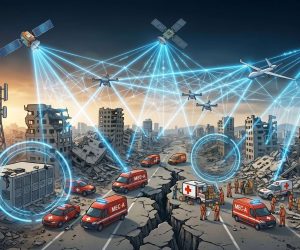
Can satellites, drones, and AI ensure real-time information flow when networks collapse, helping emergency teams respond faster and deliver relief services during crises?
End of Content.
Get the latest creative news from us about politics, business, sport and travel
End of Content.
I currently work as an Assistant Professor (Selection Grade) at the University of Petroleum and Energy Studies (UPES), Dehradun, India, where I am engaged in teaching, academic research, and collaborative work in AI-driven networking and next-generation communication systems. Prior to this, I served as an Adjunct Research Scientist at University College Dublin and as a Research Fellow at Trinity College Dublin, focusing on AI-driven communication networks, 5G/6G architectures, edge computing, and intelligent resource orchestration across Satellite–Aerial–Ground Integrated Networks (SAGINs). With over a decade of research experience, my work spans service placement, cloud-native design, intelligent transport systems, disaster response, and urban sensing.

I currently work as an Assistant Professor (Selection Grade) at the University of Petroleum and Energy Studies (UPES), Dehradun, India, where I am engaged in teaching, academic research, and collaborative work in AI-driven networking and next-generation communication systems. Prior to this, I served as an Adjunct Research Scientist at University College Dublin and as a Research Fellow at Trinity College Dublin, focusing on AI-driven communication networks, 5G/6G architectures, edge computing, and intelligent resource orchestration across Satellite–Aerial–Ground Integrated Networks (SAGINs). With over a decade of research experience, my work spans service placement, cloud-native design, intelligent transport systems, disaster response, and urban sensing.

Can satellites, drones, and AI ensure real-time information flow when networks collapse, helping emergency teams respond faster and deliver relief services during crises?