

Subscribe For More!

Get the latest creative news from us about politics, business, sport and travel

 
Subscription Form
Edit Template

Part II: Migration As Nature’s Response To Climate Change

The first part of the article is titled “Part I: All Living Things Descended From The Survivors Of Snowball Earth”. This second article in the series is based on a new scientific perspective titled "Ecosystem relocation on Snowball Earth: a polar–alpine ancestry for the extant surface biosphere?", published by geologist Paul F. Hoffman of the University of Victoria (British Columbia) and Harvard University (Cambridge) in the Proceedings of the National Academy of Sciences (PNAS).
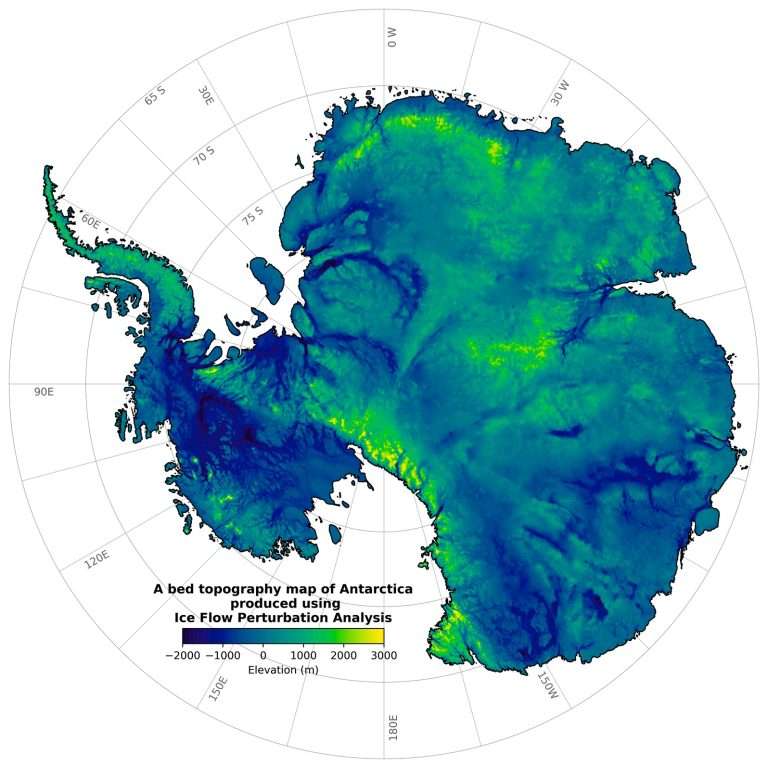
Figure 5. Subglacial topography of the Antarctic continent inferred from Ice Flow Perturbation Analysis (IFPA) of ice sheet surface morphology mapped by orbiting satellites (Ockenden et al. 2026). Bedrock relief of 4−6,000 m (13,000−20,000 ft) is widespread beneath the Antarctic Ice Sheet, including tectonically stable East Antarctica. Preglacial bedrock topography was enhanced by erosion of steep-walled valleys (dark blue) by fast-flowing ice streams, while mountains (yellow) that project upward into colder ice have been little eroded. The bedrock surface would rise hundreds of meters in elevation if the load of the ice sheet was removed by melting. Image courtesy: American Association for the Advancement of Science.

In Chapter 11 of On the Origin of Species (1859), Charles Darwin offered a vision of how organisms respond to climate change that did not require simultaneous adaptation. In response to climate warming at the end of the last Ice Age (from 18,000 to 10,000 years ago), entire ecosystems migrated to higher elevations and latitudes. This explains how identical species came to inhabit geographically isolated mountaintops.

Since 1802, when naturalists Alexander von Humboldt and Aimé Bonpland famously documented the zonation of animals and plants with elevation on Mount Chimborazo (6,263 m; 20,548 ft) in Ecuador, their zones have moved about 240 m (800 feet) higher vertically in response to ongoing global warming. The onset of an ice age would induce migrations downward in elevation and latitude. According to Darwin, alpine life forms would descend to the lowlands and ‘arctic’ ones to the temperate zone. Simultaneously, temperate life forms would displace the tropical ones, which would perish. In the extreme case, he wrote (p. 366), only ‘arctic’ (polar) life forms would survive.

Habitat migration and selective survival on Snowball Earth

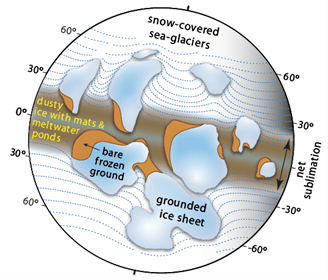
Applied to Snowball Earth, Darwin’s vision implies that Snowball survivors were mainly those that occupied polar and alpine habitats before the Cryogenian, and which moved along with their habitats to the Snowball equatorial zone of net sublimation (Figure 1). There, wind-blown dust from the ice-free lands provided essential nutrients and darkened bare ice surfaces, allowing meltwater pits, ponds and streams to develop. The growth of microbial mats with dark pigments for UV protection (Figure 2) enhanced the melting and hastened Snowball deglaciation.

Figure 1. Surface environments on the younger Cryogenian Snowball Earth. Floating ‘sea-glaciers’ flow from higher latitudes where they are thicker, due to snow accumulation and basal freezing, toward the equatorial zone where they are thinner, due to sublimation and basal melting. Continents are mostly blanketed by ice sheets fed by moisture sublimated off the equatorial sea glacier. Ice-free land areas of bare frozen ground are sources of wind-blown dust, that darkens the sublimative surface of the equatorial sea-glacier, promoting meltwater production and the growth of surface microbial mats (Figure 2).
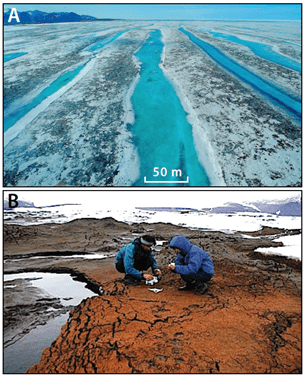
Figure 2. Microbial mats and meltwater ponds on the ablative surfaces of Arctic Ocean ice shelves at 83°N latitude off Ellesmere Island, Nunavut, Canada. (A) Aerial view looking westward of linear meltwater ponds in late summer, when dark microbial mats are exposed on ice ridges between the ponds, which are less than 3.0 m (10 ft) deep and up to 15 km (9.3 mi.) long. The linearity of the ponds reflects buckling of the ice shelf by back-pressure from the annual growth of sea ice. Linear ponds aligned parallel to the equator would have existed in the equatorial zone of Snowball Earth due to back-pressure from the convergence of the sea-glaciers (Figure 1). (B) Microbial mats on the Markham Ice Shelf are strongly pigmented for UV protection in summer. The carotenoid (orange) pigments are produced by the terrestrial green alga Bracteacoccus, and the black (scytonemin) pigments are products of filamentous Cyanobacteria. The mats offer protection and sustenance for diverse other life forms including micro-invertebrates. Both images courtesy of Warwick F. Vincent.

Ocean recolonization in the torrid aftermath of Snowball Earth


When it finally occurred, many lowlands were flooded on a millennial timescale by the rapidly-warming and meltwater-dominated surface waters of a biotically near-vacant ocean (Figure 3). Some of the surviving species retreated skyward and poleward with the ice margins. Others recolonized the oceans, creating what Joe Kirschvink described as “a series of post-glacial sweepstakes, perhaps allowing novel forms to establish themselves, free from the competition of preexisting biota”. In the torrid ultra-greenhouse aftermath, marine colonization was favored in relatively cool polar waters and upwelling zones, spreading elsewhere as conditions ameliorated. By implication, the living surface biosphere is descended from a polar−alpine subset of pre-Cryogenian life forms. Marine fossils before and after are related through common ancestry, but not by direct descent.

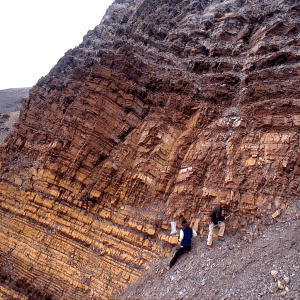
Figure 3. Geologists collecting samples on Ditlovtoppen nunatak in NE Svalbard (Arctic Europe) of sediments deposited during the global sea-level rise accompanying the younger Snowball Earth meltdown. Upward decrease in carbonate content (buff color) relative to shale (maroon and olive) reflects decreasing carbonate saturation with increasing water depth. The samples provide isotopic records of carbon, sulfur and oxygen geochemical cycling during extreme climate change.

How to test the habitat migration and ocean recolonization scenario

This migratory scenario makes three predictions that can be tested in different ways. First, it predicts that preexisting polar−alpine biomes were sufficiently diverse—ecologically, taxonomically, metabolically, and genetically—to have given rise to the biotic radiations seen in the fossil record following the Cryogenian Period.

Second, it predicts that the genomes of living organisms might bear molecular evidence of polar−alpine pre-Cryogenian ancestry.

Third, it predicts that glacial refugia existed during the ultra-greenhouse aftermath of the first Cryogenian Snowball, allowing their readvance to the equatorial zone during the second and last Snowball Earth.

Testing these predictions requires the ‘crossing’ of not only climate dynamics and geology, but also polar−alpine microbial ecology and molecular phylogenomics.

Microbial diversity in modern polar ecosystems

Polar microbial ecologists Warwick Vincent (Figure 4) and Clive Howard-Williams, based in Canada and New Zealand, respectively, pointed out at the millennium when Snowball Earth survival was first widely debated, that the surfaces of modern landfast ice shelves in both polar regions are occupied by meltwater streams and ponds in summer that are carpeted by dark microbial mats (Figure 2). The mats provide sustenance and protection to a wide range of less cold-tolerant organisms, including viruses, bacteria, protists, and invertebrates, allowing them to survive, grow, and evolve on Snowball Earth.

Appreciation of the diversity of polar habitats and their microbial constituents continues to grow, as does the Darwinian threat to their survival posed by amplified polar warming. It now seems quite plausible that the surface biosphere we have today evolved mainly, if not exclusively, from a cold-adapted subset of pre-Cryogenian biotic diversity. Virtually all ancient life forms are found in polar−alpine environments. Interestingly, the cold-tolerant Cyanobacteria of ice mats are fast-responders to change, and have relatively high optimal temperatures for growth (15−35°C, or 60−95°F), well suited to tolerate the ultra-greenhouse aftermath, when bacteria would be favoured over eukaryotes in waters not cooled by upwellings or latitude.

Figure 4. (upper left) Microbial ecologist Warwick F. Vincent (Laval University, Québec, Canada); (upper right) molecular biologist Haiwei Luo (Chinese University of Hong Kong, China); (lower left) geologist Paul F. Hoffman (University of Victoria, British Columbia, Canada), a leading Snowball Earth advocate; (lower right) molecular biologist Patricia Sánchez-Baracaldo (University of Bristol, Avon, United Kingdom).

Freshwater ancestry of modern marine primary producers?

Patricia Sánchez-Baracaldo (Figure 4) is a Colombian plant biologist who, after obtaining a PhD from UC-Berkeley, moved to the University of Bristol (UK) and redirected her research toward the molecular ecology and evolution of marine planktonic Cyanobacteria. They are numerically the most abundant cellular organisms in the oceans and major contributors to marine primary production. From their genomes, she statistically inferred their ancestral habitats (marine, brackish, or freshwater) and lifestyles (bottom-dwellers, swimmers, or passive drifters).

Surprisingly, her analyses suggested that major groups of modern marine plankton (passive drifters) were most likely freshwater mat-dwellers for much of their evolutionary history, radiating into post-Cryogenian oceans as passive drifters . Such a result would risk being tossed aside as nonsense, were it not for the Snowball Earth scenario in which the ice-mat biota of equatorial meltwater ponds responded to the ecological bonanza of a re-illuminated but vacant ocean.

Adaptation to Snowball Earth shapes present biogeography

Does knowledge of ancestry inform current behaviour? Molecular biologist Haiwei Luo (Figure 4) heads a research group at the Chinese University of Hong Kong studying the tiniest unicellular Cyanobacteria, which are the dominant primary producers in the oceans far from land. Around a thousandth of a millimeter in diameter, they have genomes four times larger than our own. They perform photosynthesis during the day and, at night, consume organic matter and undergo cell division. They are divided into two taxa: Pro- (Prochlorococcus), which occurs exclusively in tropical oceans, and Syn- (Synechococcus), which is dominant in mid-latitude oceans and in polar lakes and rivers, but is outcompeted by microalgae in polar oceans.

Reasons for their latitude preferences are debated. Haiwei Luo’s group discovered that during the Cryogenian Period, Pro- underwent a massive gene-reduction event during a time of unusually small effective population size (Zhang et al. 2021, 2024). Such events, in which unused genes are jettisoned to improve efficiency, are an important evolutionary process in bacteria.

One of the genes, Pro- lost, was KaiA, one of three Kai genes that control circadian rhythm, the switching from daytime to nighttime activities that are signalled in advance of sensory cues. When Pro-‘s ancestor relocated to the sublimation zone on Snowball Earth (Figure 1), only two Kai genes were needed because daylight hours in the tropics change little over the course of the year. Syn-, more conservative than Pro-, retained all three Kai genes during the Cryogenian, so that when Snowball Earth ended, it could exploit mid- and high-latitude waters, where daylight hours vary dramatically with the seasons.

How did cold-adapted biomes survive the torrid aftermath of the older Cryogenian Snowball Earth?

In order for cold-adapted life forms to attend the younger Cryogenian Snowball, they must have survived the ultra-greenhouse aftermath of the older one. The 10−20 million year interval between Snowballs, including the greenhouse aftermath, may have been insufficient for re-adaptation to cold habitats. Model results and fossil evidence from more recent warm periods imply that no Arctic winter sea ice would have existed in the greenhouse aftermath.

Mountain peaks might still be glaciated, however, especially if they lay outside the tropics. If the limits of glaciers on Mount Chimborazo were to rise 5.5 times higher in elevation than they have since 1802, the top of the mountain would still be ice covered despite its equatorial location. But would such mountains exist after 56 million years of erosion by an enveloping ice sheet that flowed like a river in slow-motion?

Would mountains still exist after 56 million years of glacial erosion?—Lessons from Antarctica

Some geologists imagine that prolonged glacial erosion tends to level bedrock topography, like the lowlands of central Canada after the Laurentide Ice Sheet withdrew. Others counter that central Canada was bevelled long before the ice sheet existed. Its muted topography owes more to tectonic stability than glacial erosion. Bedrock topography beneath the Antarctic Ice Sheet provides a lesson. The ice sheet has been in continuous existence for almost 15 million years, and for 25 of the last 34 million years.

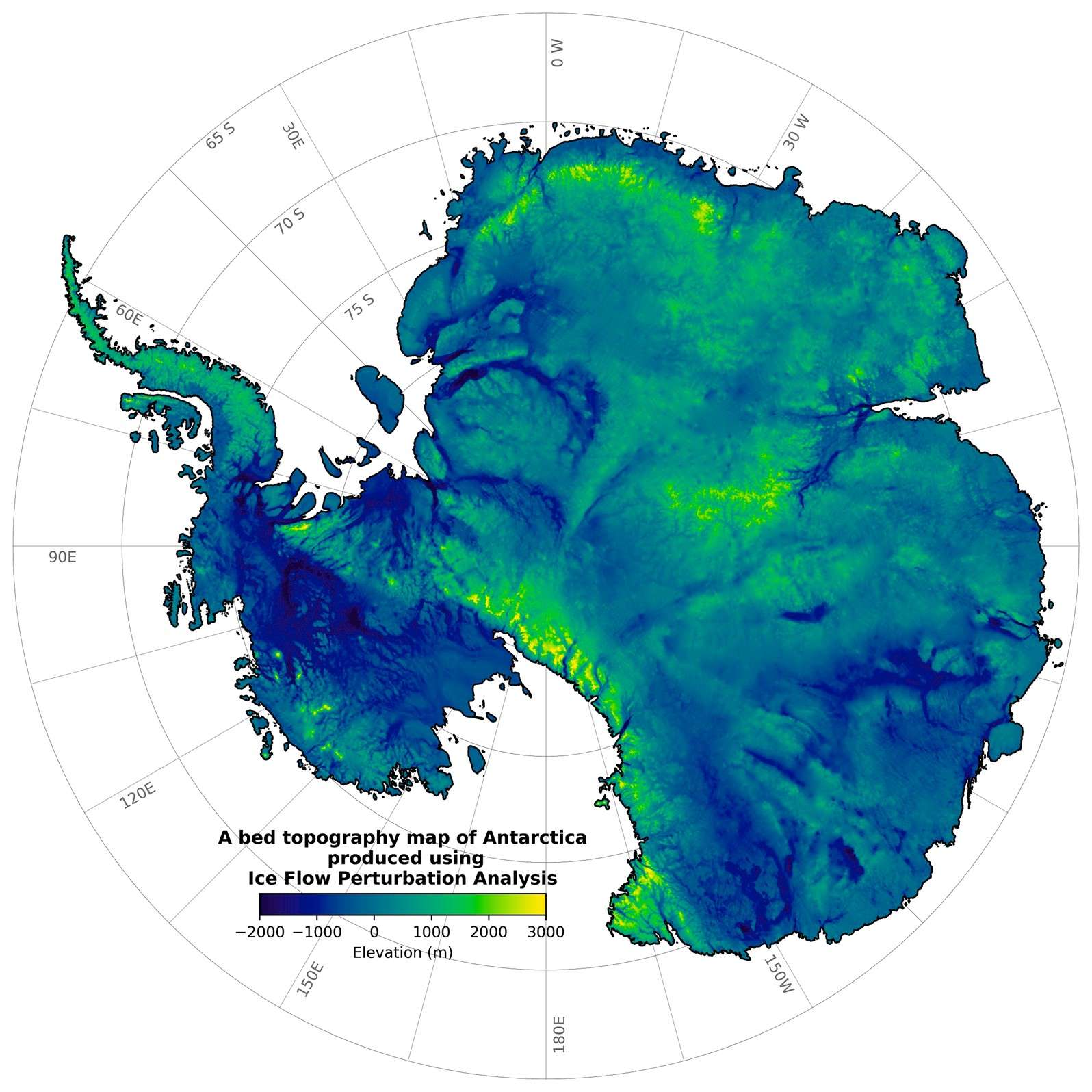
East Antarctica is tectonically stable, but certain sectors were raised up when India and Australia rifted away, back in the Cretaceous when dinosaurs roamed. Antarctica’s subglacial bedrock topography has been revealed locally by ice-penetrating radar and continent-wide by high-resolution satellite mapping of surface irregularities related to stresses generated by glacial flow over bedrock topography. The results indicate that local bedrock relief of 3−4,000 m is widespread beneath the Antarctic Ice Sheet (Figure 5).

Figure 5. Subglacial topography of the Antarctic continent inferred from Ice Flow Perturbation Analysis (IFPA) of ice sheet surface morphology mapped by orbiting satellites (Ockenden et al. 2026). Bedrock relief of 4−6,000 m (13,000−20,000 ft) is widespread beneath the Antarctic Ice Sheet, including tectonically stable East Antarctica. Preglacial bedrock topography was enhanced by erosion of steep-walled valleys (dark blue) by fast-flowing ice streams, while mountains (yellow) that project upward into colder ice have been little eroded. The bedrock surface would rise hundreds of meters in elevation if the load of the ice sheet was removed by melting. Image courtesy: American Association for the Advancement of Science.

Glacial erosion is focussed on the floors of steep-walled valleys, where the ice is relatively warm and fast-flowing. Mountains are little eroded because they project upward into cold ice or, as nunataks, into colder air. Any process that carves valleys drives peak heights higher, simply because removing mass reduces the crustal load. The highest Antarctic nunataks reach nearly 5,000 m (16,000 ft) above sea level and would rise several hundred meters more if the load of the ice sheet were removed.

Mountains in Cryogenian paleogeography

During Cryogenian time, the supercontinent Rodinia was breaking apart into the continents we broadly identify today. The opening up of new oceans was accommodated by the closing of old ones, by subduction at oceanic trenches and at continental margins. Subduction at continental margins generates stratovolcanoes, which would have provided glacial refuges for our cold-adapted ancestors, allowing them to advance once again to the equatorial zone of salvation (Figure 1) during the younger Cryogenian Snowball Earth.

Marine fossils before and after are related through common ancestry, but not by direct descent.

Paul F. Hoffman

References


Hoffman, P.F., 2026. The Tooth of Time: Charles Darwin’s prophecy regarding selective survival on Snowball Earth. Geoscience Canada, v. 53, no. 1, https://doi.org/10.12789/geocanj.2026.53.227

Hoffman, P.F., 2025. Perspective: Ecosystem relocation on Snowball Earth. Proceedings of the National Academy of Sciences USA, v. 122, no. 20, e2414059122, https://doi.org/10.1073/pnas.2414059122

Key Insights

Selective survival on Snowball Earth favored organisms pre-adapted to cold habitats.
At Snowball onsets, preexisting polar and alpine biomes moved to the equatorial desert, where dust provided nutrients and darkened bare ice surfaces, generating meltwater and protective microbial ice-mats.
In the oceans, food webs collapsed because of perpetual darkness and ultra-cold brine beneath half-mile-thick ice.
When the Snowball finally melted, the ice desert biota divided between those that retreated with the glaciers and those that reinhabited the oceans.
Phylogenomic evidence is emerging that the extant surface biosphere descended largely from a cold-adapted subset of pre-Cryogenian life.

Related Articles

Subscription Form

© 2025 all rights received by thesciencematters.org