
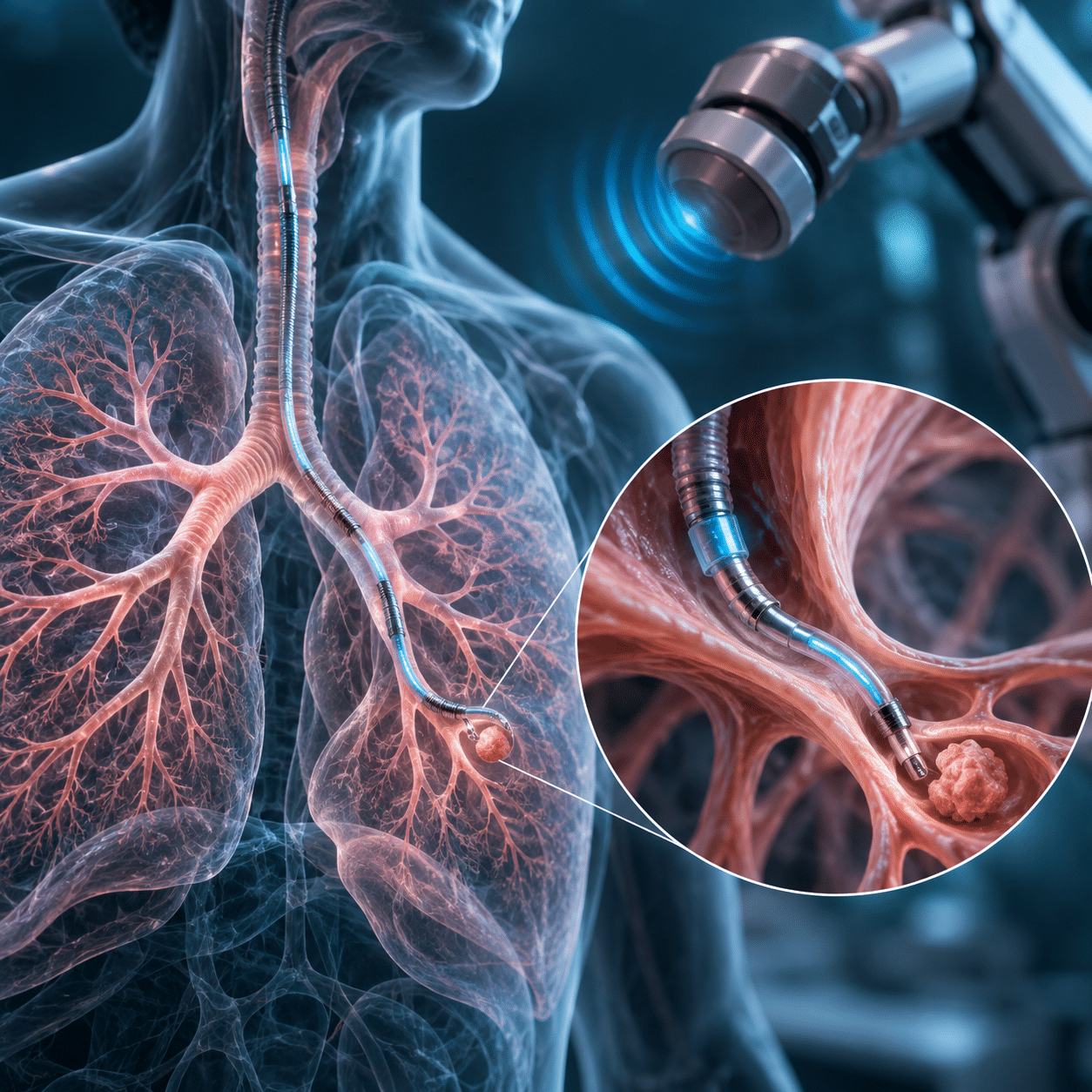
A new robotic bronchoscopy system developed by researchers at Shanghai Jiao Tong University has demonstrated an unusual ability that could eventually help doctors navigate some of the most difficult regions of the lung. The device uses a slender catheter that can switch between flexible and rigid states, allowing it to bend through complex bronchial pathways and then become stable enough to support an intervention.
The research was led by Tianqi Huang and Boyu Zhang of the School of Biomedical Engineering at Shanghai Jiao Tong University, together with colleagues from Shanghai Jiao Tong University and Nanjing University of Information Science and Technology. The findings were published in the journal Advanced Intelligent Systems in the research article, “Bronchoscopy Robot with Enhanced Flexibility and Stability via Multi-Segment Variable Stiffness Catheter.”
A difficult journey through the lung
The human airway is a highly branched structure. As the bronchi divides deeper inside the lungs, the passages become progressively narrower and more tortuous. This creates a fundamental engineering challenge for robotic bronchoscopy.
A bronchoscopy device must be sufficiently flexible to negotiate sharp bends and reach peripheral regions of the lung. At the same time, it needs adequate stiffness and force transmission once it reaches a target, particularly when a biopsy or another intervention is required. A device that is always rigid may struggle to navigate narrow, curved airways, while one that remains continuously soft may lack the stability needed for precise procedures.
This challenge is particularly relevant to early lung cancer, where small pulmonary nodules can occur in peripheral regions that are difficult to access. The researchers note that existing commercial robotic bronchoscopy platforms have demonstrated improvements over traditional techniques, but their larger outer diameters and mechanical characteristics can restrict access to some distal airways.
A catheter that can change its mechanical behaviour
The new system addresses this problem with a multi segment variable stiffness catheter, or VSC. Rather than remaining permanently soft or rigid, the catheter can alter its stiffness during the procedure.
The principle is relatively straightforward. During navigation, the catheter can be placed in a softer state, allowing it to bend and conform to complex bronchial pathways. After reaching the desired location, its stiffness can be increased, creating a more stable platform for intervention.
The researchers used NOA86, a UV curable shape memory polymer, as the principal material for the variable stiffness units. Its mechanical properties change substantially with temperature. When heated above its glass transition temperature, the polymer becomes softer. When cooled, it returns to a stiffer glassy state. The researchers measured a Young’s modulus of approximately 1.25 GPa at room temperature, decreasing to about 1.01 MPa at 80°C.
This temperature dependent behaviour gives the robotic catheter its central capability: flexibility for navigation and stiffness for intervention.
Magnetic steering without internal tendons
The catheter is also distinctive in the way it is controlled. Instead of relying entirely on internal tendons or steel wires to steer the distal end, the researchers incorporated magnetic elements into the catheter and used an external permanent magnet mounted on a six degree of freedom robotic arm.
The magnetic field interacts with ring magnets positioned within the variable stiffness segments. By changing the position and orientation of the external magnet, the catheter can be guided and bent. The proximal and distal magnetic segments provide multiple bending points, allowing the system to produce more complex shapes than a single bending segment.
This approach also contributes to miniaturisation. The catheter has an outer diameter of only 2 mm, an inner diameter of 1 mm, and a total length of 870 mm. The system contains two variable stiffness units together with a high stiffness PEBAX section that provides structural support.
The catheter also contains a central working channel, allowing instruments to be passed through it. This creates the possibility of combining navigation with diagnostic and therapeutic procedures.
Soft navigation, rigid intervention
The researchers designed a closed loop temperature control system to regulate the catheter’s stiffness. Copper wires embedded in the catheter provide Joule heating, while temperature sensors monitor the catheter surface. A microcontroller adjusts the heating through a MOSFET based on the measured temperature and the desired operating state.
During navigation, the catheter remains in its soft state. Once imaging confirms that the tip has reached the target, heating is stopped and the catheter transitions towards its rigid state. This provides positional stability for subsequent procedures. After the intervention, the catheter can be reheated to return it to a softer state for withdrawal.
The mechanical difference between the two states was substantial. The measured bending stiffness was approximately 1.4 × 10⁻³ Nm² in the rigid state and 5.5 × 10⁻⁶ Nm² in the soft state, representing a difference of nearly three orders of magnitude.
The catheter reached an average bending angle of 35.14° in the soft state compared with 0.56° in the rigid state. Its maximum recorded bending angle reached 49.07° in the flexible state, while the maximum was only 1.11° in the rigid state.
Navigating complex paths in lung models
The robotic bronchoscopy system was first evaluated in controlled experimental environments. In a two-dimensional maze, the catheter was able to pass through curved obstacles while operating in its soft state. It followed the boundaries of the pathway and completed a round trip through the maze within 24 seconds.
The researchers then tested the catheter in a transparent lung model containing multiple target locations. Five representative targets were selected to represent branches with different orientations and curvatures. The multi segment design allowed the catheter to adapt its shape as it encountered different airway bifurcations.
The ability to control the stiffness of individual segments was important. When both segments were rigid, the catheter showed limited deflection. Switching one or both segments into the soft state produced progressively greater deformation. This segment specific control allowed the researchers to generate different programmable shapes using magnetic actuation.
A miniature camera provides a view inside the airway
The system was also tested in an opaque lung model using a miniature 1 mm camera positioned within the working channel. The camera provided real time views of the bronchial lumen and bifurcations during navigation.
The arrangement introduces an important practical limitation. Because the camera occupies the working channel, larger diameter instruments cannot be used simultaneously. However, the researchers demonstrated that very thin instruments, including a laser fibre, could be introduced alongside the camera and operated under direct visualisation.
Once the catheter reached its target, it could be switched into a rigid state to provide a stable platform. For procedures requiring larger instruments, the camera would need to be withdrawn before the intervention.
Reference
Yin, S., Huang, B., Dong, S., Wang, J., Zhao, L., Yang, Y., Bao, B., Liao, H., Chen, F., Huang, T., & Zhang, B. (2026). Bronchoscopy robot with enhanced flexibility and stability via multi segment variable stiffness catheter. Advanced Intelligent Systems, e70451. https://doi.org/10.1002/aisy.70451.