Global university rankings have become a fixture in higher‑education news. Every year THE, QS, ARWU and CWUR publish lists of the “world’s best universities” that prompt press releases, marketing campaigns and anxiety in admissions offices. Their influence is evident: government ministries use them to benchmark investment, universities set policies to climb them and students cite them when choosing where to apply. Yet each ranking measures slightly different things. Understanding what sits behind the tables is vital for interpreting the results.
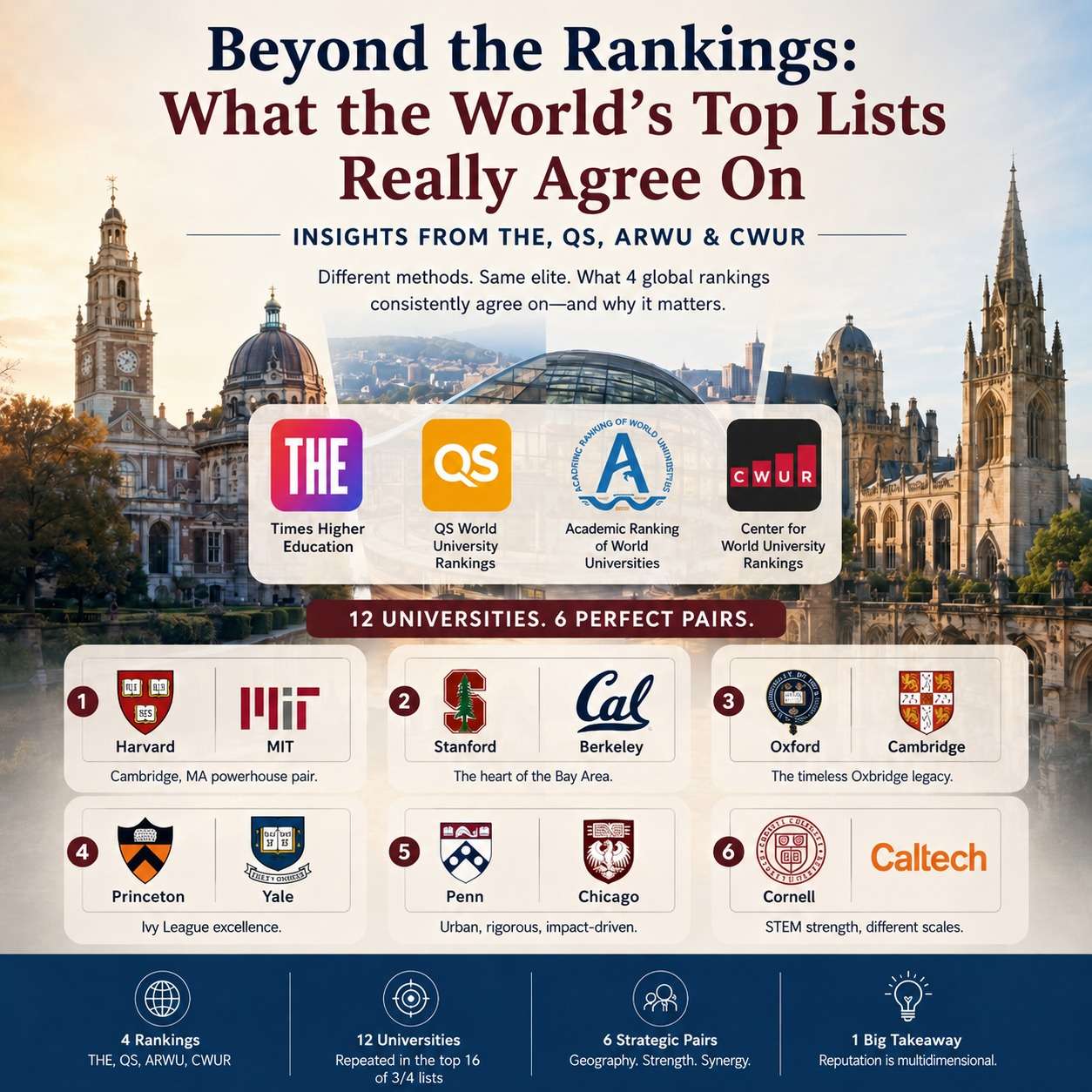
Despite methodological differences, the four major rankings often agree on which institutions occupy the apex. When we combed through recent tables from 2024–26, we found that twelve universities featured at least three times across the four lists. Harvard, Massachusetts Institute of Technology (MIT), Stanford, Cambridge, Oxford, the University of Pennsylvania (Penn), Yale, Princeton, Cornell, the University of California at Berkeley (Berkeley), the University of Chicago (Chicago) and the California Institute of Technology (Caltech) consistently appear near the top. Some have risen or fallen slightly year‑on‑year, but the core group has remained stable across editions.
What the rankings measure
QS World University Rankings
QS bills itself as a student‑focused ranking, emphasising reputation surveys and ratios. Its methodology uses six indicators: academic reputation (worth 40 %), employer reputation (10 %), student‑to‑faculty ratio (20 %), research citations per faculty member (20 %) and the proportions of international faculty and students (each worth 5 %). The heavy weight placed on peer and employer surveys means the QS table reflects perceptions of prestige as much as quantifiable outputs. The 2025 edition included over 1,500 universities across 105 countries and again crowned MIT as the world’s best for the 13th consecutive year. Imperial College London climbed to second place, followed by Oxford, Harvard and Cambridge. Although QS’s focus on internationalisation and reputation can make it more volatile than other rankings, the elite names seldom drop far.
Times Higher Education (THE) World University Rankings
THE’s World University Rankings lean on bibliometrics and research quality. The system uses thirteen performance indicators grouped into five categories: teaching (30 %), research (30 %), citations (30 %), international outlook (7.5 %) and industry income (2.5 %). Teaching and research scores include large reputation surveys, but the citations metric, which normalises for subject area, often shapes the top. In the 2025 list MIT surged to second place, overtaking Stanford; Harvard rose to third, Princeton to fourth and Cambridge remained fifth. Stanford slipped from second to sixth while Berkeley climbed into eighth, illustrating how small shifts in citation scores can shuffle positions. THE’s method treats each indicator separately and publishes separate scores for them, offering a granular view of institutional strengths.
Academic Ranking of World Universities (ARWU)
ARWU, commonly called the Shanghai Ranking, relies exclusively on research excellence. Its six indicators measure Nobel and Fields laureates among alumni (10 %), laureates among staff (20 %), the number of highly cited researchers (20 %), the number of papers in Nature and Science (20 %), the number of papers indexed in the Science Citation Index and Social Sciences Citation Index (20 %), and per‑capita performance (10 %). ARWU ranks more than 2,500 universities but publishes the top 1,000. The 2025 ranking places Harvard first, Stanford second, MIT third and Cambridge fourth. Berkeley and Oxford follow in fifth and sixth place, while Princeton, Columbia, Caltech and Chicago round out the top ten. Because ARWU weights Nobel prizes and high‑impact papers heavily, universities with long histories of prize‑winning alumni and large science faculties maintain an edge.
Center for World University Rankings (CWUR)
CWUR claims to be the largest academic ranking, listing the top 2,000 universities out of over 21,000 institutions. Its methodology uses four factors: education (quality of education based on alumni achievements) and employability (alumni employment), each worth 25 %; faculty quality (10 %), and research performance (40 %). Notably, CWUR does not rely on surveys or data submitted by institutions, instead analysing millions of outcome‑based data points. In the 2025 and 2026 lists Harvard, MIT and Stanford occupy the top three positions. Cambridge and Oxford follow, while Princeton, Penn, Columbia, Yale and Chicago complete the top ten. This ranking resembles ARWU’s focus on research output but incorporates alumni outcomes to gauge education quality and employability.
A closer look at the top performers
Across all four ranking systems, a cluster of universities consistently appears at or near the summit. Harvard is perhaps the most ubiquitous. It tops ARWU’s 2025 table and CWUR’s 2025–26 lists. It also ranks third in THE’s 2025 edition and fourth in QS’s 2025 ranking. Harvard’s enduring dominance reflects its enormous research output, world‑class faculty and storied history. MIT similarly appears in every ranking’s top three: second in THE’s 2025 list, third in ARWU, first in QS for 13 straight years and second in CWUR. MIT’s strong engineering and science programmes, combined with high citations and Nobel‑winning faculty, make it a perennial contender.
Stanford, Cambridge and Oxford complete the core quintet. Stanford sits second in ARWU and third in CWUR. It slipped to sixth in THE’s 2025 ranking yet remains within QS’s top six. Cambridge and Oxford vie for fourth and fifth across ARWU and CWUR. Oxford claimed the top spot in THE for a decade running, demonstrating how different weighting schemes can favour particular strengths – Oxford excels in research quality and international outlook, while ARWU’s heavy emphasis on Nobel prizes boosts Harvard and Stanford.
Beyond this core, the American Ivy League and several non‑Ivy universities regularly populate the upper echelons. Princeton, Penn, Yale and Cornell all appear in at least three rankings. Princeton reaches fourth in THE’s 2025 table, seventh in ARWU and sixth in CWUR. Penn sits among the top seven in CWUR and features in the QS and THE top 20. Yale consistently appears within the top ten of the THE and CWUR lists and just outside ARWU’s top 10. Cornell ranks tenth to twelfth in ARWU and appears in the mid‑20s of QS. The University of Chicago and Berkeley, while not Ivy League, hold their own; Berkeley leaps into eighth place in THE’s 2025 ranking and fifth in ARWU, while Chicago sits tenth in both ARWU and CWUR. Caltech, though tiny by comparison, punches above its weight with top‑ten finishes in THE and ARWU.
Ivy versus non‑Ivy
An interesting pattern emerges when we divide the frequently ranked universities into Ivy League and non‑Ivy institutions. Among the Ivies, Harvard, Princeton, Penn, Yale and Cornell dominate. These institutions combine centuries of tradition with vast endowments, attracting top faculty and students. Harvard, Princeton and Yale benefit from ARWU’s weighting of Nobel and Fields laureates, while Penn’s Wharton School and research output boost its CWUR standing. The Ivy “brand” likely bolsters performance in reputation‑weighted metrics such as QS’s academic reputation indicator.
Non‑Ivy universities often outperform their Ivy counterparts, especially in STEM‑focused metrics. MIT, Stanford and Caltech are prime examples. Their heavy investment in engineering and applied sciences yields high citation counts and technology transfer revenues, enhancing scores in THE’s research and industry income categories. Cambridge and Oxford (UK) and Berkeley and Chicago (US) are public research universities whose mission includes broad access alongside high‑level research, proving that public institutions can rival private ones. Cambridge’s position as the top public university in the world for more than a decade according to CWUR’s press releases exemplifies this.
A fun way to think about excellence
To make sense of the repeating names, we paired the twelve universities into six duos based on geographic proximity and complementary strengths. These pairings are less scientific than the rankings themselves but highlight interesting parallels.
- Harvard – MIT: Both sit along the Charles River in Cambridge, Massachusetts. Harvard’s breadth across humanities, law and medicine complements MIT’s strength in science and engineering. They often collaborate on research and share cross‑registration agreements. Their dominance across all four rankings underscores Boston’s status as a global academic powerhouse.
- Stanford – Berkeley: These two anchor Northern California’s Silicon Valley. Stanford’s private‑sector ties and entrepreneurial culture contrast with Berkeley’s public mission and history of activism. Both excel in technology and science, which explains their high positions in ARWU and THE. Their proximity fosters collaboration as well as competition.
- Oxford – Cambridge: The quintessential British duo, collectively dubbed “Oxbridge.” These universities share centuries‑old collegiate structures, tutorial systems and global prestige. Oxford’s leadership in THE’s rankings reflects strong research quality, while Cambridge performs better in ARWU’s citation‑heavy metrics.
- Princeton – Yale: Both are Ivy League institutions on the U.S. East Coast with strong liberal‑arts traditions and powerful research programmes. Princeton’s recent climb in THE’s ranking may reflect strategic investments in science and engineering, while Yale consistently appears in the top ten of CWUR.
- Penn – Chicago: These urban universities are known for professional programmes and rigorous social sciences. Penn’s Wharton School and Chicago’s Booth School of Business set global standards. Both institutions secure top‑ten spots in CWUR and strong research scores in ARWU and THE.
- Cornell – Caltech: Cornell, though an Ivy, operates a large public–private hybrid campus in Ithaca alongside a medical college in New York City. Caltech, by contrast, is a tiny powerhouse focusing almost exclusively on science and engineering. Both rank within the top 12 of ARWU and maintain strong reputations for research intensity.
What rankings mean for students – and what they don’t
For prospective students, rankings can provide a useful starting point. They highlight universities with strong research environments, global reputations and successful alumni. Yet each ranking emphasises different factors. QS leans heavily on reputation surveys, so universities with long‑standing prestige may fare better than younger institutions doing cutting‑edge work. THE’s equal weighting of teaching, research and citations can reward well‑rounded universities, but the indicators are complex and sometimes correlated. ARWU’s focus on Nobel prizes and high‑impact papers favours institutions strong in the natural sciences, potentially under‑rating universities excelling in humanities or social sciences. CWUR’s outcome‑based metrics attempt to sidestep subjective surveys but still depend on available data.
Rankings also gloss over factors that matter in real student experience. They say little about campus culture, mentorship quality, financial aid, internship support or fit with a student’s goals. A high ranking does not guarantee that a particular programme will suit every student. Many excellent universities rank outside the global top 50 but offer superb education in specific fields. Conversely, some top‑ranked universities may be highly selective or expensive. Students should use rankings alongside other resources: departmental rankings, course syllabi, alumni networks and personal visits.
Beyond the scoreboard
Global university rankings will continue to attract attention and controversy. While the methodologies vary, they converge on a core message: a relatively small group of institutions consistently leads the world in research output, teaching quality and reputation. Harvard, MIT, Stanford, Cambridge, Oxford and their peers remain firmly at the top across THE, QS, ARWU and CWUR. Understanding why – from Nobel laureates to entrepreneurial ecosystems – can offer insights into how universities create impact.
References
QS Quacquarelli Symonds. (2024). QS World University Rankings 2025. QS. https://www.topuniversities.com/world-university-rankings
Times Higher Education. (2024). World University Rankings 2025. Times Higher Education. https://www.timeshighereducation.com/world-university-rankings
ShanghaiRanking Consultancy. (2025). Academic Ranking of World Universities 2025. ShanghaiRanking. https://www.shanghairanking.com/rankings/arwu
Center for World University Rankings. (2025). CWUR World University Rankings 2025–2026. CWUR. https://cwur.org/world-university-rankings.php
Hazelkorn, E. (2015). Rankings and the reshaping of higher education: The battle for world-class excellence (2nd ed.). Palgrave Macmillan.