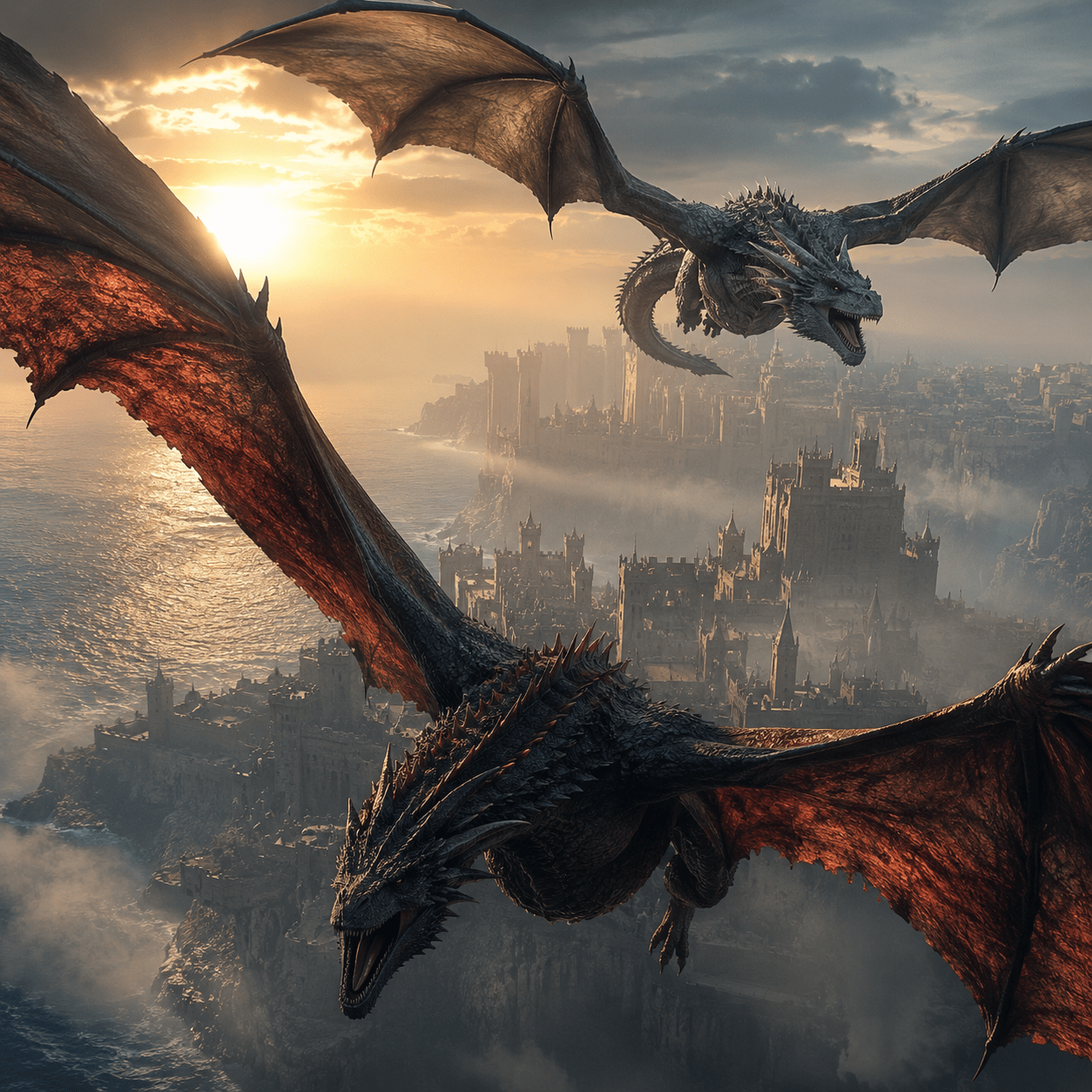
As House of the Dragon returns audiences to the Targaryen dynasty, dragons once again dominate television screens. In Game of Thrones, the moment Daenerys Targaryen emerges from the funeral pyre with three newly hatched dragons, these mythical beasts become symbols of power, survival, and political transformation. By the final seasons, Dragon has grown into an enormous flying predator capable of carrying his rider across continents and reducing castles to rubble with devastating bursts of fire.
For many viewers, these spectacular scenes remain firmly within the realm of fantasy. From Vhagar’s immense size to Caraxes’ distinctive serpentine body and Syrax’s agility, viewers are asking an old question with renewed curiosity: could creatures like these ever exist outside fantasy? If dragons differ so dramatically in size and shape, would they all be capable of flight?
Three studies provide particularly interesting perspectives. The first, by Stefanie Lethbridge, published in the journal helden. heroes. héros., examines dragons as literary figures rather than biological organisms. The second, led by Li Xujin from Sichuan University, develops mathematical models describing dragon growth, metabolism and ecology. The third, led by Zheng Cao from the University of Washington, constructs engineering and energetic models to determine whether the dragons could plausibly exist in the real world.
Reimagining dragons
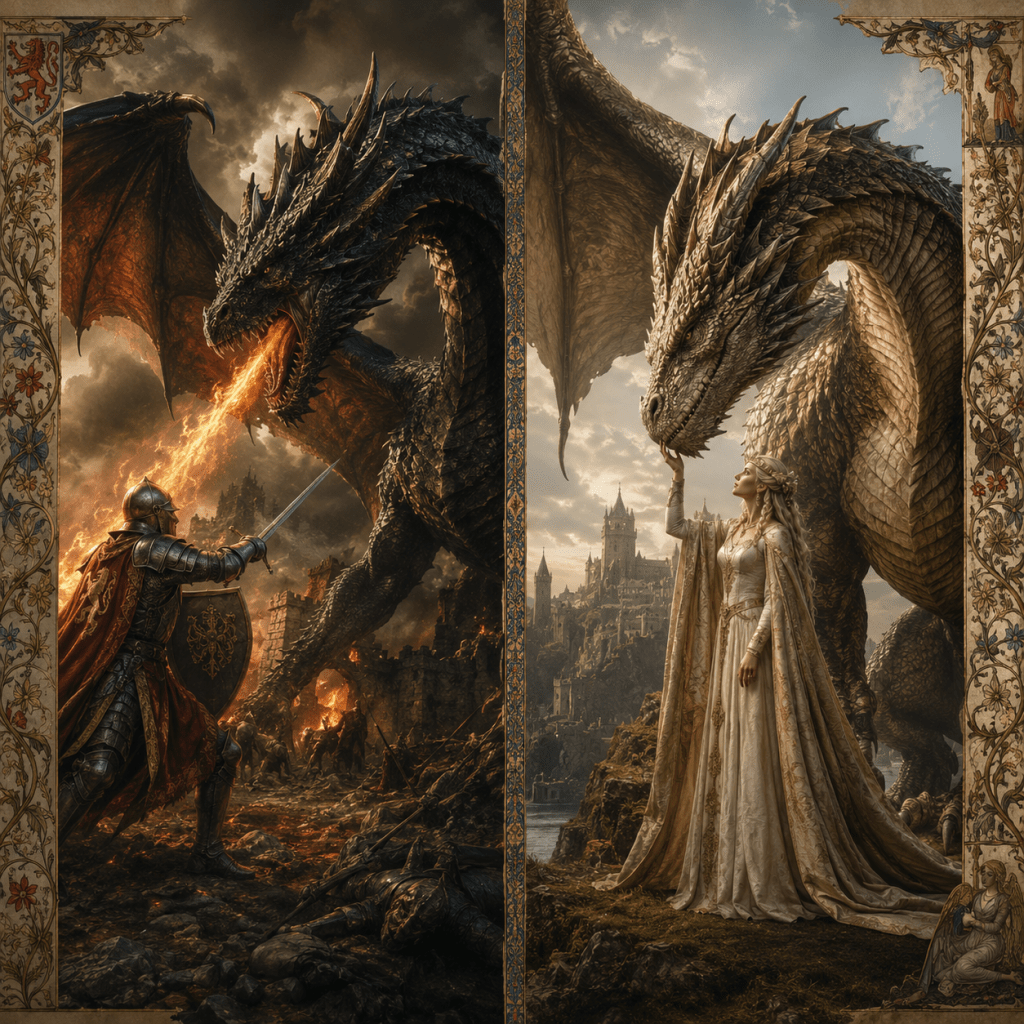
For centuries, dragons have typically been portrayed as villains. From medieval legends to Christian iconography, dragons often represented greed, destruction and evil. Heroes proved their worth by defeating these monstrous creatures.
Stefanie Lethbridge argues that Game of Thrones deliberately overturns this centuries-old tradition. Rather than portraying dragons as obstacles for heroic knights, the series transforms them into heroic agents themselves. Drogon repeatedly rescues Daenerys from overwhelming danger, while the other dragons similarly protect Jon Snow and his companions during critical moments. Instead of abducting princesses, these dragons become loyal protectors willing to risk their own lives for those they serve.
The study further suggests that the dragons possess agency without becoming human-like characters. They do not speak, nor do they simply function as obedient weapons. Instead, they exist within complex relationships with their human companions, particularly Daenerys, who refers to them as her children. Their actions blur the traditional distinction between human heroes and mythical beasts, challenging readers and viewers to reconsider established ideas about heroism itself.
Interestingly, Lethbridge is not concerned with whether dragons could physically fly. Their ability to fly and breathe fire is accepted as part of the fictional world. The research instead explores how these extraordinary abilities reshape traditional storytelling and symbolic meaning.
Mathematics and Westeros
While literary scholars focused on symbolism, another group of researchers approached dragons from an entirely different perspective.
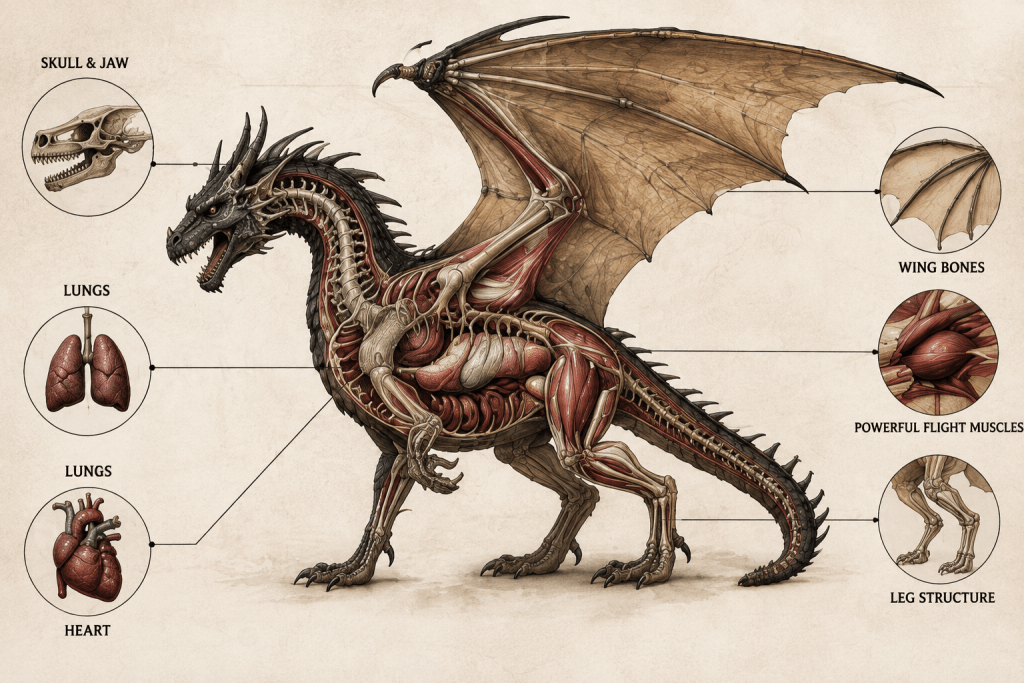
Li Xujin and colleagues from Sichuan University treated dragons as though they were real organisms whose biology could be analysed mathematically. Their work, titled A Dragon Analysis Model, asks questions similar to those investigated in living species. How quickly would dragons grow? How much would they weigh? How much food would they require? Could ecosystems realistically support them?
To answer these questions, the researchers borrowed models commonly used in biology. Since dragons obviously do not exist, dinosaurs and large birds served as biological analogues. Richards growth models, frequently applied to describe organismal growth, were combined with regression equations derived from dinosaur skeletal measurements to estimate dragon body size.
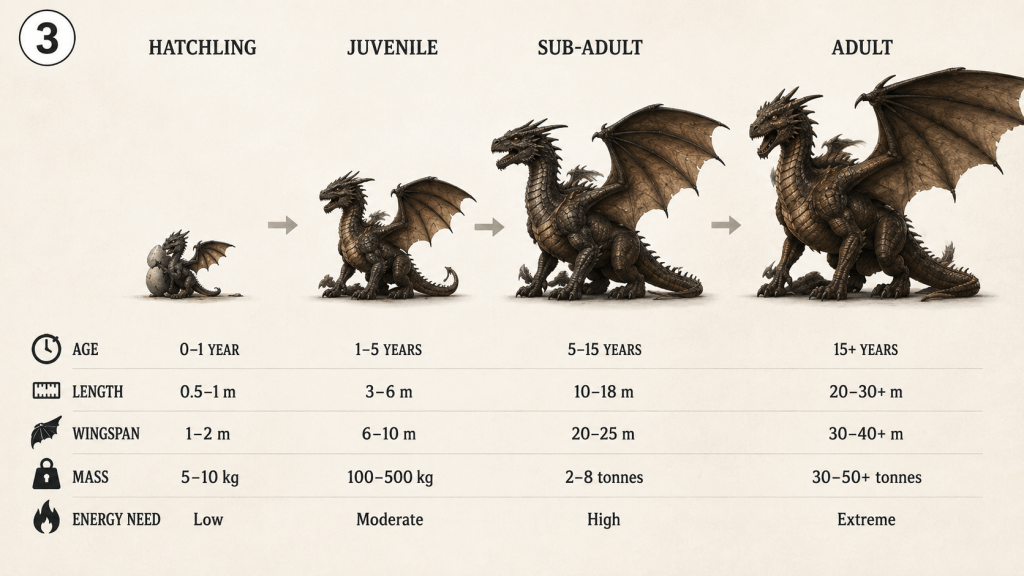
The resulting model predicts that an adult dragon could approach a body volume of approximately 45 cubic metres and a mass approaching 50 tonnes. Such values immediately illustrate the extraordinary biological challenge associated with sustaining such an organism.
The researchers then extended their work by constructing an energy budget model. Borrowing concepts from avian physiology, they estimated basal metabolic rate, active metabolic rate during flight and additional energetic demands associated with fire breathing. According to their calculations, an adult dragon would require an astonishing annual energy intake of approximately 2.48 × 10⁹ kilojoules.
The assumptions behind the numbers
Despite its mathematical sophistication, the Sichuan University study contains an important caveat.
The researchers openly acknowledge that their analysis begins with several simplifying assumptions. Among the most significant are the assumptions that dragons can already fly over long distances, breathe fire and resist severe physical injury. Rather than proving these abilities are biologically possible, the model explores their consequences if they already existed.
This distinction is crucial because mathematical models are designed to investigate hypothetical systems rather than establish biological reality. Scientists routinely use assumptions to simplify complex problems before examining their implications. Climate scientists model future warming scenarios using assumptions about greenhouse gas emissions. Epidemiologists model disease spread using assumptions about human behaviour. Dragon researchers adopt a similar strategy.
Consequently, the study demonstrates how mathematical modelling can explore fantasy within scientifically consistent frameworks, even when the underlying assumptions remain speculative.
Measuring Dragons
The third study, A Game of Simulation: Modeling and Analyzing the Dragons of Game of Thrones, takes perhaps the most ambitious approach.
Led by Zheng Cao and colleagues from the University of Washington, the researchers sought to determine whether the dragons portrayed in HBO’s television adaptation could plausibly exist under real-world physical constraints. Rather than inventing dragon dimensions, they extracted measurements directly from scenes featuring Daenerys and Drogon. Human heights served as reference scales, allowing the researchers to estimate body length, head dimensions and overall growth across multiple seasons.
These measurements were subsequently combined with three dimensional computer modelling software to estimate dragon volume and mass. The resulting data allowed the team to calculate energetic requirements using metabolic equations derived from living animals.
Unlike the previous study, the researchers explicitly state that one of their primary objectives is to examine whether dragons similar to those in Game of Thrones could realistically exist.
The greatest obstacle: Flight
Perhaps the most fascinating aspect of the University of Washington study concerns flight.
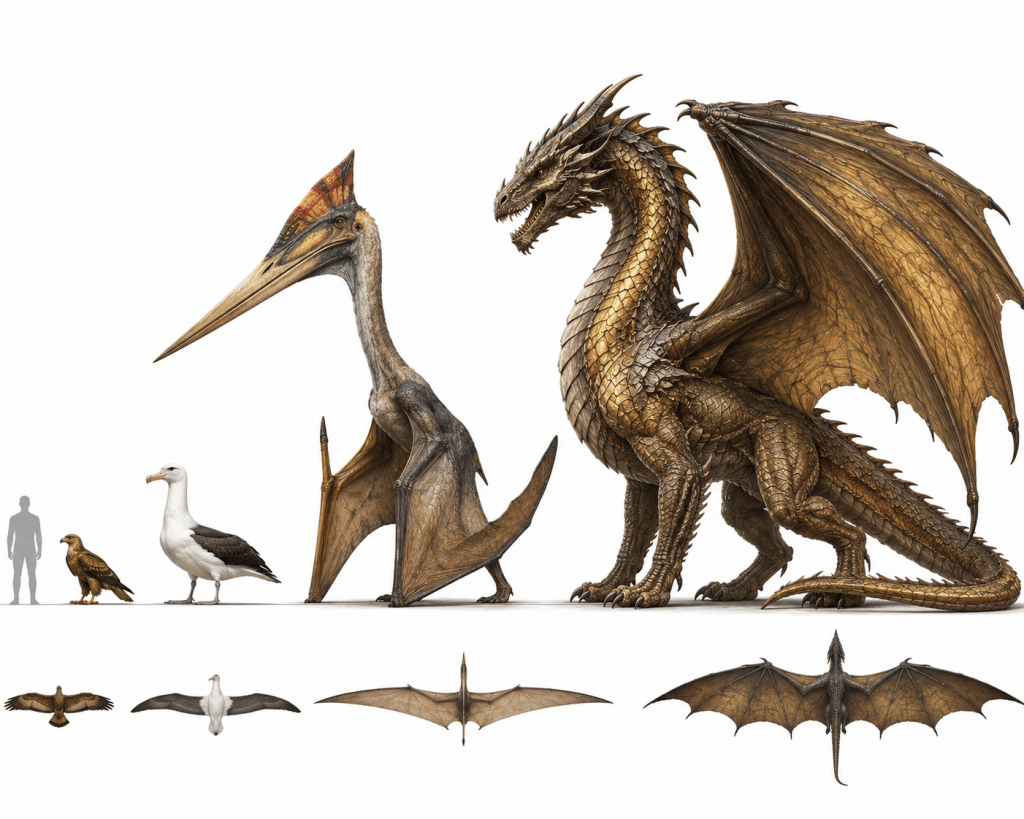
Every flying organism must satisfy a delicate balance between body mass, wing area and lift generation. Birds achieve this balance through lightweight skeletons, specialised respiratory systems and exceptionally powerful flight muscles.
Recognising this challenge, the researchers introduced several assumptions to improve the physical plausibility of dragons. They assumed dragon density would be less than or equal to that of water, making the body considerably lighter than would otherwise be expected. They also assumed that the wings contributed relatively little mass compared with the torso.
These assumptions illustrate an important scientific principle. As animals increase in size, body mass grows much faster than wing surface area. Consequently, simply scaling up an eagle or bat does not automatically produce a gigantic flying dragon. Instead, biological and aerodynamic constraints become increasingly severe.
Rather than eliminating these challenges, the model demonstrates precisely why enormous flying vertebrates are so difficult to accommodate within known biomechanics.
Fire breathing
Flight is only one remarkable feature of dragons. Fire-breathing presents an equally fascinating biological puzzle.
Li Xujin and colleagues approached this problem by proposing that dragons might generate combustible methane within specialised organs. According to their model, methane stored within the chest could be expelled and ignited following rapid increases in body temperature generated through elevated metabolism. Although entirely hypothetical, this mechanism attempts to remain consistent with basic principles of chemistry and energy metabolism.
The researchers also estimated the energetic cost associated with repeated fire breathing, incorporating these calculations into the overall metabolic budget.
Importantly, this proposal does not establish that methane producing dragons could evolve naturally. Instead, it demonstrates how biological reasoning can be applied creatively to fictional organisms while remaining grounded in established scientific concepts.
Ecology of an apex predator
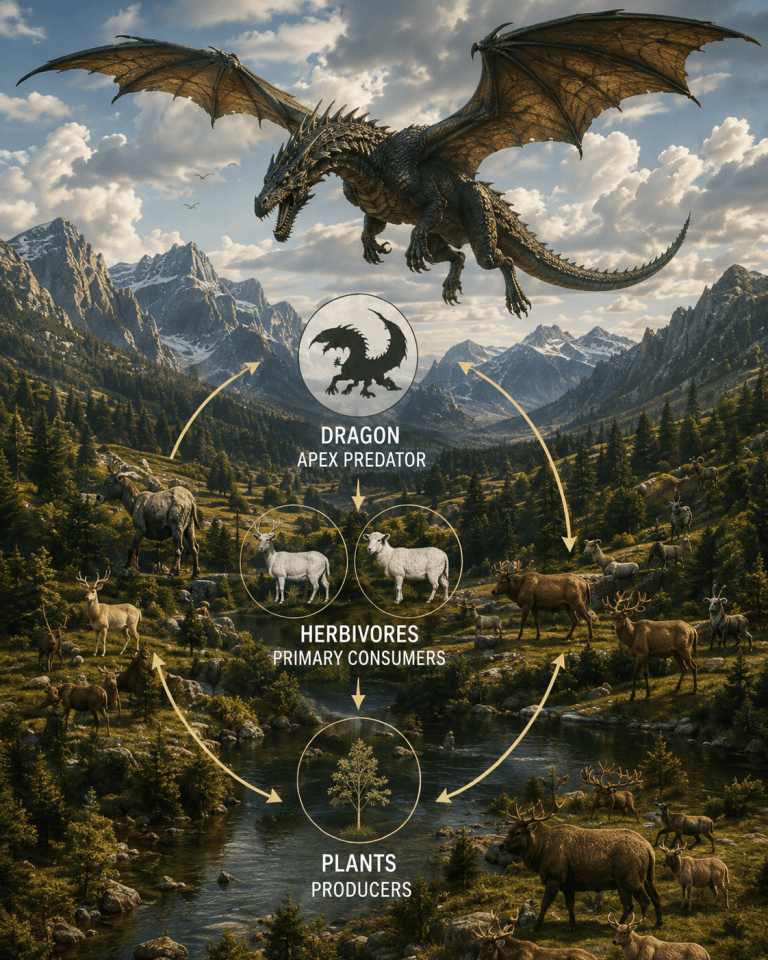
Another aspect shared by the modelling studies concerns ecology. Large predators require extensive territories and abundant food supplies. Lions, tigers and wolves all depend upon complex ecosystems capable of supporting large populations of prey.
Applying similar ecological reasoning, Li Xujin and colleagues estimated that three adult dragons would require approximately 157 square kilometres of suitable habitat together with prey populations capable of supplying roughly 1.5 × 10¹¹ kilojoules of stored energy.
These calculations highlight that the biological challenges associated with dragons extend well beyond flight. Even if dragons could remain airborne, ecosystems would need to sustain extraordinary energetic demands. Such analyses mirror conservation biology, where researchers estimate habitat requirements for endangered species and apex predators.
Final thoughts
Throughout history, scientists have used thought experiments to investigate impossible situations. Albert Einstein imagined travelling alongside beams of light before developing the theory of relativity. Evolutionary biologists reconstruct extinct dinosaurs using mathematical models despite never observing them alive. Astronomers routinely simulate planetary systems that cannot yet be directly observed.
The dragons of Game of Thrones and House of the Dragon will almost certainly remain fictional creatures. Current understanding of biomechanics, aerodynamics, and animal physiology suggests that sustaining a fifty-tonne flying, fire-breathing reptile would present formidable challenges. Interestingly, the scientific papers reviewed here do not attempt to ignore these obstacles. Instead, they illuminate them through mathematics, engineering and biology.
References
Lethbridge, S. (2018). Entangled Agency: Heroic Dragons and Direwolves in Game of Thrones. helden. heroes. héros. https://doi.org/10.6094/helden.heroes.heros./2018/A/02
Li, X., Zheng, Z., & Yu, G. (2020). A Dragon Analysis Model. 2020 International Signal Processing, Communications and Engineering Management Conference (ISPCEM). https://doi.org/10.1109/ISPCEM52197.2020.00051
Cao, Z., Bottrell, B., Gao, J., Pock, M., & Vinsensius. (2022). A Game of Simulation: Modeling and Analyzing the Dragons of Game of Thrones. arXiv Preprint.
https://doi.org/10.48550/arXiv.2209.11397