In a world increasingly shaped by artificial intelligence, few technologies capture the public imagination quite like self-driving cars. The idea of stepping into a taxi with no human driver is no longer science fiction. Yet, as new research suggests, the real story is not about the disappearance of drivers. It is about the transformation of work itself.
A recent study led by Leah Kaplan from the Department of Engineering Management and Systems Engineering at George Washington University explores this shift in remarkable depth. Published in the journal Systems Engineering, the article titled “A Systems Perspective on AI Driven Labor Transitions: Insights From the Rise of Robotaxis” examines how artificial intelligence is reshaping labor systems through the example of robotaxi services.
Rather than asking whether AI will replace jobs, the research reframes the question entirely. It asks how work is reorganized when intelligent systems are introduced into complex, real-world environments.
A systems-level perspective
Much of the public debate around AI and jobs tends to focus on simple narratives of replacement. Either machines take over human roles, or they assist workers in performing them. However, this study challenges that binary thinking by adopting a systems-level perspective.
In practical terms, this means examining not just individual tasks or roles, but the entire network of activities, responsibilities, and interactions that make up a working system. In the case of taxi services, this includes drivers, dispatchers, maintenance staff, customer service, and operational management.
The findings show that when AI is introduced, particularly in the form of autonomous vehicles, its impact extends far beyond driving. Instead, there is a ripple effect across the entire system, leading to a reorganization of tasks, roles, and workflows. This phenomenon is described as the “rebundling” of labor.
This insight is particularly important for discussions about the future of work, automation, and workforce transformation, as it highlights the limitations of analyzing AI impact at a single level.
The hidden workforce behind driverless cars
To understand this transformation, the researchers conducted an extensive comparative analysis of traditional taxi systems and emerging robotaxi operations in the United States. Their methodology combined government occupational data, field observations, interviews with industry professionals, and archival research.
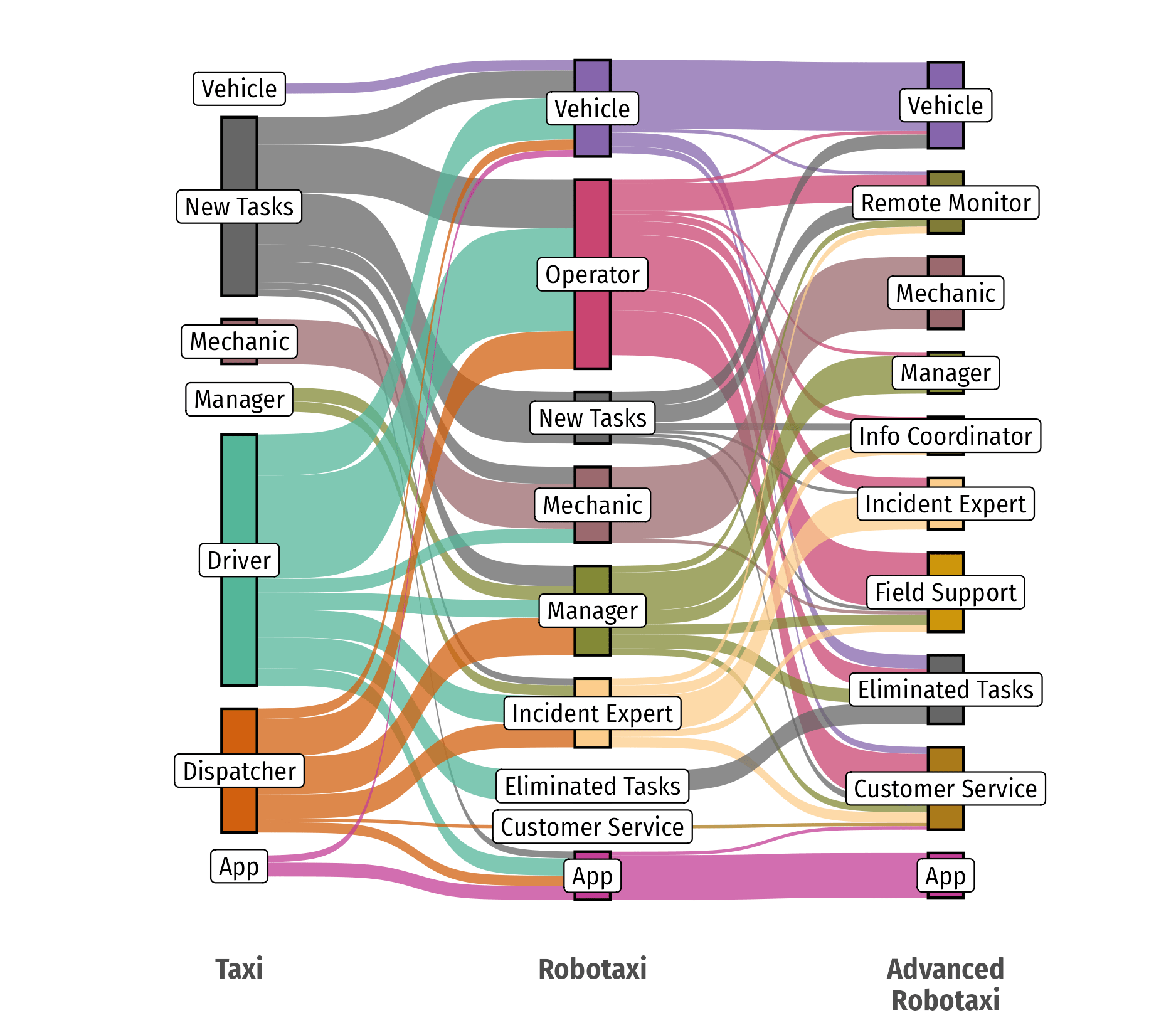
One of the most striking findings is the emergence of a hidden workforce that supports autonomous vehicle operations. While the driver may be absent from the vehicle, a network of human roles continues to operate behind the scenes.
These roles include remote monitors who oversee vehicle performance, customer service agents who interact with passengers, and field support staff who respond to incidents on the ground. In addition, specialized roles such as information coordinators and incident experts play a crucial part in ensuring safety, regulatory compliance, and operational efficiency.
This layered structure reveals that AI does not eliminate human labor. Instead, it redistributes it across new domains, often increasing the complexity of coordination and communication within the system.
Three patterns reshaping the future of work
At the core of the study is the identification of three archetypal patterns that describe how work evolves in response to AI-driven technologies. These patterns provide a structured framework for understanding labor transitions and are central to the study’s contribution to systems engineering and labor economics.
The first pattern, distributing, occurs when a role is effectively removed, and its tasks are allocated across multiple other roles. For taxi drivers, responsibilities such as navigation, customer interaction, and vehicle maintenance do not disappear. Instead, they are divided among different workers and technological systems.
The second pattern, consolidating, involves creating new roles that combine tasks from multiple existing roles, along with newly generated responsibilities. For example, remote monitoring positions integrate elements of operational oversight, safety verification, and system interaction, forming entirely new occupational categories.
The third pattern, scaffolding, is perhaps the most intriguing. It refers to temporary or transitional roles that emerge during the implementation phase of a technology. These roles support the system as it evolves and may eventually be replaced as the technology matures. An example is the onboard safety operator in early robotaxi deployments, who acts as a bridge between human control and full autonomy.
Why driving is only part of the story
One key insight from the research is that driving itself accounts for only a portion of what taxi drivers actually do. Beyond operating the vehicle, drivers handle customer interactions, manage payments, ensure safety, and respond to unexpected situations.
When autonomous vehicles take over the driving function, these additional tasks must still be performed. As a result, they are reassigned within the system, often requiring new forms of collaboration between humans and machines.
This challenges the assumption that automating a core task leads directly to job elimination. Instead, it highlights the importance of understanding the full scope of work associated with any occupation. In many cases, the non-automated tasks become the defining factor in determining how roles evolve.
Such insights are particularly relevant for sectors beyond transportation, including healthcare, retail, and professional services, where complex task structures are common.
Implications for the AI labor market debate
The study contributes to ongoing debates about the impact of artificial intelligence on employment by offering a more nuanced analytical framework. Traditional approaches often focus on estimating the percentage of jobs that are at risk of automation. However, these estimates may overlook the intricate ways in which work systems adapt.
By tracing the movement of tasks between roles, the research reveals that AI can both create and transform jobs, even as it automates specific functions. It also shows that some roles indirectly connected to automated tasks may be affected, expanding the scope of impact beyond initial predictions.
This has significant implications for policymakers, educators, and industry leaders who are seeking to prepare for the future of work. It suggests that strategies should focus not only on job displacement but also on skill adaptation, role redesign, and system-level planning.
A shift in how we understand automation
The broader message of the research is that automation should not be viewed as a simple substitution of human labor with machines. Instead, it represents a shift in how work is organized, distributed, and valued within a system.
This perspective aligns with emerging trends in AI research and systems engineering, which emphasize the co-evolution of technology and human activity. As AI systems become more integrated into everyday operations, their impact will depend not only on their capabilities but also on how they are embedded within organizational structures.
In the case of robotaxis, the transition from human-driven vehicles to autonomous fleets involves a reconfiguration of roles, responsibilities, and interactions. This process is shaped by technical constraints, regulatory requirements, and organizational decisions, making it highly context dependent.
As such, there is no single pathway for how AI will transform work. Different industries and organizations may adopt different approaches, leading to diverse outcomes.
Our research found that AI does not simply eliminate work, but rather transforms it. Systems thinking is critical for understanding and capturing how these changes are unfolding.
—John Paul Helveston
Redesigning work in the age of AI
The introduction of artificial intelligence into complex work systems does not simply eliminate jobs. It reshapes them in ways that are often unexpected and far-reaching.
By examining the case of robotaxis, this research offers valuable insights into how tasks and roles are reorganized through processes of distribution, consolidation, and scaffolding. It challenges simplistic narratives about automation and provides a more comprehensive framework for understanding labor transitions.
As debates about AI and employment continue, studies such as this highlight the importance of looking beyond individual tasks and considering the broader systems in which they are embedded.
The future of work, it seems, is not about humans versus machines. It is about how humans and machines work together within evolving systems that redefine what work means.
Reference
Kaplan, L., Szajnfarber, Z., & Helveston, J. P. (2026). A systems perspective on AI driven labor transitions: Insights from the rise of robotaxis. Systems Engineering. https://doi.org/10.1002/sys.70043
Coauthors
 |
Zoe Szajnfarber is a Professor of the Engineering Management and Systems Engineering Department at the George Washington University. She studies the design and development of complex systems in their socio-technical context. Recent work has focused on strategies for leveraging non-traditional design inputs, from open innovation to AI-enabled workflows. Her work considers both the organization and technical system architectures to “design-in” an ability to achieve performance goals across extended and highly uncertain operational lifetimes. |
 |
John Paul Helveston is an Associate Professor of the Engineering Management and Systems Engineering Department at the George Washington University. He is interested in understanding the factors that shape technological change, with a particular focus on transitioning to more sustainable and energy-saving technologies. He studies consumer preferences and market demand for new technologies as well as relationships between innovation, industry structure, and technology policy. He has explored these themes in the context of China’s rapidly developing electric vehicle industry. He applies an interdisciplinary approach to research, with expertise in discrete choice modeling and conjoint analysis as well as interview-based case studies. |