A major new study led by Nivin Abdelmeguid from Cairo University provides one of the most detailed forecasts to date of how Egypt’s energy system could evolve over the next quarter-century. Published in the Review of Economics and Political Science, the article titled “Decarbonising Egypt’s energy sector: pathways for an accelerated energy transition” offers a framework for understanding how different energy mix choices will reshape the country’s emissions, costs, and long-term energy security.
The research applies an integrated energy modelling approach using the Long Range Energy Alternatives Planning system. It assesses how various technological pathways could impact Egypt’s trajectory to 2050. The study focuses on four scenarios, each reflecting varying levels of renewable integration, nuclear deployment and future demand growth.
At a time when Egypt faces rising temperatures, higher energy demand and growing economic pressures, the findings offer a timely roadmap. They also contribute to global evidence on energy system modelling, showcasing how upper-middle-income countries can use scenario analysis to align economic growth with environmental sustainability.
Egypt’s energy dilemma in a warming climate
Egypt has long been vulnerable to the impacts of climate change. Rising temperatures, shifting rainfall patterns, and more frequent extreme weather events have intensified pressure on infrastructure, industry, and households. With the country’s economic ambitions closely tied to energy availability, understanding future demand is crucial.
More than 75 percent of global greenhouse gas emissions originate from the energy sector. In Egypt, the proportion is even more significant. Fossil fuels, particularly natural gas and oil, continue to dominate the electricity generation sector. Although renewable energy has expanded over the past decade, it remains a modest share of the overall mix.
The study highlights how Egypt’s commitments under the Paris Agreement and its Nationally Determined Contributions require an ambitious reconfiguration of its future energy landscape. The nation has pledged to reduce emissions in the electricity sector by 37 percent by 2030. Achieving this target will require strategic planning that considers both demand growth and the evolving cost structure of different technologies.
How the research was conducted
The research team, based at Cairo University, used a long-term scenario modelling approach to examine Egypt’s energy demand and supply between 2010 and 2050. The LEAP model was selected due to its ability to integrate top-down and bottom-up perspectives. It can represent both technological detail and macroeconomic effects, which is critical for reliable policy analysis.
The model begins with baseline data from Egypt’s residential, industrial, commercial, agricultural and public sectors. This data informs future demand projections. The authors then evaluate how various power generation technologies perform under shifting policy constraints. These include renewable energy targets, nuclear integration and emissions limits.
This methodology allows the researchers to calculate not only energy output but also greenhouse gas emissions, energy production costs, and the impact of different technologies on long-term system performance. The study also incorporates Egypt-specific data on natural gas production, renewable resource availability, and economic indicators.
-Nivin Abdelmeguid
The four possible futures: From fossil-heavy to renewable-led
The baseline scenario, known as RS1, extends historical patterns until 2050. It mirrors Egypt’s existing dependence on natural gas and oil. In this future, natural gas continues to dominate electricity generation. Greenhouse gas emissions continue to climb, reaching almost 494 million tonnes of carbon dioxide equivalent by 2050.
A second scenario, RS2, introduces nuclear energy into the mix, assuming energy demand grows by 5 percent per year. This reflects the highest annual growth recorded during the early 2000s. Nuclear power accounts for three percent of generation by 2035 but the rise in overall demand still drives an increase in fossil fuel use. In this scenario, emissions remain high and production costs rise due to nuclear investment.
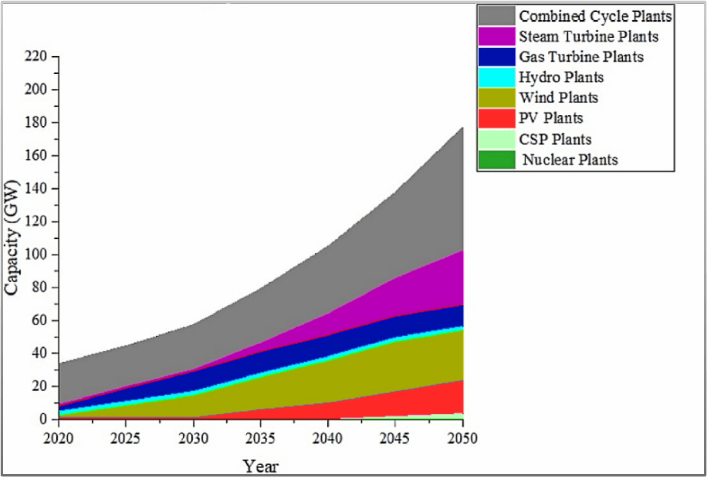
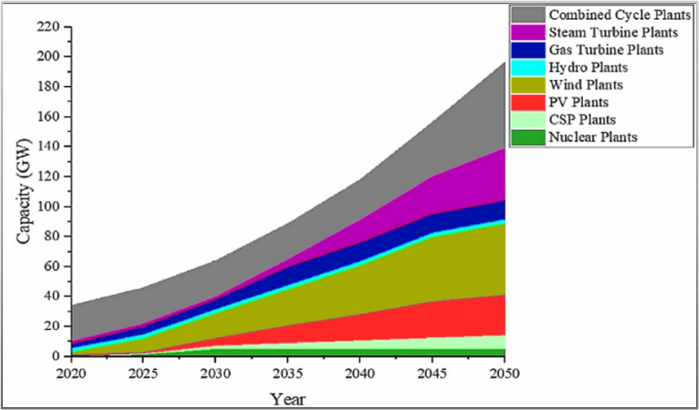
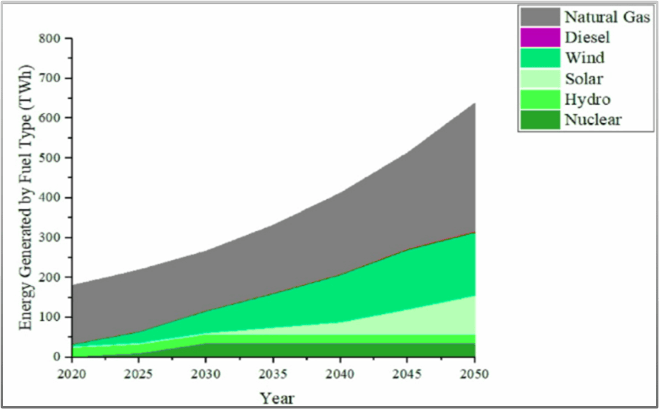
The third scenario, RE1, imposes a renewable energy target of 42 percent by 2030 and an emissions constraint aligned with Egypt’s climate commitments. Renewable deployment increases rapidly, and fossil fuel reliance declines more sharply. Although emissions are falling, demand growth limits the amount of reduction that can be achieved by 2030. Long-term outcomes are expected to improve significantly through 2050, thanks to the deeper penetration of wind and solar energy.
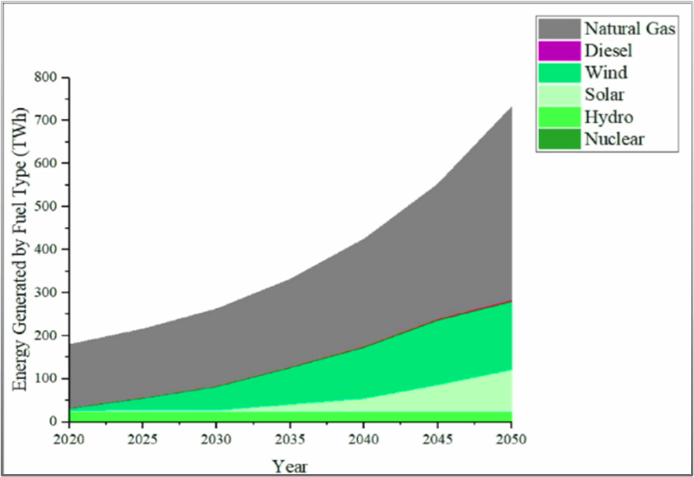
The fourth scenario, RE2, is the most ambitious of all. It raises renewable energy capacity targets to 75 percent by 2050 and incorporates nuclear energy, albeit without strict emissions limits. This pathway produces the lowest emissions of all four options. By 2050, wind energy is expected to become the leading source of electricity, and solar generation is projected to grow substantially. Natural gas contributions drop to about a quarter of total generation.
These scenarios allow direct comparison of costs, emissions, and energy security. This is crucial for policymakers facing decisions that will shape infrastructure investment for decades.
What the model reveals about costs and emissions
The modelling shows notable differences in greenhouse gas emissions between the scenarios. RS1 generates the highest emissions due to its continued reliance on fossil fuels. RS2 reduces emissions modestly through nuclear deployment but remains constrained by rising demand. RE1 shows more meaningful reductions through renewable integration and emissions controls.
The largest decline occurs in RE2. Under this scenario, emissions are projected to decline to approximately 53 million tonnes of carbon dioxide equivalent by 2050. This is a dramatic contrast to the fossil-heavy baseline and aligns with global objectives for limiting warming.
Cost patterns evolve differently. In the short term, renewable heavy scenarios are more expensive due to installation and integration costs. RS2 has the highest costs in the medium term due to reliance on nuclear technology. Over time, however, renewable scenarios become the most economical. By 2050, RE2 is expected to have the lowest production cost at $0.05 per kilowatt-hour. This places it below all other scenarios and illustrates the long-term affordability of renewables once the initial investments are recouped.
What this means for Egypt’s strategic direction
The research outlines a clear opportunity for Egypt to reorient its energy future. If the country expands its renewable energy and reduces its dependence on fossil fuels, it can substantially cut emissions while lowering long-term costs. A diversified mix also enhances energy security by reducing exposure to volatile gas prices.
The authors stress the importance of phasing out gas subsidies, improving energy storage, and expanding grid capacity. Investment in transmission infrastructure will be essential if wind and solar are to operate at large scale. They also emphasise the importance of maintaining low interest rates and providing favourable financing conditions for renewable projects.
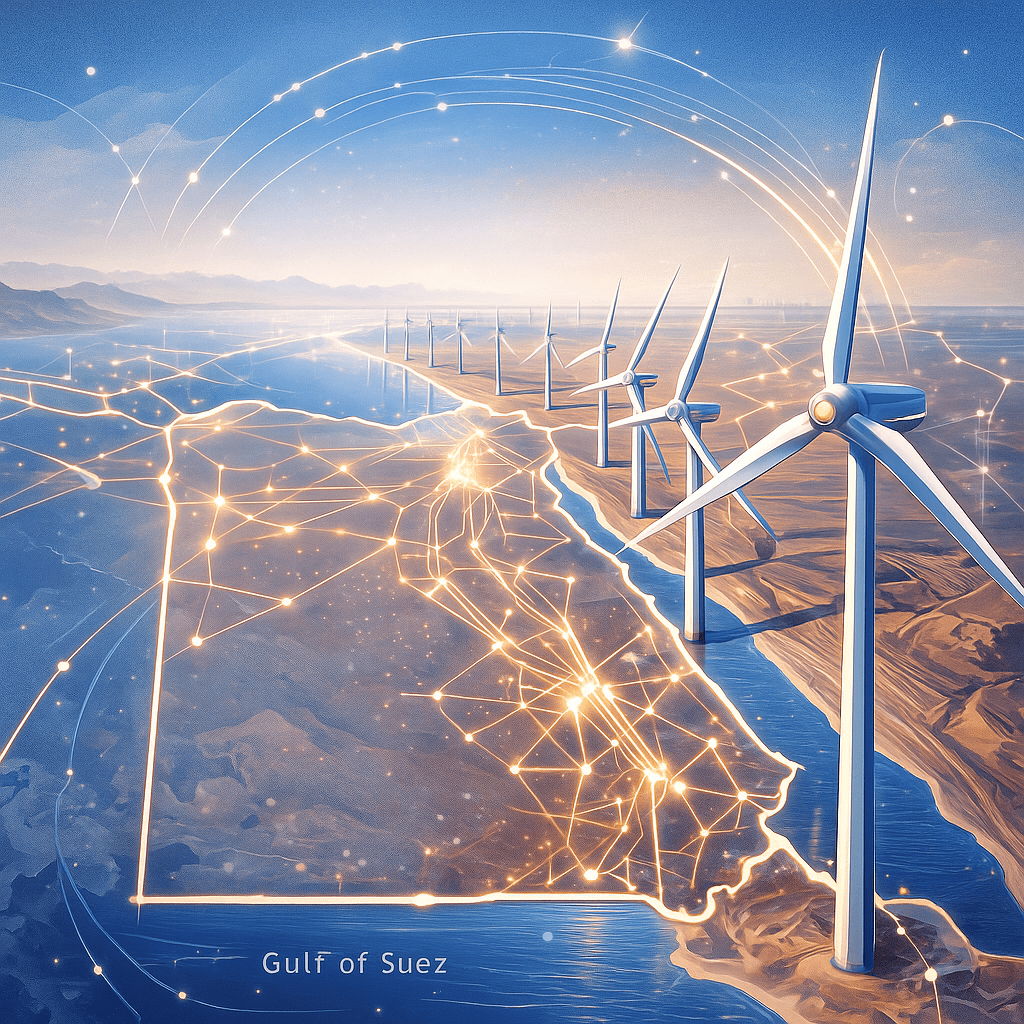
The study underscores how Egypt’s geographic characteristics give it a strategic advantage. High solar irradiation and strong wind corridors along the Gulf of Suez make renewables not only climate friendly but economically attractive. With long term planning, Egypt could become a regional leader in clean energy and benefit from new investment flows.
Reference
Abdelmeguid, N., & Ibrahiem, D. M. (2025). Decarbonising Egypt’s energy sector: pathways for an accelerated energy transition. Review of Economics and Political Science, 10(4), 303 to 322. https://doi.org/10.1108/REPS-03-2024-0001