
A new theoretical physics paper proposes a conditional mathematical route to one of the most familiar numbers in fundamental physics: the fine-structure constant. The study links topology, symmetry, phase, spin and finite-state counting to a calculated value for the low-energy electromagnetic coupling. Its centerpiece is an exact convergent alpha tower whose value is 137.0359991761419945…, remarkably close to the 2022 CODATA recommendation. The author presents the framework as conditional and testable rather than as a complete derivation of the laws of nature.
Published in Symmetry, the article is titled A Conditional Structural Derivation of the Fine Structure Constant from Neutral Codimension Two Holonomy Capacity and is authored by Bin Li of the Research Department, Silicon Minds Inc., Clarksville, Maryland, USA.
The alpha tower
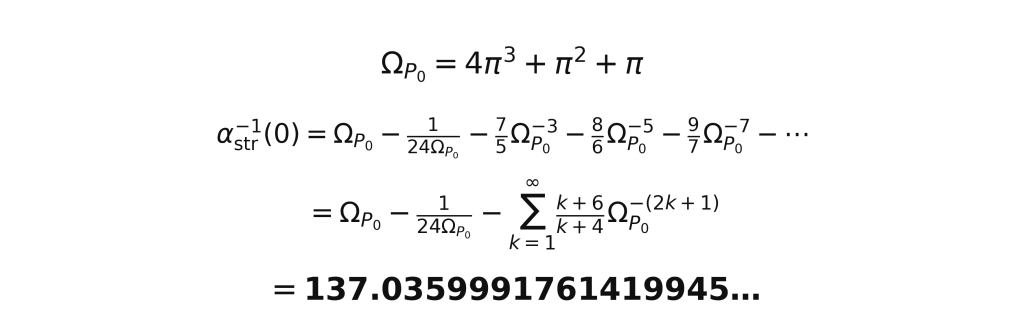
The proposal can be seen at a glance in the tower below. It starts from a leading capacity built from π, subtracts a first correction selected from 24 symmetry-equivalent states, and then adds an infinite hierarchy of ever smaller odd-power corrections.
Quantum electrodynamics tells us with extraordinary precision how electromagnetism behaves once the fine-structure constant is supplied. My question is one step earlier: could the value itself be the readable trace of a deeper structural requirement? The derivation is conditional, but every assumption is exposed, so the proposal can be tested and challenged.
—Bin Li
The number behind electromagnetic interactions
The fine structure constant, written as α, is a dimensionless coupling that characterises the strength of electromagnetic interactions. Its low energy value is extraordinarily well measured, with the inverse of the constant lying close to 137.036. This apparently simple number appears in quantum electrodynamics, the theory that describes the interaction of charged particles and electromagnetic fields.
What makes the fine-structure constant especially interesting is not merely its precision, but its status within the Standard Model. The theory successfully describes electromagnetic phenomena once the relevant parameters are supplied, yet the numerical value of the low-energy fine-structure constant is treated as an empirical input rather than calculated from deeper first principles. Li’s paper begins from this long-standing question and asks whether the value could instead emerge from a deeper structural description.
From topology to a persistent loop
One of the central concepts in the paper is holonomy. In physics and geometry, holonomy describes information that can be acquired when a quantity is transported around a closed path. The Aharonov Bohm effect provides a well-known physical example in which phase information can remain relevant even when the local electromagnetic field strength along the path is zero.
Li’s framework uses a related idea in a more abstract setting. The proposed neutral parent structure is associated with a local defect whose identity can be detected from the topology of its complement. A small loop surrounding the defect can carry a phase, providing what the paper calls a return readable identity. This is connected to the mathematical concept of codimension two.
The importance of codimension two comes from the topology of the space around a defect. For two transverse dimensions, removing the central point leaves a punctured plane whose loops can wind around the missing point. Such winding is described by the fundamental group of the circle, π1(S1), which is isomorphic to the integers, Z. The paper argues that this gives the minimal local structure capable of supporting persistent winding under its Indefinite Reconstruction Stability Principle, or IRSP.
Where phase and spin enter the picture
The next stage of the construction brings together two mathematical structures. The phase channel is represented by U(1), the unit complex numbers, while the spin frame is represented by SU(2), the unit quaternions. These are familiar mathematical groups in physics, although the paper stresses that its SU(2) construction is not the electroweak SU(2)L gauge group.
The framework considers three nonempty exposure possibilities for the two channels: phase only, spin only, and joint phase and spin exposure. The marginal cases involve a Z2 identification, while the joint case retains the relative phase spin information. The corresponding capacities are then combined to produce a leading structural quantity.
That leading quantity is expressed as ΩP₀ = 4π³ + π² + π. The paper treats this not as a probability or the volume of a hidden particle, but as a capacity associated with the carrier-readable structure. The normalisation is linked to the native multiplicative norms of complex numbers and quaternions.
Why 24 states matter
The calculation becomes more unusual when the proposed structure reaches its first finite interface. Four distinct readout roles are declared, alongside one protected identity. Under the paper’s first-interface saturation rule, these four roles require four nonidentity classes in addition to the protected zero class, leading to a cyclic order of n = 5.
The outgoing and returning winding coordinates then produce a state space with 25 elements. Removing the protected zero state leaves 24 nonzero state pairs. Within the declared symmetry structure, these 24 states form a single orbit. Selecting one completely aligned state therefore gives a weight of 1/24.
This number is important because it produces the first correction to the leading capacity. The paper emphasises that the 1/24 factor is not inserted to make the numerical answer agree with experiment. It follows within the declared first interface assumptions. At the same time, the paper openly identifies the role selection and one state alignment as structural assumptions that could be challenged.
Successive interfaces refine the calculation
The framework then continues through successive finite resolutions. Rather than treating the Chinese remainder theorem as the physical rule that determines the later coefficients, the paper uses it only to establish a common mathematical refinement between adjacent cyclic resolutions. The actual transfer of capacity is governed by a separately declared complete source and exposed target rule.
This produces the coefficient sequence (n + 2)/n for the later interfaces. Beginning at n = 5, the coefficients are 7/5, 8/6, 9/7 and so on. Together with the paired-interface grading rule and orientation reversal, the corrections appear at inverse third, fifth, seventh and higher odd powers of ΩP₀.
The resulting series is convergent. The paper also derives exact analytic expressions for the infinite sum, including a logarithmic representation. This means the numerical result is not simply the output of a finite approximation. The full tower can be evaluated to a stable value using the mathematical rules specified in the paper.
A number remarkably close to experiment
The exact structural calculation gives an inverse fine-structure constant of 137.0359991761419945…. The paper then introduces a separate physical correspondence postulate that identifies this structural response with the renormalised electromagnetic coupling in the zero-momentum, or Thomson, limit.
The resulting value is extremely close to the 2022 CODATA recommended value of 137.035999177(21). The paper reports that the structural value differs from the CODATA adjustment by about 0.041 standard deviations. The numerical agreement is therefore striking, particularly because the displayed structural coefficients are fixed once the stated assumptions have been adopted.
However, the comparison requires care. The paper notes that the principal precision determinations of the fine structure constant are not mutually identical. It compares the structural value with cesium recoil, rubidium recoil, an electron magnetic moment determination combined with QED, and the CODATA adjustment. The author explicitly states that these should not be treated as four independent confirmations.
Why the result is scientifically interesting
The broader significance of the study lies in the question it raises rather than simply in the numerical proximity to 137.036. Fundamental physics contains several dimensionless parameters whose measured values are inserted into effective theories. Understanding whether such values are arbitrary inputs or consequences of deeper mathematical principles remains an important theoretical question.
Li’s proposal takes one such parameter and constructs a detailed route from topology and symmetry to a numerical boundary condition. Its unusual feature is the explicit separation between standard mathematical results, structural axioms, derived consequences and physical correspondence. This makes the proposal comparatively straightforward to analyse because changing one of its assumptions changes a defined part of the calculation.
The study also illustrates how mathematical physics can operate at the boundary between established theory and speculative structure. The topology of codimension two, the properties of U(1) and SU(2), finite group actions, counting measures and convergent series are established mathematical tools. The proposed physical dictionary connecting these ingredients to the electromagnetic coupling is the more ambitious part of the framework.
Reference
Li, B. (2026). A conditional structural derivation of the fine structure constant from neutral codimension two holonomy capacity. Symmetry, 18, 1418. https://doi.org/10.3390/sym18091418