October 26, 2026
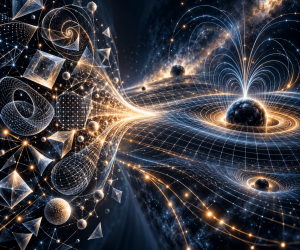
Why three dimensions of space and one of time? A reconstruction framework explores how spacetime, electromagnetism, gravity and fundamental symmetries could emerge from deeper structural requirements.

Why three dimensions of space and one of time? A reconstruction framework explores how spacetime, electromagnetism, gravity and fundamental symmetries could emerge from deeper structural requirements.
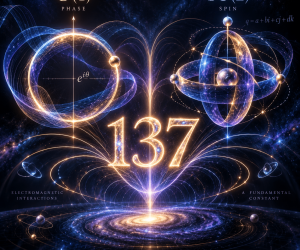
Can a convergent mathematical tower built from π help explain why the fine-structure constant is so close to 137? A new conditional model connects topology, holonomy and finite-state counting to one of physics' most famous numbers.
Why is the electron so much lighter than the muon? And why is the tau, in turn, dramatically heavier than both?

What if geometry should never be quantised? Discover a provocative new framework that challenges decades of quantum gravity research.