
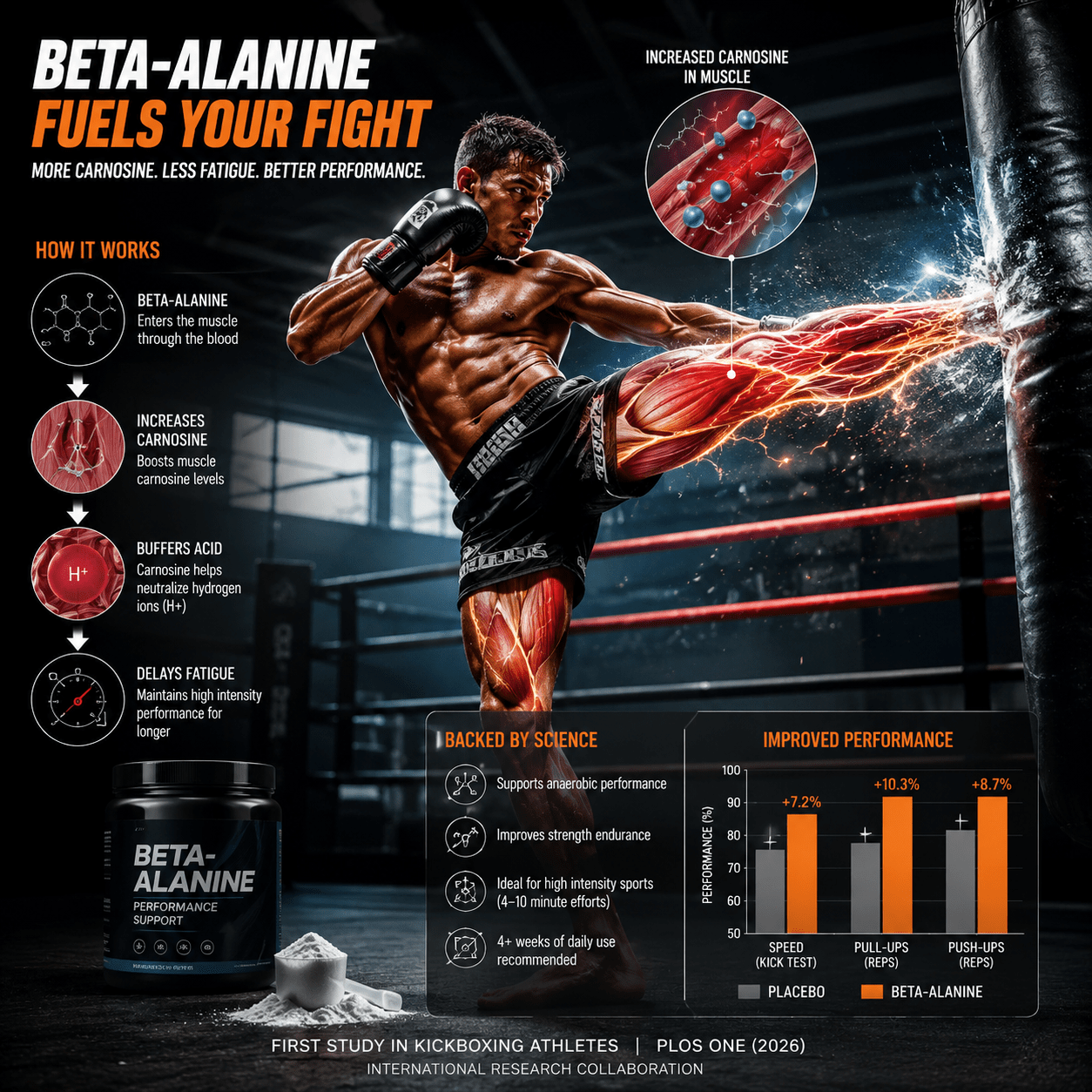
A study conducted by Furkan Hasan Küçük (Erzurum City Hospital), Cebrail Gençoğlu, Salih Çabuk, Muhammet Raşit İnaç, Süleyman Ulupınar, and Serhat Özbay (Erzurum Technical University), Osman Ateş (İstanbul University-Cerrahpaşa), in collaboration with Brazilian researcher Jonatas Deivyson Reis da Silva Duarte (Federal University of Mato Grosso) and Croatian researcher Dino Belošević (University of Split), was the first in the world to investigate the effects of beta-alanine supplementation on performance in kickboxing. Although the article was developed by an international research team, the study itself was conducted in Turkey. The findings were published in 2026 in the renowned scientific journal PLOS ONE.
Evidence generated by Sport Sciences, the field responsible for investigating and developing strategies to optimize athletic performance, has continuously evolved and contributed to making sports increasingly competitive. In this context, sports with higher levels of development and investment (such as soccer and basketball) tend to have more consolidated scientific structures, facilitating advances in training methods, recovery strategies, and overall athletic performance.
What is beta-alanine?
Beta-alanine is a substance naturally used by the body and belongs to the group of amino acids, which function as small “building blocks” important for various body functions. Although it is present in the diet, it is not found in large amounts in its free form. Its main dietary sources are animal-based foods, such as tuna, beef, salmon, and pork.
Scientific interest in beta-alanine increased, especially from 2006 onwards, when studies began to emerge investigating its potential effects on physical exercise and sports. Since then, it has received greater attention in sports science and has been increasingly studied, although there is still a smaller body of research compared with more traditional supplements, such as creatine.
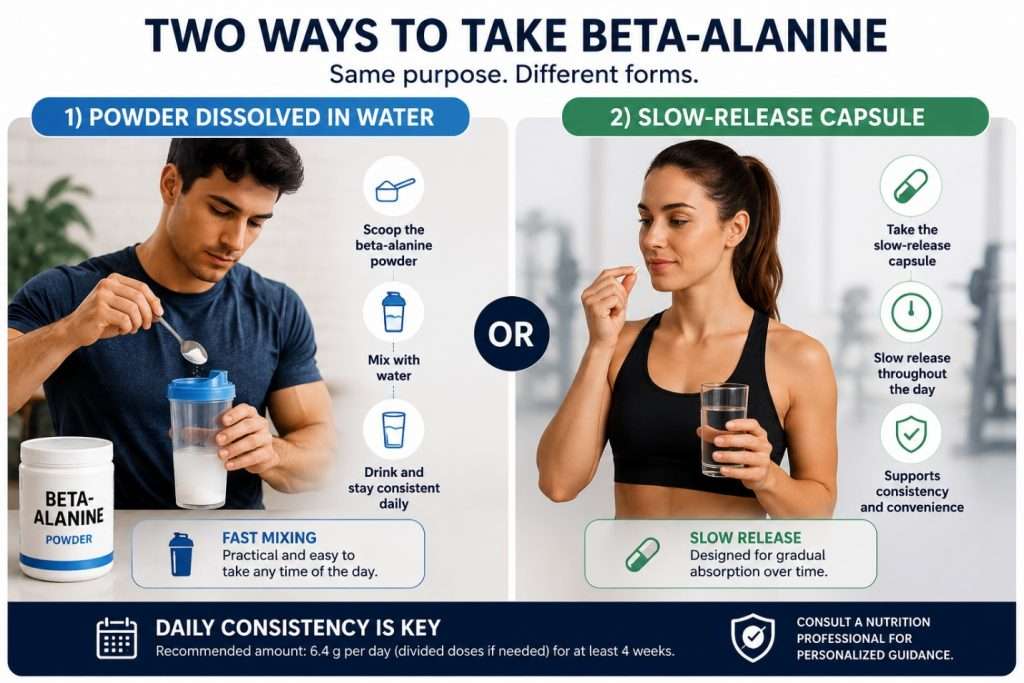
Currently, beta-alanine is increasingly used in sports contexts and is frequently prescribed by sports nutritionists. According to many scientific studies, one of the most commonly used doses is 6.4 g per day, with continuous daily consumption. In general, studies indicate that its effects begin to be observed after approximately four weeks of regular use.
This article is intended for informational purposes only. For individualized guidance, dose adjustments, or appropriate prescription, athletes and physically active individuals should consult a sports nutritionist or another qualified healthcare professional.
Does beta-alanine help performance?
The main mechanism of action of beta-alanine occurs after it is converted into carnosine inside the muscle. Carnosine acts as a type of “protector” against muscle acidity by helping neutralize part of the hydrogen ions (H+), substances that naturally increase during high-intensity exercise. As a result, the muscle takes longer to become excessively acidic, creating a more favorable environment for continued intense effort. In practice, this may help athletes maintain a high pace for longer before fatigue sets in.
For this reason, scientific studies have observed benefits of beta-alanine supplementation in sports that require intense efforts lasting several minutes, such as boxing, judo, 2,000 m rowing, and 100 to 200 m swimming, among others. On the other hand, in very long-duration sports, such as marathons, triathlons, and long-distance cycling events, the effects of beta-alanine tend to be smaller. This occurs because, in these modalities, fatigue is generally not primarily caused by increased muscle acidity.
Overall, research indicates that the greatest benefits of beta-alanine appear in exercises lasting approximately 4 to 10 minutes, especially those performed at high intensity.
Beta-alanine and kickboxing
When considering supplements that may improve sports performance, it is important to take into account the predominant energy systems of the sport. Depending on the physiological demands of the modality, certain nutritional strategies may be more or less applicable.
In kickboxing, although aerobic metabolism plays an important role, especially in sustaining the bout and promoting recovery between actions, the moments that usually determine competitive performance (such as offensive sequences, counterattacks, and intense striking exchanges) rely heavily on anaerobic metabolism.
Among these systems, the anaerobic lactic (glycolytic) system stands out, being responsible for rapid energy production during intense and repeated efforts. However, this process is also associated with an increase in hydrogen ion (H+) concentration within the muscle, contributing to a reduction in intramuscular pH and the development of fatigue.
Within this physiological context, Küçük and colleagues investigated whether beta-alanine supplementation could improve performance in a kickboxing-specific test. The test used was the Kickboxing Anaerobic Speed Test, validated by Gençoğlu and colleagues. In addition, the researchers assessed countermovement jump performance, the number of pull-up repetitions, and the number of push-ups performed during 1 minute.The results demonstrated improvements in performance only in the Kickboxing Anaerobic Speed Test, the number of pull-up repetitions, and the number of push-ups performed.
Beta-alanine may be an interesting option for improving performance in kickboxing.
—Jonatas Deivyson Reis da Silva Duarte
Side effects of beta-alanine
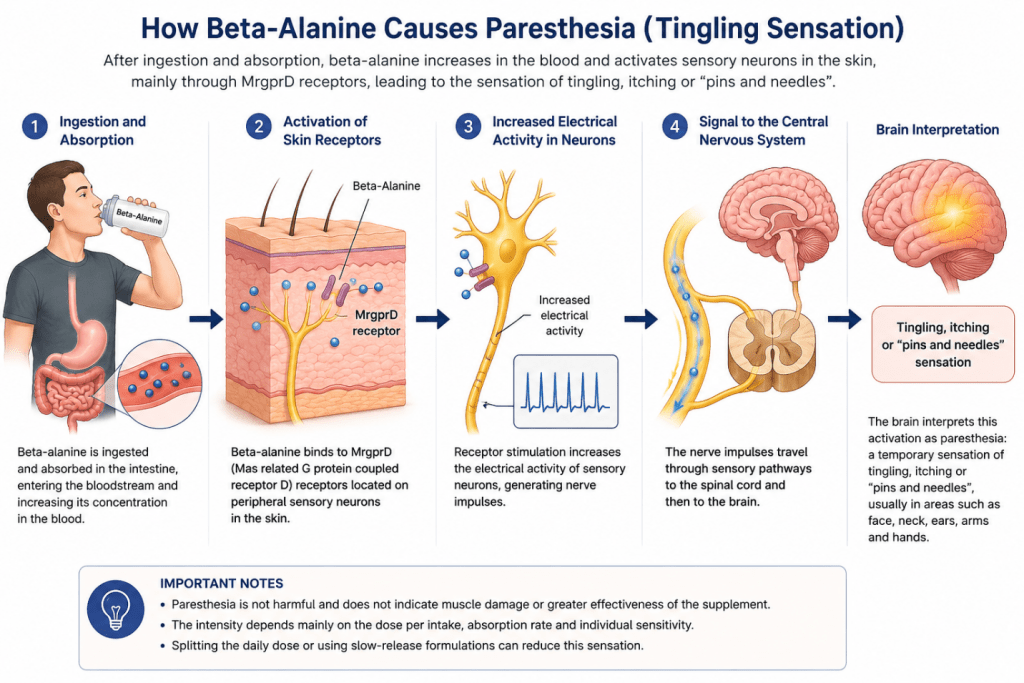
Although beta-alanine may improve performance in certain situations, especially during high-intensity exercise, it is important to note a relatively common side effect: paresthesia.
Paresthesia is characterized by a temporary sensation of tingling, itching, or mild burning of the skin, usually occurring in the face, neck, hands, and arms after ingestion of the supplement. Although it may cause discomfort in some individuals, this effect is considered transient and, in healthy individuals, is not considered a known health risk.
This phenomenon is mainly related to the amount consumed per dose. Higher single doses (often above approximately 800-1600 mg per serving, although there is considerable individual variability) tend to increase both the probability and the intensity of paresthesia. For this reason, a commonly used strategy is to divide the daily dose into smaller servings throughout the day or use slow-release formulations (for example, tablets), reducing the occurrence of this effect without necessarily compromising the increase in muscle carnosine levels.
It is important to emphasize that paresthesia does not mean that the muscle is functioning better at that moment, nor does it mean that the supplement is “working more effectively.” In general, it also does not indicate that any damage has occurred to the body.
Reference
Küçük, F. H., Gençoğlu, C., Ateş, O., Da Silva Duarte, J. D. R., Belošević, D., Çabuk, S., Inaç, M. R., Ulupinar, S. & Özbay, S. (2026). Effects of β-alanine supplementation on kickboxing-specific anaerobic performance, neuromuscular power, and strength endurance: A randomized, double-blind, placebo-controlled trial. PLoS One, 21(5), 1-17. https://doi.org/10.1371/journal.pone.0346898