
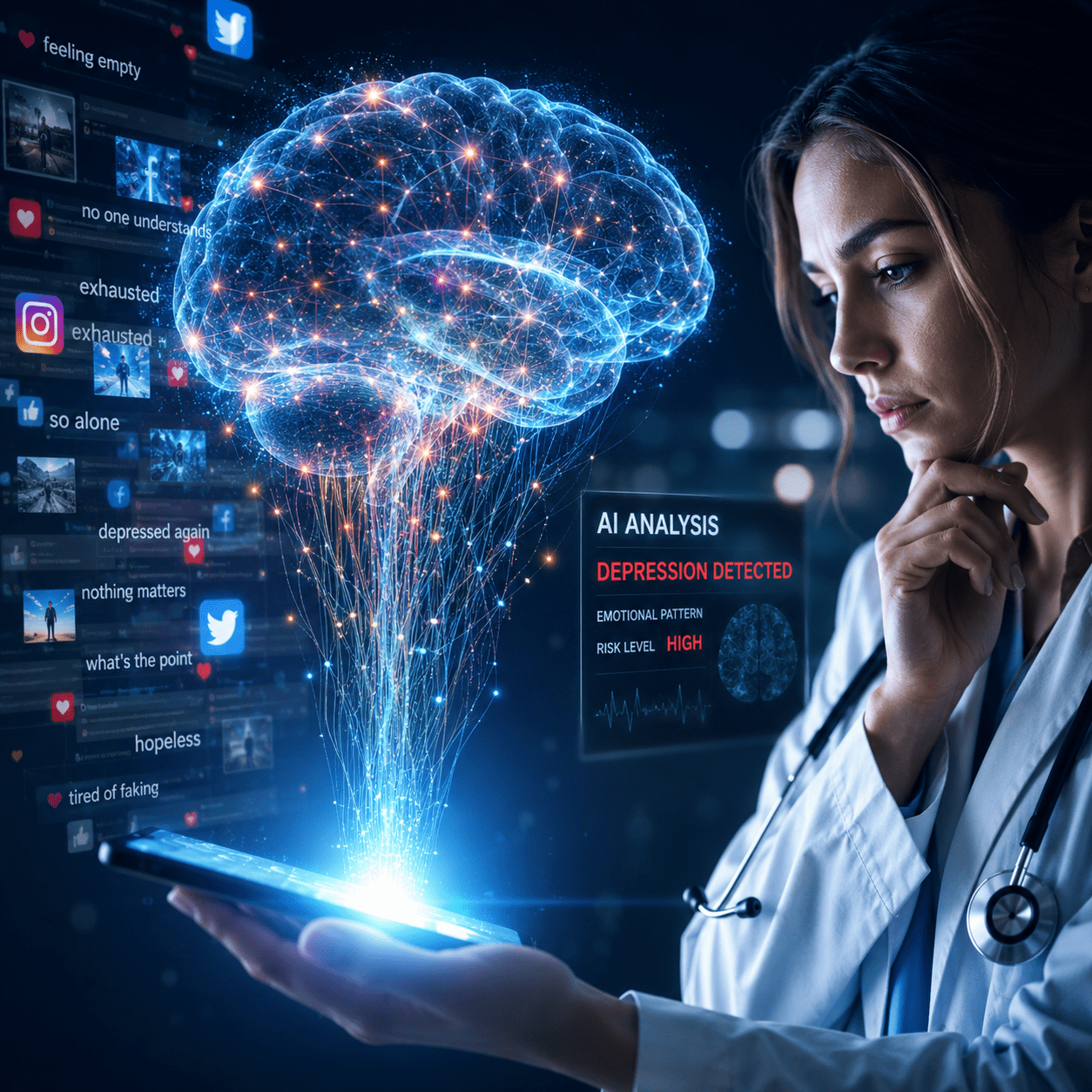
Artificial intelligence is rapidly transforming healthcare, but perhaps nowhere is its potential more intriguing and controversial than in mental health. From identifying early signs of depression through social media posts to assisting clinicians with treatment planning, large language models (LLMs) are beginning to influence how mental health conditions are detected, monitored and managed.
A recent systematic review titled Large Language Models in Mental Health: A Systematic Review of Applications, Innovations and Ethical Challenges, led by Yisong Chen from the College of Computing, Georgia Institute of Technology, USA, provides one of the most comprehensive assessments of this emerging field. Published in the Journal of Industrial Integration and Management, the review analysed 92 high-quality studies and examined how LLMs are being applied across mental health research and clinical practice.
The findings suggest that generative AI systems such as ChatGPT, GPT 4, Llama, and other transformer-based models could significantly expand access to mental health support. However, the review also highlights substantial ethical, technical, and regulatory challenges that must be addressed before these technologies can be trusted in real-world healthcare settings.
A growing mental health challenge
Mental health disorders remain among the leading causes of disability worldwide. Conditions such as depression, anxiety and suicidal behaviour affect hundreds of millions of people and place significant pressure on healthcare systems. Yet access to timely diagnosis and treatment remains uneven due to shortages of mental health professionals, financial barriers, geographical limitations and persistent social stigma.
Against this backdrop, researchers have increasingly turned to artificial intelligence as a potential tool for bridging gaps in mental healthcare delivery. The rapid development of LLMs has opened new possibilities because these systems can process vast quantities of human language, recognise contextual patterns and generate responses that closely resemble natural human communication.
Unlike earlier machine learning systems that relied heavily on manually engineered features, modern LLMs can learn complex linguistic relationships from enormous datasets. This capability enables them to analyse clinical notes, therapy transcripts, electronic medical records and even public social media posts in ways that were previously difficult to achieve.
According to Chen and colleagues, these developments have created opportunities for early detection, continuous monitoring and personalised intervention strategies that may ultimately complement traditional mental healthcare services.
When social media becomes a mental health signal
One of the most extensively studied applications involves the analysis of social media content. Platforms such as Reddit, X, formerly Twitter, and online discussion forums have become spaces where individuals openly discuss emotions, personal struggles and mental health experiences.
Researchers have discovered that these digital conversations contain valuable behavioural and linguistic signals that may indicate psychological distress. Expressions of hopelessness, social withdrawal, emotional instability and suicidal ideation can often be detected through language patterns long before individuals seek professional help.
The review found that many studies have successfully used LLMs and transformer based architectures to identify depression, anxiety and suicide risk from publicly available social media data. Several models were trained to recognise clinically relevant symptoms rather than simply classify users as depressed or non depressed.
This shift towards symptom-level analysis represents an important advancement. Rather than generating broad diagnostic labels, newer systems attempt to identify specific indicators such as sleep disturbances, loss of interest, low mood or suicidal thoughts. Such approaches align more closely with established psychiatric assessment frameworks and may improve clinical relevance.
Researchers have also begun integrating established mental health instruments such as the Patient Health Questionnaire and medical ontologies into AI systems. These knowledge-enhanced models can provide more interpretable outputs and potentially help clinicians understand why a particular prediction was made.
The rise of AI-assisted mental healthcare
Beyond social media surveillance, LLMs are increasingly being explored as tools that can support both patients and healthcare professionals throughout the clinical workflow.
One promising application involves patient triage. Mental health services often struggle with overwhelming demand and limited resources. AI powered conversational agents can analyse patient descriptions of symptoms, identify potential risk factors and help prioritise cases that require urgent attention.
Several studies reviewed by Chen and colleagues demonstrated that conversational AI systems could provide accurate and comprehensive responses during mental health triage scenarios. While these systems occasionally showed a tendency towards overtriaging, the findings suggest considerable potential for supporting early assessment processes.
Another area receiving significant attention is symptom checking. Modern LLMs can engage in interactive dialogue, ask follow-up questions, and generate personalised responses based on patient input. In some cases, specialised models developed for depression and suicide risk assessment achieved impressive performance levels.
A new assistant for therapists
Perhaps one of the most practical applications identified in the review is the use of LLMs for clinical documentation and therapy support.
Mental health professionals spend substantial amounts of time recording session notes, preparing reports and documenting patient progress. These administrative tasks can contribute to clinician burnout and reduce the time available for direct patient care.
Recent studies suggest that LLMs may help automate portions of this workload. Researchers have demonstrated that AI systems can summarise therapy sessions, identify clinically relevant symptom discussions and generate structured documentation that aligns with professional standards.
AI will not replace mental health professionals, but it may become a powerful tool for extending care to more people, identifying risks earlier, and supporting clinicians in delivering better outcomes.
—Yisong Chen
Personalised education and patient engagement
Another emerging role for LLMs involves psychoeducation and patient engagement.
Psychoeducation refers to the process of helping individuals understand mental health conditions, treatment options and coping strategies. Traditionally, delivering personalised educational content at scale has been challenging due to resource limitations.
Generative AI offers a potential solution by creating customised educational materials tailored to individual needs. Conversational agents can answer questions, explain psychological concepts and provide accessible information in a format that many users find engaging.
The review highlights evidence suggesting that AI driven interactions may increase patient engagement by providing immediate, non judgemental and highly personalised communication. For individuals who experience stigma or face barriers to accessing professional support, such systems could offer an additional avenue for obtaining mental health information.
Why prompt engineering matters
A particularly interesting finding from the review concerns the growing importance of prompt engineering in mental health applications.
Prompt engineering involves carefully designing instructions that guide an LLM towards producing specific types of responses. Rather than retraining entire models, researchers can adapt general purpose systems for specialised mental health tasks through strategic prompting techniques.
Methods such as zero-shot prompting, few-shot prompting, chain of thought reasoning, and prompt chaining are increasingly being used to improve mental health assessments, symptom extraction, and therapeutic dialogue generation.
These approaches are attractive because they reduce the need for expensive model retraining while allowing rapid adaptation to new clinical scenarios. As a result, prompt engineering is becoming an important area of research within digital mental health and medical artificial intelligence.
The next frontier: Multimodal mental health AI
While most current systems rely heavily on text, researchers are increasingly moving towards multimodal AI models.
Mental health is inherently complex and cannot always be fully understood through language alone. Human emotions and psychological states are reflected through speech patterns, facial expressions, physiological signals and behavioural changes.
The review identifies multimodal learning as one of the most promising future directions in the field. These systems combine multiple sources of information, including text, voice recordings, wearable sensor data and behavioural metrics, to create more comprehensive representations of mental health status.
The ethical dilemma that cannot be ignored
Despite impressive technological advances, the review repeatedly emphasises that significant ethical concerns remain unresolved. Privacy represents one of the most pressing issues. Mental health information is among the most sensitive forms of personal data, and the use of social media content, therapy transcripts and electronic medical records raises important questions regarding consent, confidentiality and data protection.
Bias also remains a major challenge. LLMs learn from existing datasets, which may contain demographic, cultural or linguistic biases. Consequently, AI systems could potentially generate inaccurate assessments for certain populations or reinforce existing inequalities in healthcare access.
Another concern involves hallucinations, a phenomenon in which AI systems generate plausible sounding but incorrect information. In mental healthcare, inaccurate advice or misleading recommendations could have serious consequences.
Reference
Chen, Y., Gao, Y., Yu, S., Zhao, C., & Lu, Y. (2025). Large language models in mental health: A systematic review of applications, innovations and ethical challenges. Journal of Industrial Integration and Management. https://doi.org/10.1142/S2424862225300042