When a major disaster strikes, communication systems are often among the first casualties. Earthquakes, hurricanes, and floods routinely destroy terrestrial infrastructure, leaving emergency responders struggling to coordinate rescue efforts. Events such as the Haiti earthquake (2010) and Hurricane Maria (2017) exposed a critical vulnerability in global disaster response systems: without reliable communication, even the most well-resourced rescue operations can falter.
In this context, a new study led by Sangita Dhara, Hadi Tabatabaee Malazi, Saqib Rasool Chaudhry, Aqeel Kazmi and Siobhan Clarke and published in the IEEE Transactions on Services Computing proposes a technically sophisticated yet practical solution. Titled “Co-operative Caching for Real-time Content Retrieval in an Integrated Space-Air-Ground Network for a Post-Disaster Scenario”, the research introduces an intelligent, adaptive framework designed to maintain data accessibility even when traditional networks fail. Conducted at Trinity College Dublin, the work addresses one of the most pressing challenges in disaster management while ensuring timely access to critical information.
The communication crisis in disaster zones
Modern disaster response depends heavily on real-time data. Emergency teams require up-to-date satellite imagery, environmental sensor readings, video feeds, and crowd-sourced information to coordinate evacuation, medical assistance, and resource allocation. However, disasters often damage cellular towers and disrupt internet connectivity, creating what researchers describe as a “communication blackout”.
Existing approaches attempt to restore connectivity using either terrestrial ad hoc networks or aerial and satellite systems. While these solutions provide partial relief, they are constrained by limited bandwidth, high latency, and restricted storage capacity. Moreover, they often assume static datasets or predictable user behaviour, assumptions that rarely hold true in chaotic post-disaster environments.
The study highlights that, in disaster scenarios, large volumes of content are continuously generated by satellites, drones, emergency vehicles, and even affected civilians. This information is critical for enabling immediate disaster response and supporting relief services. However, such data generation is highly dynamic in terms of data size, generation frequency, urgency, and priority. The challenge is not only transmitting this data, but also ensuring that the right information is available at the right place and time according to the operational requirements of emergency teams on the ground. This is where intelligent content caching becomes crucial.
A three-tier network: Space, air and ground working together
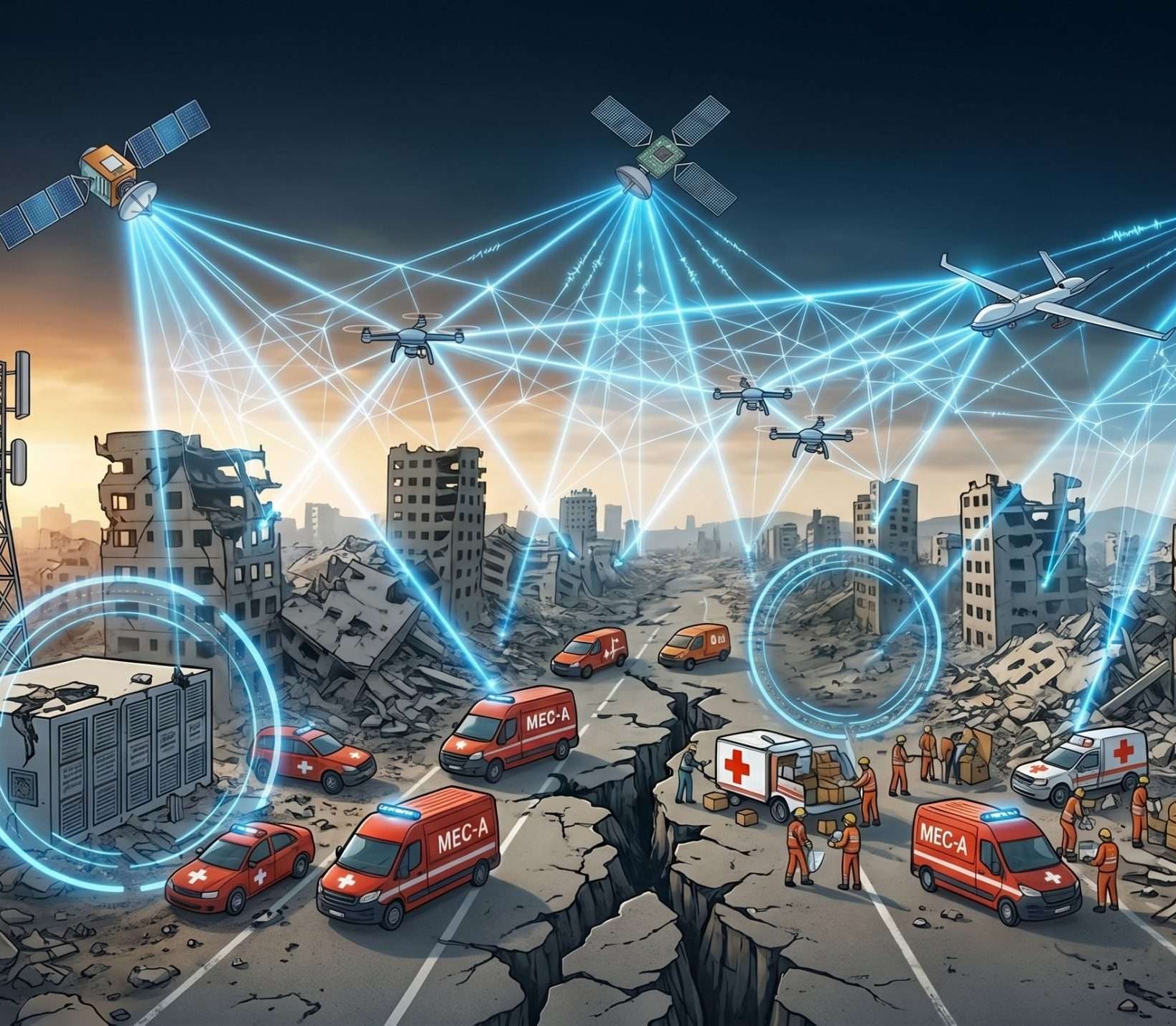
At the core of the research lies the concept of a Space Air Ground Integrated Network, commonly referred to as SAGIN. This architecture combines three distinct layers: satellites in space, unmanned aerial vehicles in the air, and ground-based systems such as emergency vehicles and base stations.
Each layer plays a unique role. Low Earth Orbit satellites provide wide-area coverage and capture large-scale data such as geographical imagery and weather patterns. UAVs operate closer to the ground, collecting localised data and acting as intermediaries between satellites and terrestrial nodes. Ground systems, including rescue vehicles, are the primary users of this information, relying on it for decision-making in real time.
The integration of these layers enables a more resilient communication system. However, it also introduces complexity. Data must move efficiently across layers with different capabilities, latencies, and storage constraints. The researchers address this challenge by designing a multi-layered content caching and retrieval system that dynamically manages data across the entire network.
Bringing data closer to where it is needed
When a disaster happens, emergency vehicles on the ground provide urgent services such as rescuing trapped people, delivering medical kits, transporting victims, and supplying food or relief materials. To perform these tasks effectively, they need real-time information: which roads are still usable, which areas are severely affected, where victims are located, and where immediate support is required.
This information can come from different sources. Satellite images can show large-scale damage, blocked routes, flooded zones, or destroyed infrastructure. UAVs or drones can capture local sensor data, images, and videos from affected areas. Emergency vehicles and affected civilians can also generate useful information through videos, reports, or crowd-sourced updates. However, when traditional communication infrastructure is damaged, collecting and retrieving this data in real time becomes extremely difficult.
One practical solution is to store important information closer to where it may be needed. This is known as caching. In simple terms, caching means keeping frequently used or important data near the users so that it can be accessed faster. For example, instead of every emergency vehicle repeatedly requesting satellite images from a distant source, useful data can be stored in nearby UAVs, vehicles, or operational base stations.
In normal networks, caching often depends on past user behaviour or predefined content. However, disaster situations are unpredictable. The required information changes quickly based on the type of disaster, affected location, rescue priority, and movement of emergency teams. Therefore, caching must be dynamic and intelligent.
The proposed framework introduces an adaptive caching mechanism that decides what data should be stored, where it should be stored, and when it should be replaced. It considers several factors, including how frequently the content is requested, how fresh or valid the information is, how large the data is, and how quickly it must be delivered. For example, evacuation routes, survivor locations, or structural safety warnings must be delivered with very low delay, while less urgent situational reports can tolerate longer access times.
A key innovation of this work is the use of a Contextual Multi-Armed Bandit model, a learning-based technique that helps the system improve its caching decisions over time. The system observes which cached data was useful, how quickly it was retrieved, and whether it helped satisfy emergency requests. Based on this feedback, it learns to store the most relevant content closer to emergency responders.
This is further enhanced using a Federated Multi-Armed Bandit framework. In this approach, UAVs, vehicles, and base stations do not need to send all raw data to a central controller. Instead, they share their learning outcomes in a distributed manner. This allows different parts of the network to cooperate, improve caching decisions faster, and maintain better content availability across the disaster-affected region.
Real-time learning in unpredictable environments
Disaster environments are inherently dynamic and unpredictable. User demands can change rapidly depending on the severity and location of the disaster. Network conditions fluctuate as communication infrastructure fails or partially recovers, while data availability continuously changes across satellites, drones, vehicles, and affected regions. Traditional optimisation approaches often struggle to adapt to such highly non-stationary environments.
One of the key innovations is the use of a Contextual Multi-Armed Bandit model, a reinforcement learning technique that allows the system to learn optimal caching strategies through continuous interaction with the environment. By evaluating the success of previous decisions, the system adjusts its behaviour to maximise content availability and minimise retrieval delays. For example, a large video file may consume significant storage and communication resources, making it less useful for immediate rescue tasks in some situations. In contrast, small but critical sensor updates or emergency alerts may be prioritised because they can quickly support evacuation planning, route selection, or medical coordination. This multi-criteria optimisation helps the system use limited storage, bandwidth, and communication resources more effectively during crisis situations.
The proposed learning-based framework addresses this challenge by incorporating contextual information directly into caching decisions. Instead of treating all data equally, the system evaluates each content item based on multiple factors, including how frequently it is requested, how long the information remains valid, how large the content is, and how urgently it may be needed for rescue or relief operations.
This approach is further enhanced through a Federated Multi-Armed Bandit framework. In this model, different nodes such as UAVs, vehicles, and base stations share their learning outcomes in a decentralised manner. This enables faster convergence and improved performance across the network without requiring centralised control.
Importantly, the framework operates with microsecond-level decision latency, making it suitable for real-time disaster response applications. Such rapid decision-making is critical because even small delays in retrieving important information can directly affect rescue coordination, relief distribution, and emergency response outcomes.
Why this research matters in a changing climate
The frequency and intensity of natural disasters are increasing due to climate change. As a result, the need for resilient communication systems is becoming more urgent. Technologies that can maintain connectivity and data accessibility in extreme conditions are no longer optional; they are essential.
The proposed SAGIN framework represents a significant step forward in this direction. By combining advanced networking techniques with machine learning, it offers a scalable and adaptive solution to one of the most challenging problems in disaster management.
Nevertheless, the research provides a strong foundation for future work. As UAV technology advances and satellite networks become more accessible, the integration of space, air, and ground systems is likely to become increasingly feasible.
Reference
Dhara, S., Tabatabaee Malazi, H., Chaudhry, S. R., Kazmi, A., & Clarke, S. (2026). Co-operative caching for real-time content retrieval in an integrated space-air-ground network for a post-disaster scenario. IEEE Transactions on Services Computing. https://doi.org/10.1109/TSC.2026.3667518