
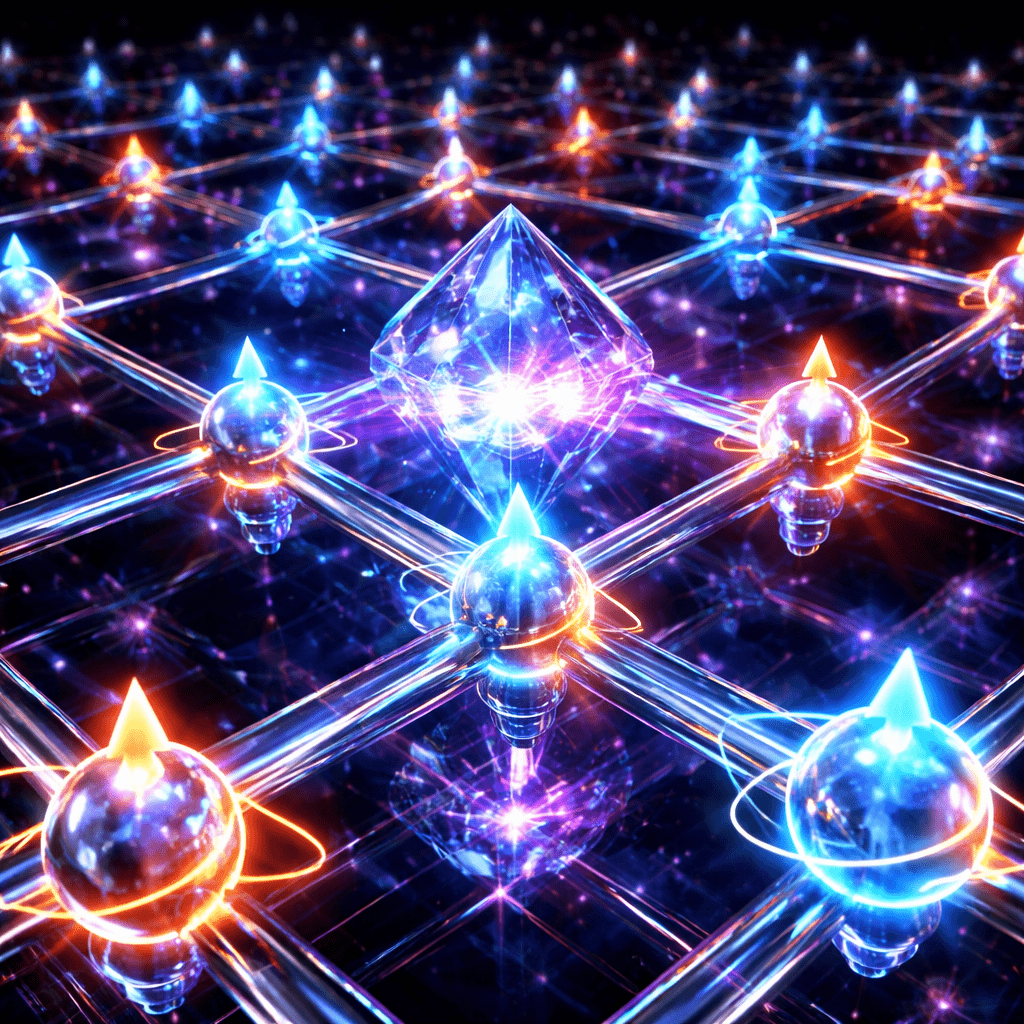
A recent study by Nandan Pakhira and colleagues has drawn attention in the materials science community by exploring the unusual electronic and magnetic behaviour of a copper manganese oxide (CuMnO₂) compound. Published in the journal Computational Materials Science, the paper titled Spin gapless state in ferromagnetic CuMnO₂: A first principles study examines how this magnetic semiconductor could contribute to future spintronics technologies and energy-efficient electronics. The research was conducted primarily at Kazi Nazrul University in West Bengal, India, with collaboration from researchers at the Indian Institute of Technology Kharagpur.
Magnetic semiconductors have become central to the next generation of electronics because they combine electrical conductivity with magnetism. This dual functionality offers pathways to devices that store and process information through electron spin rather than charge alone. The study focuses on CuMnO₂, a material already known for its complex magnetic ordering and semiconductor properties, but whose detailed electronic band structure in the ferromagnetic state had remained insufficiently understood.
Understanding the spin gapless phenomenon
The researchers investigated CuMnO₂ using density functional theory, a widely accepted computational method for analysing electronic band structure and atomic-scale interactions. Their calculations revealed that the material behaves as a spin-gapless semiconductor, meaning that electrons with one spin orientation are free to move. In contrast, those with the opposite spin orientation experience an energy gap. This leads to nearly 100 percent spin polarisation, a highly desirable characteristic for spintronic applications.
Such behaviour is rare. In conventional semiconductors, both spin channels typically exhibit an energy gap. In spin gapless semiconductors, however, one spin channel is gapless while the other remains semiconducting. This unusual electronic structure allows selective spin transport, which could improve the efficiency of spin valves, magnetic tunnel junctions, and other devices used in advanced data storage technologies. According to the authors, these findings strengthen the case for CuMnO₂ as a candidate material in future spintronics research.
Why spintronics matters
Spintronics, short for spin electronics, represents a growing field that exploits electron spin as well as charge to carry information. Conventional electronics depend largely on charge transport, which inevitably generates heat and limits efficiency. Spin-based technologies aim to reduce energy consumption while increasing speed and data density. This makes them particularly attractive for memory storage, sensors, and quantum computing components.
Materials with strong spin polarisation are essential for such technologies. The study indicates that ferromagnetic CuMnO₂ exhibits a fully spin-polarised state due to the interplay of electronic orbitals, lattice distortions, and magnetic interactions. This makes it potentially useful for magnetic random-access memory devices and other applications that require precise spin control. The authors note that its compatibility with tunnel magnetoresistance effects further enhances its technological relevance.
Computational insights into electronic band structure
To understand the material at an atomic level, the team performed extensive density functional theory simulations using established exchange-correlation functionals and the projector-augmented wave method. The electronic band structure calculations showed that the spin-up channel touches the Fermi level while the spin-down channel displays a clear band gap. This asymmetry confirms the spin-gapless semiconductor behaviour predicted by the study.
Importantly, the researchers also tested the effects of electron correlation and spin-orbit coupling. These factors can sometimes significantly alter electronic properties. However, their calculations showed that the essential spin gapless characteristics remained largely unchanged. This suggests that the electronic structure is robust and not merely an artefact of computational approximation, which strengthens confidence in the findings.
The role of crystal structure and orbital interactions
The distinctive properties of CuMnO₂ arise partly from its layered crystal structure. In this arrangement, manganese atoms form octahedral coordination with oxygen, while copper atoms occupy linear oxygen chains separating the layers. This geometry leads to orbital hybridisation between manganese d orbitals and oxygen p orbitals, which strongly influences magnetic ordering and electronic conduction.
The study highlights the importance of the Kugel-Khomskii mechanism, a theoretical framework that describes how orbital degeneracy and lattice distortion interact with magnetism. According to the researchers, this mechanism stabilises the spin-selective transport observed in CuMnO₂. Such insights help explain why the material behaves differently from conventional semiconductors and could guide the search for similar compounds.
Magnetic properties and fractional moments
Beyond electronic structure, the research also explored magnetic characteristics. The calculated magnetic moment on manganese atoms was approximately 3.7 Bohr magnetons, consistent with previous experimental observations. The slight deviation from integer values arises from orbital hybridisation and electron delocalisation within the crystal lattice.
Interestingly, induced magnetic moments were also detected on oxygen and copper atoms, although these were comparatively small. When combined with the manganese contribution, the total magnetic moment per unit cell reached an integer value, supporting theoretical predictions for spin-gapless systems. These magnetic interactions play a crucial role in determining electron spin transport and device potential.
Our numerical computation, based on density functional theory, shows fully spin polarized energy band for one spin while the other spin band is fully gaped. Spin selective transport and altered magneto-resistance can have applications in spintronic and magnetic random access memory devices
—Nandan Pakhira
Potential applications in advanced electronics
One of the most compelling aspects of this research lies in its technological implications. Spin-gapless semiconductors such as CuMnO₂ could serve as efficient spin injectors in spin valves, which are key components of modern magnetic storage devices. Improved spin-injection efficiency could enhance data-processing speeds while reducing energy consumption.
The authors also suggest relevance to photovoltaic systems, photocatalytic materials, and energy storage technologies. Magnetic semiconductors often exhibit multifunctional properties, making them attractive for integrated electronic platforms. Although practical implementation requires further experimental validation, computational predictions provide a valuable roadmap for future materials development.
Challenges and future research directions
Despite promising results, several challenges remain before CuMnO₂ can be used in commercial devices. The study notes that temperature effects were not fully incorporated in the simulations because density functional theory primarily describes ground-state behaviour. Since ferromagnetic ordering in this material occurs at elevated temperatures, finite temperature extensions of computational models will be important.
Further experimental studies will also be necessary to confirm the predicted spin gapless behaviour under realistic conditions. Researchers will likely examine thin films, doping effects, and device-level integration. These steps are essential for translating theoretical materials science into practical electronic applications.
Growing interest in magnetic semiconductors
The broader significance of this work reflects increasing global interest in magnetic semiconductors and spintronic materials. As the electronics industry seeks alternatives to traditional silicon-based technologies, compounds that combine magnetic ordering with semiconducting behaviour are attracting considerable attention. Advances in computational materials science allow researchers to identify promising candidates before expensive experimental trials.
This approach accelerates innovation while deepening understanding of fundamental physics. Studies such as this one demonstrate how theoretical modelling can uncover subtle electronic phenomena that might otherwise remain hidden. The discovery of spin gapless characteristics in CuMnO₂ adds another piece to the puzzle of designing next-generation energy-efficient electronics.
Reference
Sarkar, A., Patel, S., Chatterjee, J., Mukherjee, S., Taraphder, A., & Pakhira, N. (2026). Spin gapless state in ferromagnetic CuMnO₂: A first principles study. Computational Materials Science, 262, 114401. https://doi.org/10.1016/j.commatsci.2025.114401
Coauthors

Mr. Apurba Sarkar is a Ph. D scholar at the Department of Physics, Kazi Nazrul University, Asansol, India. His research interests are theoretical and experimental investigations of delafossite semiconductors.

Dr. Shubham Patel did his master’s and Ph. D from the Indian Institute of Technology,Kharagpur, and at present is presently a postdoctoral fellow at the Department of Physics, University of Bath, U.K. His research interests are the electronic properties of quantum matter.

Dr. Joydeep Chatterjee did his Ph. D from S. N. Bose National Centre for Basic Sciences, Kolkata, India. He is a postdoctoral fellow at the Department of Physics, Indian Institute of Technology, Kharagpur, India. His research interests are the electronic structure of two-dimensional materials.

Dr. Soumya Mukherjee completed his master’s and Ph.D. from Jadavpur University, Kolkata, India, and is currently an Assistant Professor in the Department of Metallurgical Engineering at Kazi Nazrul University, Asansol, India. His area of interest is experimental investigation and modelling of semiconducting materials.

Prof. Arghya Taraphder did his Ph. D from the Indian Institute of Science, Bangalore, India, followed by postdoctoral research at Rutgers University, New Jersey, USA. He was a visiting professor at Michigan State University, ICTP in Trieste, and at many other institutions. At present, he is a senior professor in the Department of Physics at the Indian Institute of Technology, Kharagpur, India, and his research interests are in the theory of quantum matter.