Around ten billion years ago, the universe experienced its most intense period of galaxy growth, an era astronomers often call cosmic noon. During this time, galaxies formed stars at rates far exceeding those seen in the present-day universe. Understanding how and why this happened remains one of the central questions in modern astrophysics.
A new study led by Jonathan S. Gómez, an astrophysicist at the Universidad Autónoma de Madrid, provides a detailed look at this turbulent epoch. The study, titled “Resolved Schmidt–Kennicutt relation in a binary hyperluminous infrared galaxy at z =2.41 ALMA observations of H-ATLAS J084933.4+021443”, was published in the journal Astronomy and Astrophysics. The research focuses on a rare and extreme system known as H-ATLAS J084933.4+021443, a hyperluminous infrared galaxy system located at a redshift of 2.41. The findings reveal that star formation in these early galaxies does not simply scale up the rules observed in nearby galaxies. Instead, it appears to follow a fundamentally different regime.
Hyperluminous galaxies and extreme star formation
Hyperluminous infrared galaxies, often abbreviated as HyLIRGs, represent some of the most extreme star-forming environments ever observed. With infrared luminosities exceeding ten trillion times that of the Sun (above 10¹³ solar luminosities), these systems can form stars at rates approaching or even surpassing one thousand solar masses per year. For comparison, the Milky Way forms only a few solar masses of stars annually.
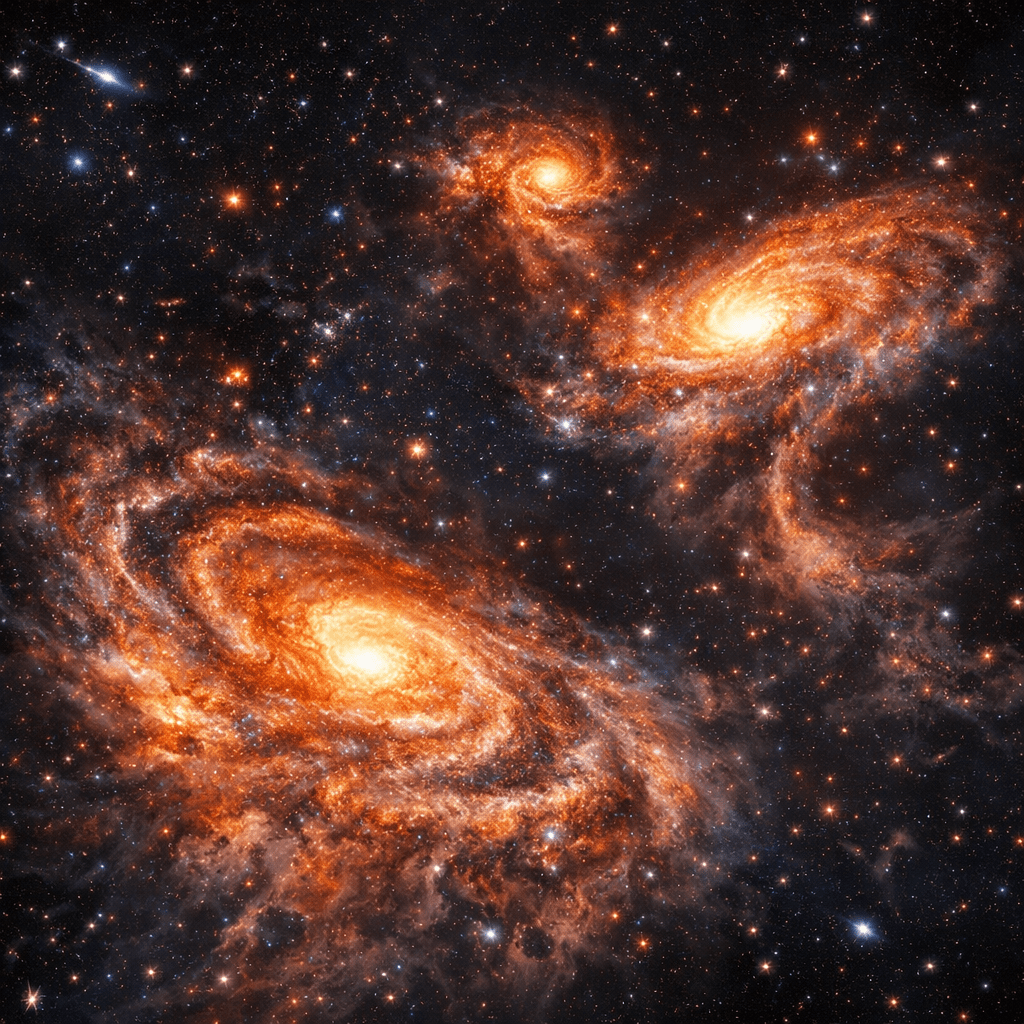
The galaxy system studied by Gómez and colleagues is particularly unusual. H-ATLAS J084933.4+021443 consists of at least four interacting galaxies spread across a region roughly one hundred kiloparsecs wide. Two of these galaxies, labelled W and T, qualify as independent hyperluminous infrared galaxies in their own right, while two additional companions exhibit ultraluminous activity.
This combination of extreme star formation, multiple interacting components and favourable observational conditions makes the system an ideal laboratory for testing theories of galaxy evolution. Because these galaxies are observed during cosmic noon, they provide a direct window into the processes that shaped many of today’s massive galaxies.
Revisiting a cornerstone of astrophysics
At the core of the study lies the Schmidt-Kennicutt relation, one of the most widely used empirical laws in astrophysics. This relation links the surface density of gas in a galaxy to the rate at which that gas forms stars. In nearby star-forming galaxies, the relation is approximately linear, meaning that doubling the gas density roughly doubles the star formation rate.
While this relation has been well established on global, galaxy-wide scales, testing it within galaxies, especially at high redshift, has proven challenging. Most previous studies lacked the spatial resolution required to examine how star formation behaves on kiloparsec scales in the early universe.
The new ALMA observations overcome this limitation. By resolving the gas and dust emission to scales of about 2.5 kiloparsecs, the researchers were able to construct a spatially resolved Schmidt-Kennicutt relation for the galaxies W and T. The result is striking. Rather than following a near-linear trend, these galaxies exhibit a much steeper relation, with a power law index close to 1.7.
Even in the most extreme galaxies of the early universe, star formation is not chaotic. It follows physical laws, but in a more intense and efficient regime.
-Jonathan S. Gómez
This implies that star formation becomes increasingly efficient as gas density increases, a behaviour that differs markedly from that observed in normal star-forming galaxies today.
ALMA and the anatomy of distant galaxies
The level of detail achieved in this study is enabled by ALMA’s ability to observe molecular and atomic gas tracers with high sensitivity and resolution. The team observed multiple emission lines, including high excitation carbon monoxide transitions, neutral atomic carbon, and water vapour, alongside dust continuum emission across a wide range of frequencies.
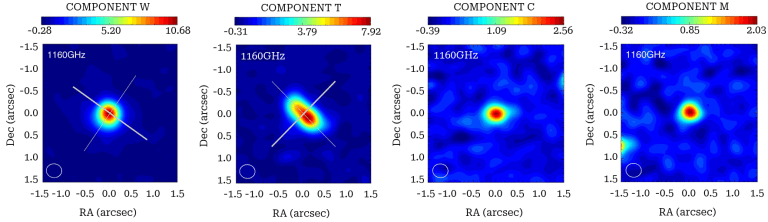
These observations allowed the researchers to map not only where star formation is occurring, but also the physical conditions of the interstellar medium that fuels it. In particular, the study demonstrates that atomic carbon emission can serve as a reliable tracer of warm, dense molecular gas in extreme environments, complementing traditional carbon monoxide measurements.
The kinematics revealed by the data show that the two main galaxies are dominated by ordered rotation rather than chaotic motions. Despite their extreme star formation rates, the gas in these systems appears to be organised into rotating discs, challenging the idea that intense starbursts must always be driven by violent disruption.
Rapid fuel consumption and short-lived starbursts
One of the most consequential results of the study concerns how quickly these galaxies are consuming their gas reservoirs. By combining gas mass estimates with star formation rates, the team derived gas exhaustion timescales ranging from about fifty to a few hundred million years.
Such short timescales suggest that hyperluminous infrared galaxies represent brief but intense phases in galaxy evolution. Unless gas is replenished from the surrounding environment, these galaxies would rapidly quench their star formation, evolving into more passive systems.
This finding supports the view that extreme starbursts play a key role in shaping massive galaxies, rapidly building stellar mass before feedback processes such as stellar winds and active galactic nuclei regulate further growth.
Implications for galaxy formation models
The discovery of a superlinear Schmidt-Kennicutt relation at high redshift has significant implications for theoretical models of galaxy formation. Many simulations assume that star formation efficiency scales similarly across cosmic time, adjusting only for changes in gas supply and feedback strength.
The results presented by Gómez and colleagues suggest that this assumption may be incomplete. In the dense and turbulent environments of early hyperluminous galaxies, star formation appears to operate under different physical conditions, potentially driven by higher gas pressures, enhanced turbulence, and more efficient conversion of gas into stars.
Incorporating these effects into cosmological simulations could help resolve long-standing discrepancies between observed galaxy populations and theoretical predictions, particularly at the high mass end.
Reference
Gómez, J. S., Messias, H., Nagar, N. M., Orellana González, G., Ivison, R. J., & van der Werf, P. (2025). Resolved Schmidt Kennicutt relation in a binary hyperluminous infrared galaxy at z = 2.41. Astronomy and Astrophysics, 704, A178. https://doi.org/10.1051/0004-6361/202554705