A new study of China’s urban bus sector suggests that highly visible public projects can have consequences far beyond transport planning. Research by Ning Leng of Georgetown University, published in Comparative Political Studies under the title “Visibility Projects and De Privatization: A Case of China’s Urban Bus Sector”, examines how projects designed to make government achievements highly visible can increase pressure on businesses and contribute to the return of a sector to state ownership.
The puzzle behind China’s changing bus sector
The urban bus sector might appear to be an unlikely target for government takeover. It is not a strategic industry such as oil or telecommunications, it is not generally characterised by exceptionally high profits, and it does not have the same national security significance as some other infrastructure sectors.
Yet China experienced a striking reversal. After the national government opened the urban bus sector to private investment in 1995, private operators became an important part of urban public transport. Leng’s data show that 233 of 288 cities, or 81 percent, had privatised their urban bus sectors at some point between 1996 and 2019. By the end of 2019, only about 15 per cent of these cities still had urban bus services under private control.
What are visibility projects?
The answer centres on the concept of “visibility projects”. Leng defines these as public projects that prioritise appearance and scale over practicality, cost effectiveness and sustainability. Their purpose is not necessarily limited to improving a public service. They can also increase the political visibility of the officials who initiate them and provide opportunities for political credit claiming.
Visibility is not unique to China, and the study places the phenomenon within wider research on infrastructure politics, public projects and urban planning. However, the political environment matters. In democratic systems, visible projects may be shaped by electoral incentives and voter preferences. In China, the study argues, local officials operate within a hierarchical political system in which higher level officials play an important role in career advancement. Visible achievements can therefore become a means of demonstrating governing ability and political performance.
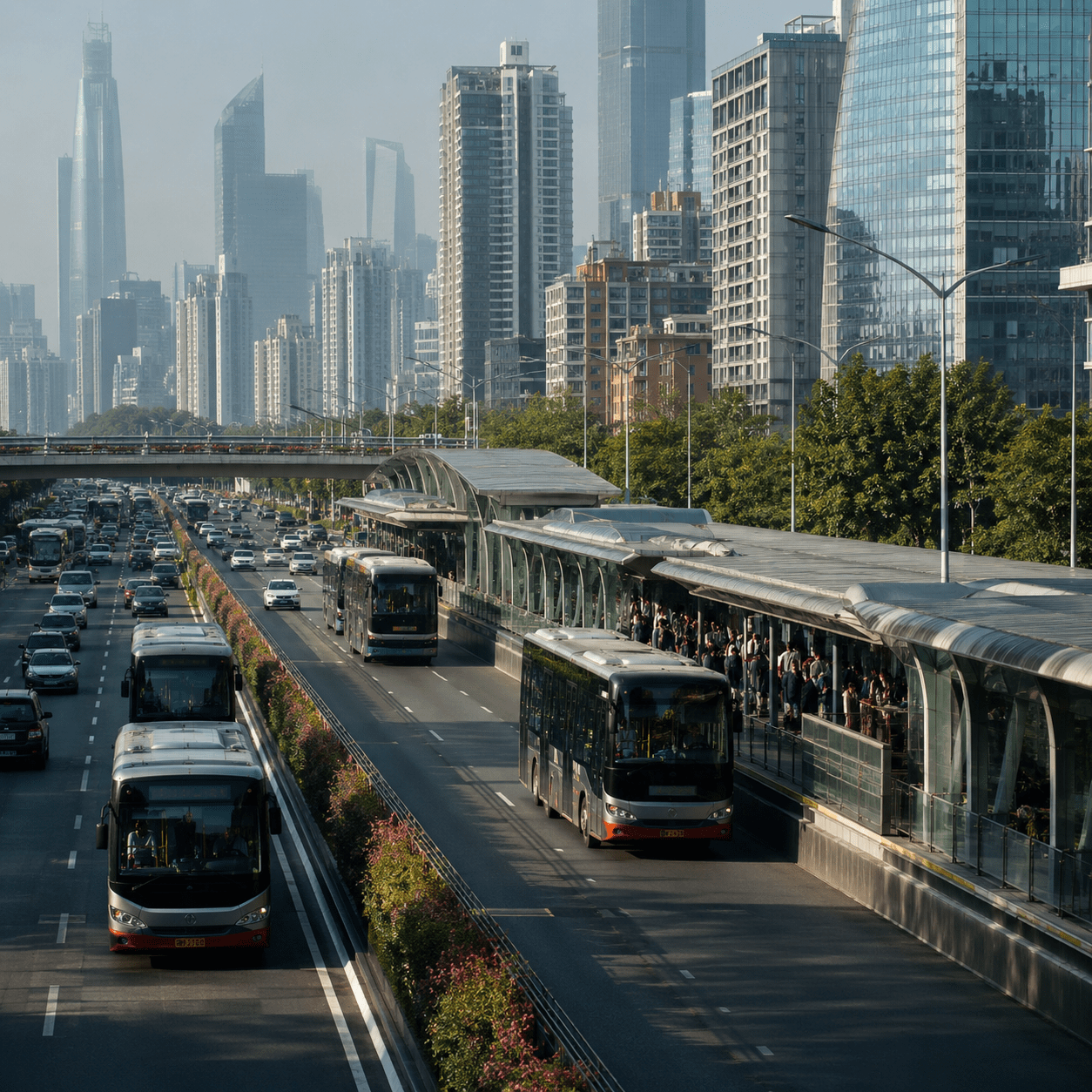
The result can be projects that are launched quickly, emphasise scale or appearance, and generate benefits that are difficult to measure in conventional economic terms. In the urban bus sector, the research identifies three major forms: bus beautification, bus upgrades and Bus Rapid Transit, or BRT, construction.
When buses become political showcases
Bus beautification may sound harmless. Yet the study finds that such campaigns were often associated with applications for national city titles. In preparation, city authorities could require operators to clean and repaint buses, remove advertisements and replace older vehicles. The improvements were frequently implemented quickly and were not necessarily associated with long-term commercial benefits for the operators.
Bus upgrades created a more substantial financial burden. Operators were sometimes asked to purchase new models beyond the normal replacement schedule. These included new energy buses as well as visually distinctive buses such as double-deckers, retro buses, and trolley buses. The study notes that upgraded buses could cost at least twice as much as regular buses, creating high costs for firms when government financial assistance was limited.
The numbers tell a striking story
The study’s quantitative analysis provides some of its strongest evidence. Using a Cox proportional hazards model, Leng examined whether visibility projects were associated with the timing of de privatisation while accounting for a range of sectoral, economic and political factors.
The results indicate that the estimated risk of de privatisation was 4.6 times higher in cities that launched BRT projects, compared with cities that did not launch such projects. The corresponding risk was 3.71 times higher for cities with bus upgrade projects and 3.24 times higher for cities with bus beautification projects. Robustness checks using alternative statistical approaches produced consistent results.
Why did private companies begin to resist?
The mechanism becomes clearer when the financial position of different types of firms is considered. Private companies generally operate under harder budget constraints. They must absorb costs and remain commercially viable. State-owned enterprises, by contrast, may have greater access to government support and can operate under softer budget constraints.
Visibility projects, therefore, created an uneven environment. All bus companies could be expected to participate, but the costs could be particularly difficult for private firms to absorb. Because the projects were imposed across the sector, contributing more did not necessarily confer a competitive advantage on an individual company or guarantee a financial return.
The research suggests that companies initially had incentives to cooperate. Firms depended on local governments for licences, routes and other regulatory decisions. However, repeated demands for costly projects could gradually turn cooperation into resistance.
The politics of visibility is an important source of waste and a deterrent to private investment in China. It can distort potentially long-term reforms, turning them into unsustainable short-term initiatives. The bus sector vividly illustrates this mechanism.
—Ning Leng
The Guangzhou story
Guangzhou provides the study’s detailed case study. The city opened its urban bus sector to private firms in 1994 and became one of the early examples of marketisation. By the end of 2006, nine of fourteen bus firms were privately owned, and wholly private firms operated 37 per cent of buses.
The research traces a sequence in which increasingly ambitious visibility projects contributed to conflict between the city government and private operators. Government demands included changes to bus fleets and the development of BRT. Private firms resisted some of the additional costs and operational requirements.
The study draws on government documents, public records and 34 interviews to reconstruct the process. According to the research, the city government ultimately regarded de privatisation as a way to remove obstacles to major transport projects. In 2007, the private bus firms were taken over by state owned enterprises. The BRT system was then developed rapidly before the Asian Games.
When visibility turns into pressure
The Guangzhou case is important because it shows the mechanism behind the statistical relationship. The quantitative evidence indicates an association between visibility projects and de privatisation. The case study illustrates how repeated demands, business resistance and government pressure could connect those two outcomes.
An internal Guangzhou government document cited in the study listed several reasons for de privatisation, including the need to ensure cooperation with BRT construction and adjustments to bus routes as new subway lines became operational. The research argues that these reasons were closely connected to the need to implement major transport projects within a limited timeframe.
The study further reports that de privatisation involved persuasion and pressure. In 2007, all private bus firms were sold to state-owned enterprises, while some former private owners remained as senior managers. After de privatisation, BRT construction proceeded rapidly before the Asian Games.
What the study means for infrastructure policy
The significance of the research extends beyond buses. It raises a broader question about how governments choose, design and implement infrastructure projects. Public investment is normally evaluated in terms of service quality, economic efficiency, sustainability and social welfare. The study suggests that political visibility can become another factor shaping these decisions.
That does not mean that every large or attractive public project is politically motivated, nor does the study claim that visibility projects are always harmful. New energy buses, for example, can have legitimate environmental benefits, while BRT can improve urban mobility when carefully planned. The concern arises when appearance, scale, or political credit takes precedence over practicality, cost effectiveness, and long-term sustainability.
The hidden cost of being visible
One of the most interesting insights from the study is that visibility projects can create costs that are not immediately obvious. A new bus fleet may look modern. A newly painted bus may improve a city’s appearance. A BRT corridor may signal ambitious urban planning. But each visible improvement can involve less visible costs, including financial pressure on operators, operational disruption and opportunity costs.
The study, therefore, shifts attention from the physical appearance of infrastructure to the institutional incentives behind it. A city may appear to be improving its transport system even as the underlying relationship between government and service providers becomes increasingly strained.
Reference
Leng, N. (2026). Visibility projects and de privatisation: A case of China’s urban bus sector. Comparative Political Studies. https://doi.org/10.1177/00104140261431812