
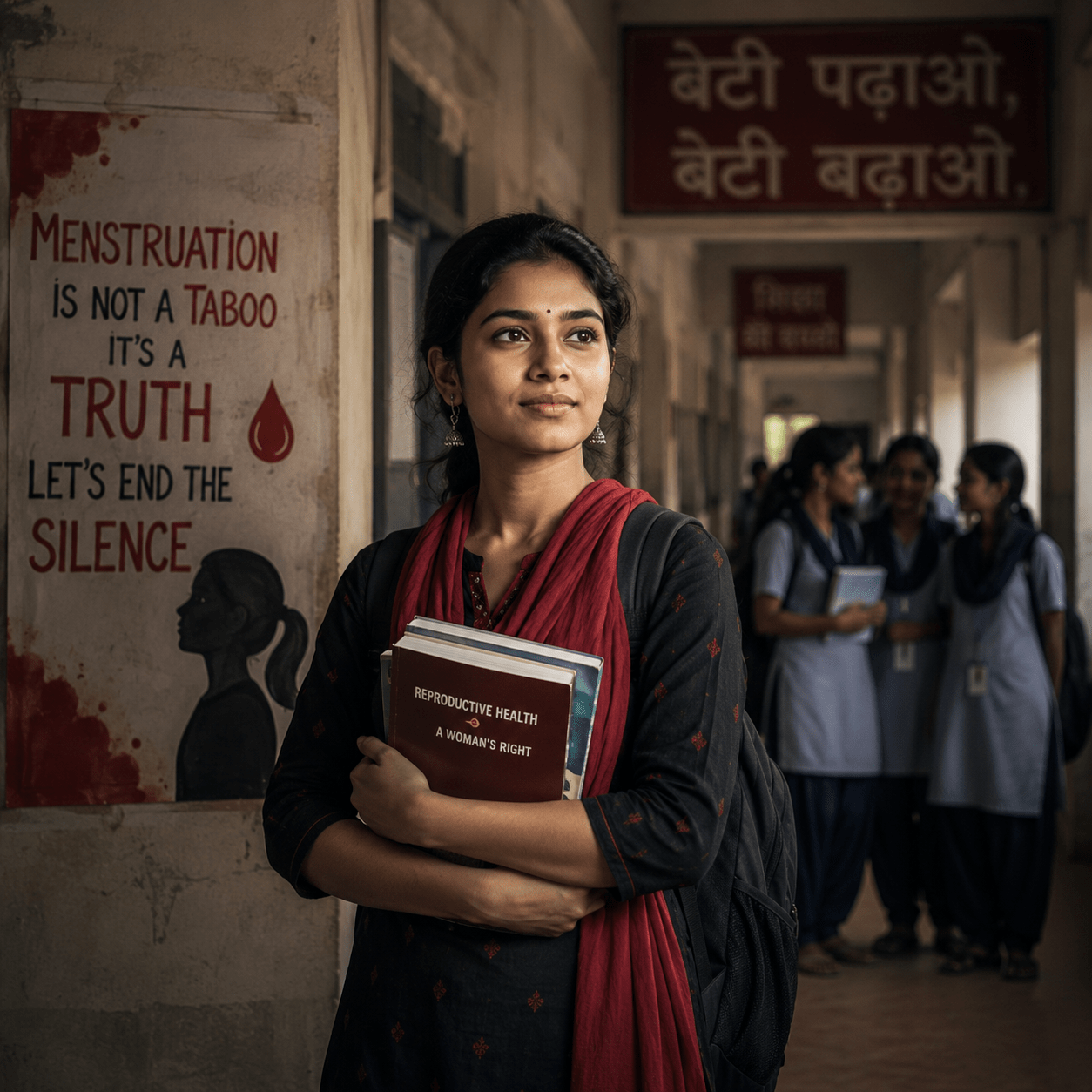
A recent study published in the Indian Journal of Human Development has reignited debate around menstrual stigma, women’s rights, and gender inequality in India. Conducted by Asmita Dwivedi and Khirod Chandra Moharana from the Department of Anthropology at the University of Allahabad, the research article titled Menstrual Taboo and Women’s Agency examines how deeply rooted menstrual taboos continue to restrict women’s autonomy, mobility, education, and bodily integrity in contemporary society.
The study argues that menstruation is not merely a biological process, but also a social phenomenon, shaped by outdated customs. Instead, menstrual taboo functions as a system of social control that directly undermines women’s agency. Drawing from interdisciplinary literature across anthropology, sociology, public health, feminist theory, and human rights scholarship, the researchers demonstrate how period stigma shapes the lived experiences of girls and women from adolescence onward.
The article arrives at a time when menstrual health is increasingly being recognized globally as a public health and human rights issue. In 2022, the World Health Organization formally acknowledged menstrual health and rights as central to gender equality and wellbeing. Yet despite growing awareness campaigns and policy reforms, millions of women and girls continue to experience shame, exclusion, and discrimination during menstruation.
When menstruation becomes surveillance
The study opens with a disturbing incident in 2020. Nearly 70 female students at a college hostel were reportedly forced to remove their underwear after authorities suspected that menstruating girls had violated hostel rules prohibiting them from entering kitchens or religious spaces. The event generated outrage nationwide, but the researchers argue that the incident reflected a broader social reality rather than an isolated act of abuse.
According to the study, menstruation in many societies continues to be associated with impurity, pollution, and danger. These beliefs frequently result in restrictions on movement, food consumption, participation in religious activities, and social interaction. In some communities, menstruating women are isolated from family spaces or prohibited from touching certain objects.
The researchers note that such practices represent more than symbolic discrimination. They become mechanisms through which women internalise shame and learn to regulate their own behaviour. Menstruation, the paper argues, becomes linked with surveillance, silence, and bodily control from the onset of puberty.
This process often begins at menarche, the first menstrual cycle experienced during adolescence. Rather than being treated as a normal physiological transition, menstruation is frequently introduced through secrecy and behavioural restrictions. Girls are taught to conceal sanitary products, suppress conversations around periods, and avoid drawing attention to their bodies.
The study suggests that this social conditioning contributes to what feminist scholars describe as “gendered invisibility”, where women are expected to minimise bodily realities to maintain social acceptance.
The science of stigma and agency
One of the most significant contributions of the research lies in its exploration of the relationship between menstrual taboo and human agency. Agency, in sociological and philosophical terms, refers to an individual’s ability to make choices, exercise autonomy, and act independently.
Drawing on the work of theorists such as Anthony Giddens, Pierre Bourdieu, Michel Foucault, and James Griffin, the paper argues that menstrual stigma directly interferes with women’s freedom to participate fully in public and private life.
The researchers explain that agency requires three essential conditions: autonomy, minimum provision, and liberty. Menstrual taboo undermines all three.
Autonomy is restricted when women are denied control over their mobility, participation, and bodily decisions during menstruation. Minimum provision is compromised when schools, workplaces, and public institutions fail to provide adequate menstrual infrastructure, such as clean toilets, water access, disposal systems, and privacy. Liberty is constrained when women fear humiliation, exclusion, or punishment for natural bodily functions.
The article argues that the menstrual taboo therefore operates not only as a cultural belief system but also as a structural barrier to gender equality.
Why misinformation still dominates
Despite increasing public conversation around menstrual health, the study highlights that misinformation and silence remain widespread. Several studies cited in the review found that many girls in India receive little or no scientific education about menstruation before experiencing their first period.
According to data referenced in the article, approximately 71 percent of girls in India reportedly had no prior knowledge of menstruation before menarche. Many described feelings of fear, anxiety, guilt, confusion, and embarrassment during their first menstrual experience.
The research identifies taboo itself as a major barrier to menstrual literacy. Since menstruation is often considered inappropriate for open discussion, girls rely on fragmented information from mothers, female relatives, or peers. These conversations may focus on behavioural restrictions rather than biological understanding.
As a result, misconceptions about menstruation continue to persist. Some participants in previous studies believed menstruating women could contaminate food, spoil pickles, or harm religious spaces. Others associated menstruation with impurity or divine punishment.
While such narratives vary across regions and communities, the researchers argue that they contribute to long-standing perceptions of menstruation as shameful or dangerous.
Menstrual taboo is not merely a cultural belief. It’s a subtle system of control that shapes mobility, education, bodily autonomy, and sense of self. Menstrual health is not only a matter of health or hygiene, but a fundamental issue of human rights, dignity, and gender justice.
— Khirod C Moharana
How schools fail menstruating girls
One of the strongest sections of the research focuses on menstrual health infrastructure in schools. The article argues that many educational institutions remain fundamentally unprepared for menstruating students.
The lack of private toilets, safe disposal systems, adequate water supply, sanitary products, and hygienic facilities creates an environment where girls experience anxiety and humiliation during periods. Teasing by peers and inadequate teacher support can intensify these experiences.
According to the review, around 23 million girls in India reportedly drop out of school annually after reaching puberty. Fear of leakage, staining, and public embarrassment frequently contributes to absenteeism and declining participation.
The researchers note that menstrual stigma transforms educational spaces into environments of psychological stress rather than inclusion. Girls may avoid classroom participation, skip examinations, or withdraw from extracurricular activities during menstruation.
Restricting movement and everyday freedom
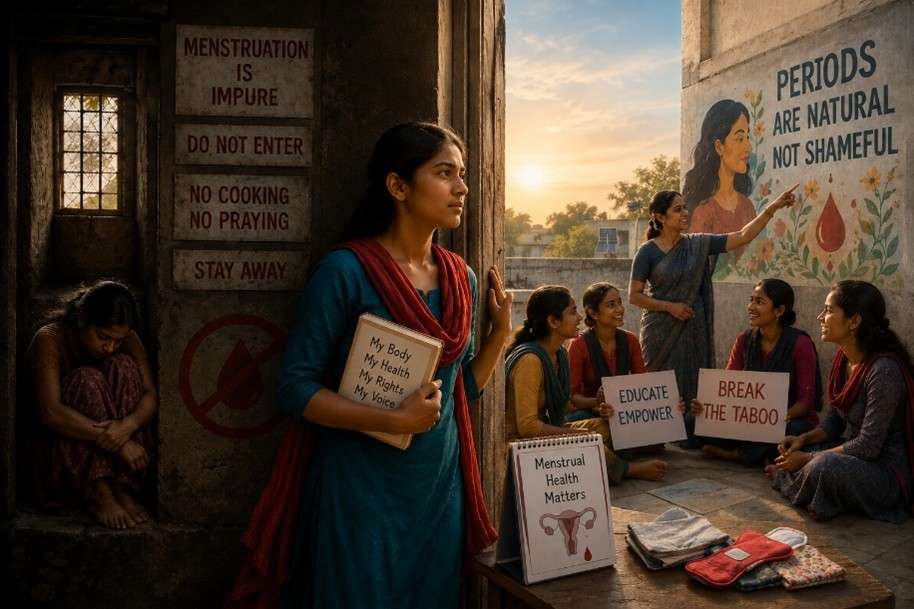
The paper also examines how menstrual taboo limits women’s physical mobility and participation in daily life. Across multiple studies reviewed by the authors, menstruating women reported restrictions on entering temples, kitchens, agricultural fields, or communal spaces.
In some regions of India and Nepal, women have historically been forced to stay in isolated menstrual huts during their periods. These practices have resulted in documented cases of smoke inhalation, animal attacks, and exposure to violence.
Although several governments and advocacy organisations have campaigned against such practices, the research suggests that social attitudes remain deeply entrenched in many communities.
The consequences extend beyond physical isolation. Repeated exclusion from social and religious spaces reinforces the perception that menstruating bodies are fundamentally impure or disruptive.
The researchers argue that, over time, this can lead to body alienation, reduced self-esteem, and diminished confidence in decision-making. Women may internalise the belief that their own bodies are burdensome, dangerous, or socially inappropriate.
Menstrual health enters public debate
Despite persistent stigma, the study acknowledges that India has witnessed growing momentum around menstrual health awareness and policy reform over the past decade.
Government initiatives such as the Menstrual Hygiene Scheme and Rashtriya Kishor Swasthya Karyakram have attempted to improve access to sanitary products and menstrual education among adolescents. Several state governments, including Kerala and Tamil Nadu, have introduced school based awareness programmes and pad distribution schemes.
Civil society organisations have also played a major role in challenging period stigma. Campaigns such as Happy To Bleed and Menstruation Matters have used social media to encourage open conversations around menstruation and gender equality.
Popular culture has contributed as well. Films such as Pad Man and the Academy Award winning documentary Period. End of Sentence helped bring menstrual health discussions into mainstream public discourse.
Reference
Dwivedi, A., & Moharana, K. C. (2026). Menstrual taboo and women’s agency. Indian Journal of Human Development, 1 to 13. https://doi.org/10.1177/09737030251415015
Coauthor

Asmita Dwivedi, an alumna of the University of Allahabad, has an interdisciplinary academic background in Anthropology, Psychology, and Economics. She holds a master’s degree in Anthropology. Her master’s thesis investigated the interaction between community dynamics, political engagement, and everyday experiences among the Nishad community in Prayagraj, Uttar Pradesh, India. Through her research, she engages with questions of gender, health, agency, embodiment, and social stigma in contemporary society.