
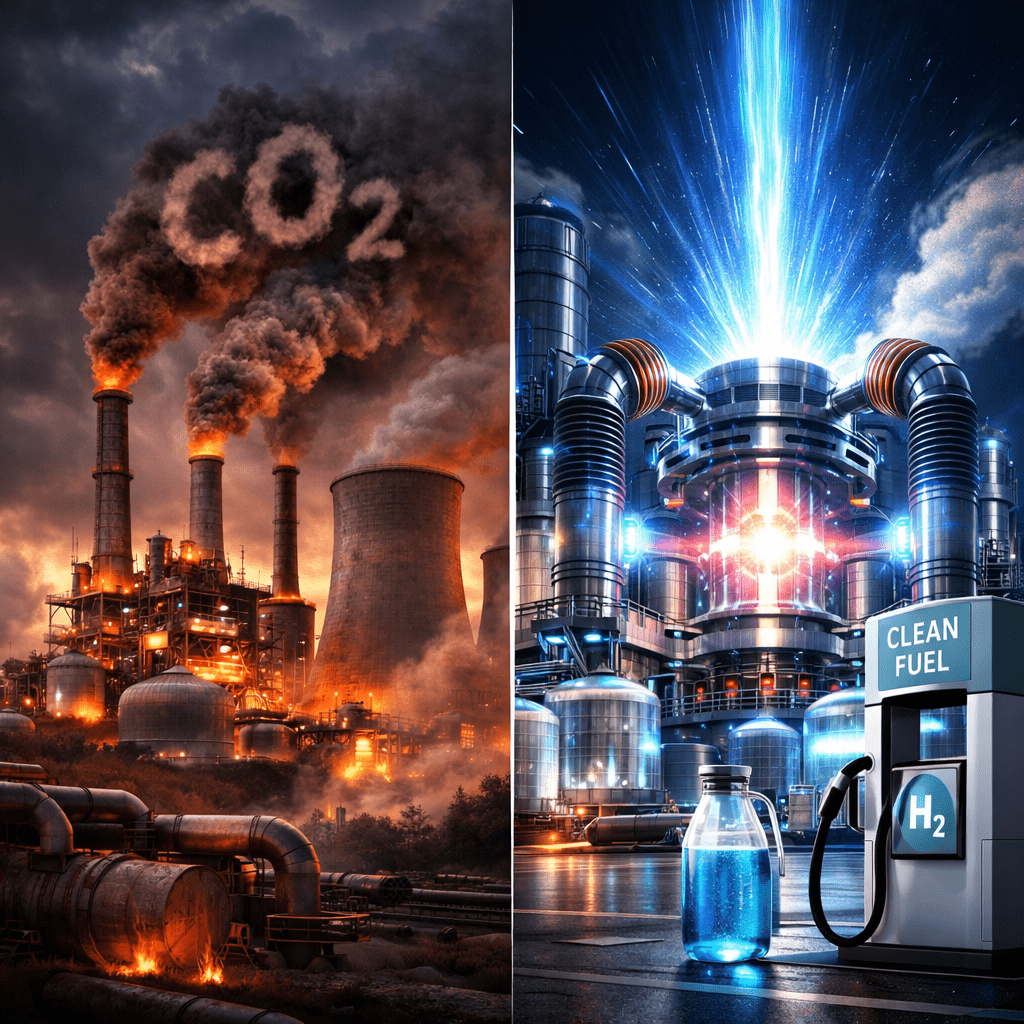
As global industries continue to grapple with reducing greenhouse gas emissions, scientists are increasingly exploring ways not just to capture carbon dioxide but also to reuse it. In sectors such as cement, steel and aviation, emissions are often unavoidable due to the fundamental chemistry of production processes. This has led to growing interest in carbon capture and utilisation technologies that can transform waste carbon into valuable products.
A recent study led by Maxwell Klein at the University of Michigan, published in Energy Advances, presents a compelling step forward in this direction. The paper, titled Non-thermal plasma upgrading of humidified CO2 into syngas in a dielectric barrier discharge reactor: tuning H2/CO ratios via specific energy input and gas flow rate, explores how carbon dioxide and water vapour can be converted into syngas using an electrically driven plasma system. The research offers new insights into how this process can be optimised for efficiency and controllability.
What is syngas, and why does it matter?
Syngas, a mixture primarily composed of hydrogen and carbon monoxide, is a cornerstone of modern industrial chemistry. It serves as a feedstock for the production of synthetic fuels, chemicals, and materials through processes such as Fischer-Tropsch synthesis. Importantly, the hydrogen-to-carbon monoxide ratio in syngas determines how effectively it can be used in downstream applications.
Traditionally, syngas is produced from fossil fuels through energy-intensive processes. However, converting carbon dioxide into syngas offers a pathway to a circular carbon economy, where emissions are recycled into useful products rather than released into the atmosphere. This is particularly relevant for achieving net-zero targets, as highlighted by international climate frameworks.
Harnessing plasma instead of heat
At the heart of the study is the use of non-thermal plasma, a state of matter in which energetic electrons coexist with relatively cool gas molecules. Unlike conventional thermal processes that rely on high temperatures, non-thermal plasma uses electrical energy to drive chemical reactions. This allows the dissociation of stable molecules, such as carbon dioxide and water, at near-ambient conditions.
In the experimental setup, the researchers employed a dielectric barrier discharge reactor, a device that generates plasma through a high-voltage electric field. When humidified carbon dioxide passes through this plasma region, energetic electrons collide with the gas molecules, breaking chemical bonds and forming new species such as hydrogen and carbon monoxide.
One advantage of this approach is that it eliminates the need for expensive catalysts, which are commonly used in traditional chemical processes but can degrade and be poisoned over time. By relying on electron-driven reactions, the system offers a potentially simpler and more robust pathway for carbon conversion.
Fine-tuning the fuel mix
A key focus of the study was understanding how operational parameters influence both the process efficiency and the composition of the syngas produced. Specifically, the researchers examined the effects of specific energy input and gas flow rate.
Specific energy input is the amount of electrical energy supplied per unit volume of gas, while the flow rate determines how long the gas remains in the plasma region. These factors are critical because they influence the distribution of electron energy and the likelihood of molecular collisions.
The results revealed that syngas composition can be tuned by adjusting these parameters. The hydrogen-to-carbon monoxide ratio ranged from approximately 0.1 to 0.2 under different conditions. This tunability is important because different industrial applications require different syngas compositions.
Interestingly, the study found that the lowest hydrogen-to-carbon monoxide ratios occurred at intermediate energy inputs rather than at the highest levels of applied energy. This challenges previous assumptions that increasing energy input would continuously favour carbon monoxide production.
The efficiency puzzle
Energy efficiency is a central concern for any emerging technology, particularly in large-scale deployment. In this study, the maximum energy efficiency reached approximately 23 percent under certain operating conditions. While this figure may appear modest, it is notable for a catalyst-free plasma system operating at near ambient temperatures.
The relationship between energy input and efficiency was found to be nonlinear. At low energy inputs, the system lacks sufficient electrons to break molecular bonds effectively. As energy input increases, efficiency improves until it reaches a peak. Beyond this point, further increases in energy lead to diminishing returns, as excess energy is dissipated through non-productive pathways such as heat generation and recombination reactions.
Flow rate also played a crucial role. Higher flow rates were associated with improved energy efficiency, likely because they reduce the residence time of molecules in the plasma and limit unwanted secondary reactions. In contrast, lower flow rates increase exposure time but also increase the likelihood of wasted energy due to repeated collisions.
Understanding the underlying chemistry
To interpret these findings, the researchers employed a simplified computational model based on electron energy distribution functions. This approach provides insight into how electrons of different energies contribute to chemical reactions.
The model suggests that different molecules require different dissociation energy thresholds. Water molecules, for example, are easier to break apart than carbon dioxide. As a result, hydrogen production can occur at lower electron energies, while carbon monoxide formation requires higher electron energies.
At intermediate energy levels, conditions favour the dissociation of carbon dioxide, leading to increased carbon monoxide production and a lower hydrogen to carbon monoxide ratio. At higher energy levels, however, both hydrogen and carbon monoxide can begin to break down again, leading to a plateau in production and reduced overall efficiency.
Implications for a circular carbon economy
The ability to convert carbon dioxide and water into tunable syngas has significant implications for the future of sustainable energy and industrial processes. By enabling the recycling of carbon emissions into valuable products, plasma-based technologies could play a key role in reducing reliance on fossil fuels.
One of the most promising applications lies in the production of synthetic fuels for sectors that are difficult to electrify, such as aviation and maritime transport. By integrating plasma reactors with renewable electricity sources, it may be possible to create low-carbon fuel production systems that operate independently of traditional fossil supply chains.
Moreover, the simplicity of the reactor design and the absence of catalysts could facilitate scalability and reduce maintenance requirements. This makes the technology particularly attractive for decentralised applications, where emissions can be treated at the source.
The research aims to reshape the carbon economy by converting waste CO2 into useful syngas using a sustainable plasma-driven system.
— Joshua Jack
Challenges and the road ahead
Despite its promise, the technology is not without challenges. Energy efficiency remains a limiting factor, and further optimisation will be required to make the process economically viable on an industrial scale.
The study also highlights the need for more advanced diagnostic tools to better understand plasma behaviour and reaction mechanisms. Techniques such as in situ spectroscopy could provide deeper insights into the transient species and pathways involved in the conversion process.
Future research will likely focus on integrating plasma systems with other technologies, such as catalytic processes or renewable energy sources, to enhance performance and broaden application
Reference
Klein, M., & Jack, J. (2026). Non thermal plasma upgrading of humidified CO2 into syngas in a dielectric barrier discharge reactor: tuning H2/CO ratios via specific energy input and gas flow rate. Energy Advances, 5, 354 to 364. https://doi.org/10.1039/d5ya00293a