Across Europe, the challenge of climate change is increasingly tied to the future of its historic built environment. Nearly one-third of the continent’s building stock comprises heritage structures that require renovation to meet climate targets. Improving their energy performance without compromising their cultural heritage value is a technically complex sustainability challenge facing policymakers, engineers, and conservation professionals.
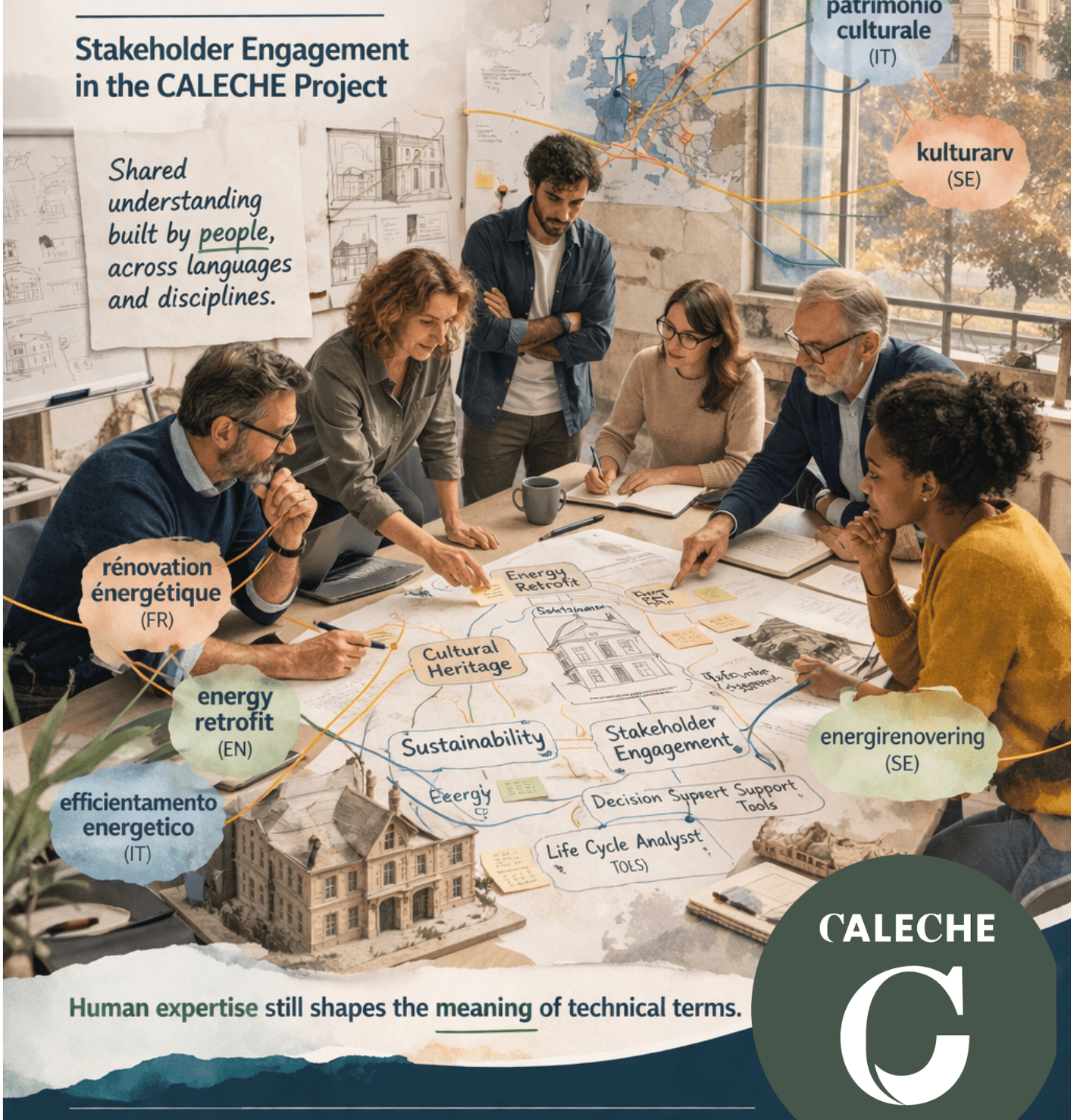
Yet progress does not depend only on technology. It also depends on communication. When architects, historians, engineers, and manufacturers collaborate across national borders, even familiar terms such as ‘energy retrofit’ or ‘cultural heritage’ can take on different meanings depending on context. Technical experts from different fields are often speaking different languages, even when they are all using English. These differences can slow decision-making and complicate cooperation in large international projects.
A recent study led by Dr. Nina Hunter of Munster Technological University highlights how artificial intelligence can help overcome this overlooked barrier. Published in Sustainability Science under the title “Developing a collaborative tool to foster communication in sustainability research”, the research demonstrates how multilingual consensus building can strengthen transdisciplinary sustainability and heritage research collaboration across Europe.
A hidden obstacle in transdisciplinary sustainability research
Climate change mitigation increasingly depends on transdisciplinary research, where expertise from the hard and soft sciences must be integrated with practice and community knowledge. However, such collaboration often includes professional friction. Participants often interpret shared terminology differently depending on their disciplinary training, professional practice, and linguistic background, although they believe they are communicating effectively because they use the same words. It is a communication hazard that can lead to fragmented cooperation and slowed decision-making.
In complex sustainability research, a critical weakness can be the illusion that we are speaking the same language just because we are using the same words.
— Dr. Nina Hunter
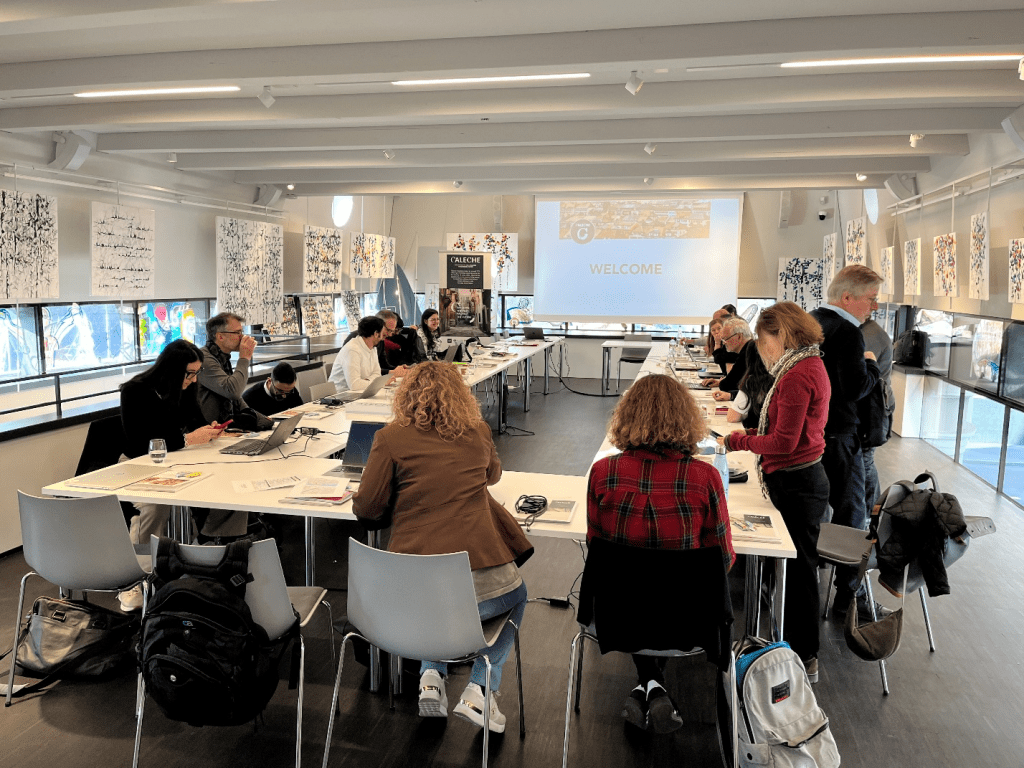
The European CALECHE research project, which investigates low-emission renovation strategies for historic buildings in France, Italy, Sweden, and Switzerland, brought together specialists from eighteen organizations representing architecture, engineering, heritage conservation, manufacturing, and research institutions. These partners were tasked with designing a decision support tool, as well as sustainable innovations and methods for heritage renovation within the wider European energy transition.
During early collaboration, researchers identified that differences in terminology were affecting communication among participants and stakeholders. Even widely used technical expressions such as life cycle analysis, and building information modeling were understood differently across professional domains and national contexts. Cooperation risked becoming fragmented.
This challenge prompted the research team to explore whether artificial intelligence could support the development of a multilingual project lexicon capable of strengthening collaboration across disciplines and languages.
The CALECHE project and the urgency of sustainable heritage renovation
The Horizon Europe funded CALECHE project, formally known as Coherent Acceptable Low Emission Cultural Heritage Efficient Renovation, aims to support decision making for sustainable renovation of cultural heritage buildings through co-design and stakeholder engagement. Its work includes applying photovoltaic modules, improving historic window conservation techniques and developing bio-based insulation materials with low embodied carbon.
These interventions are not purely technical. They also involve negotiating between different values, constraints and stakeholder perspectives. Sustainable heritage renovation involves balancing energy efficiency targets with conservation ethics, regulatory requirements and local cultural identity. As a result, decision making depends heavily on collaboration between experts and communities.
Within this context, terminology clarity becomes essential. When stakeholders do not share the same understanding of key concepts, participatory processes become less effective and implementation pathways become more difficult to coordinate. The research team therefore proposed that creating a shared multilingual glossary could improve communication across the project’s international network.
Using artificial intelligence to build consensus definitions
To develop this collaborative tool, the research team designed a multilingual survey targeting project partners and advisory board members. Respondents evaluated definitions of thirty-five technical and conceptual terms relevant to sustainable heritage renovation, including cultural heritage, stakeholder engagement, energy retrofit, and artificial intelligence. Participants were invited to accept or modify proposed definitions in English, French, Italian or Swedish.
The responses revealed a strong need for clarification. Agreement levels varied widely across terms, with definitions on core concepts such as energy retrofit and photovoltaic modules receiving only 62% consensus. These results confirmed that terminology differences were not minor linguistic issues but structural challenges affecting interdisciplinary communication in sustainability research.
At this stage, the researchers introduced artificial intelligence as a synthesis tool. GPT 4o was used to analyse survey responses across the four languages and generate consensus definitions that reflected the weighting of participant agreement and suggested modifications. Importantly, the system was instructed to rely solely on survey responses rather than external sources, ensuring that definitions remained grounded in the expertise of project participants.
The resulting lexicon represented a hybrid model of human-AI collaboration in which disciplinary insight and computational processing complemented one another. AI was particularly effective at synthesizing 11 different modifications for a single term, a task that would be difficult for a human committee dominated by one discipline. Rather than replacing researchers, artificial intelligence, acted as a neutral broker, enabling them to integrate multilingual perspectives more efficiently.
Why multilingual collaboration strengthens climate research
Multilingual communication plays a critical role in European sustainability science. With 24 official languages across the European Union and additional regional languages in active use, research projects must accommodate linguistic diversity to remain inclusive and effective.
In the CALECHE study, three-quarters of respondents chose to move away from the official project language, English, and answered in French, Italian and Swedish, to ensure that disciplinary and technical nuances weren’t lost in translation. This outcome demonstrated the importance of allowing participants to engage in their native languages when discussing complex technical concepts.
The resulting lexicon therefore functioned not only as a glossary but also as a communication bridge. It supported understanding among engineers unfamiliar with heritage terminology and heritage specialists unfamiliar with energy performance modelling. It also supported non-expert stakeholders in participating in engagement workshops addressing sustainable renovation strategies for historic buildings.
AI alone fails: Human expertise still shapes the meaning of technical terms
To guarantee technical precision and linguistic accuracy, the AI-generated definitions underwent a multi-stage validation process where native-speaking technical partners audited and refined the translations. One of the most significant findings of the study was that consensus definitions derived from participant responses differed meaningfully from definitions generated solely by artificial intelligence. Survey-informed definitions placed greater emphasis on interdisciplinary cooperation, operational contexts, and real-world implementation challenges.
For example, definitions of co-design produced through the participatory process highlighted equality of contributions among stakeholders and the diversity of expertise involved in decision-making. In contrast, purely AI-generated definitions were more abstract, and tended to focus more narrowly on aligning outcomes with stakeholder needs.
Similarly, consensus definitions of energy performance included concrete examples of operational requirements relevant to heritage renovation, making them more practical for use in project workshops and stakeholder consultations. These differences suggest that human input is nuanced and operational, bringing reasoning grounded in real-world experience, and is essential when developing terminology frameworks for sustainability research collaboration.
From glossary to decision support tool for sustainable heritage renovation
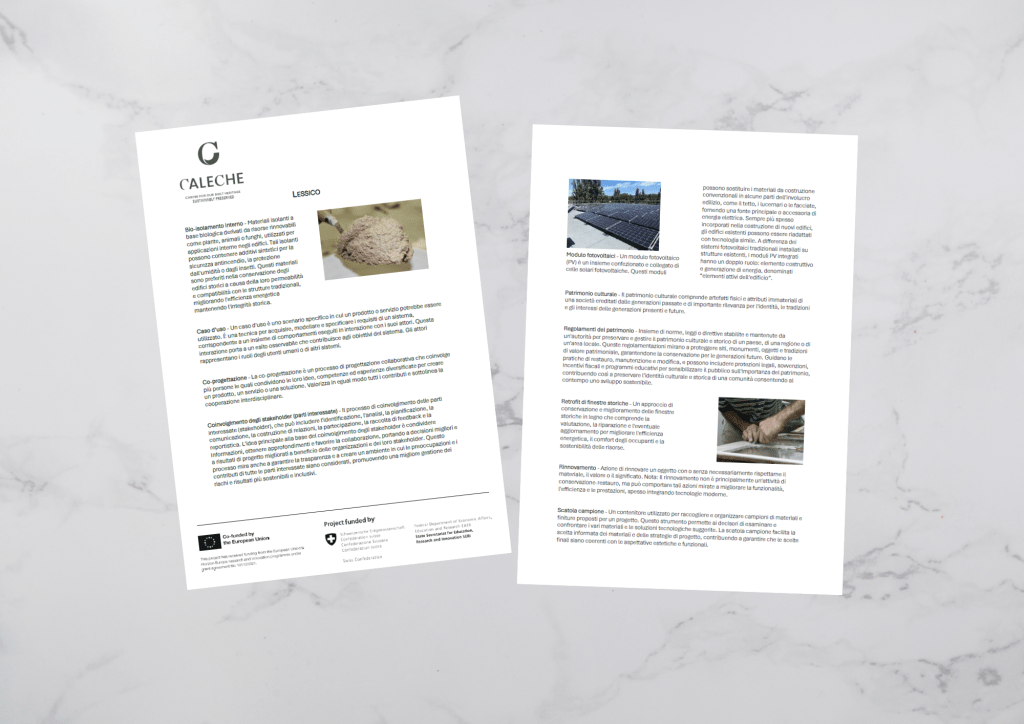
The completed lexicon included thirty-two validated terms and will be incorporated into the CALECHE Historic Renovation Hub, a digital resource designed to support communication among project partners and stakeholders. Shorter versions of the glossary were also developed for expert and non-expert audiences participating in local engagement workshops.
For example, non-expert participants received illustrated explanations of photovoltaic modules and interior bio-insulation materials to support understanding during discussions of renovation strategies. Expert participants received more specialized terminology related to decision trees, building information modeling, and scenario analysis.
This targeted approach ensured that terminology clarification supported both technical collaboration and community engagement. By facilitating communication at multiple levels, the lexicon contributed to more inclusive participation in sustainability research processes addressing climate change mitigation. The CALECHE research demonstrates that a shared technical vocabulary is not a luxury, but a foundational requirement for moving sustainability from abstract theory into successful, real-world implementation
Reference
Hunter, N., Perret, N. L., & Klepal, M. (2026). Developing a collaborative tool to foster communication in sustainability research. Sustainability Science. https://doi.org/10.1007/s11625-025-01791-8
Coauthors

Dr. Noëlle-Laetitia Perret is an Associate Professor at the University of Geneva and co-director of the Institut Arthur Piaget in Neuchâtel. A social historian specializing in diplomacy and collective memory, she provides critical humanities expertise to the CALECHE project. Her work bridges historical power dynamics with modern sustainability challenges, focusing on how shared definitions and consensus-building facilitate the renovation of European heritage buildings within the wider energy transition.

Dr. Martin Klepal is a Lecturer and Researcher at Munster Technological University (MTU) in the Department of Electrical and Electronic Engineering. He focuses on smart systems and user engagement technologies. With a background in indoor localization and energy-efficient district management, he provides critical technical expertise to the CALECHE project. His work centres on developing innovative applications that integrate advanced analytics with human-centric design to drive sustainable technological transitions.