
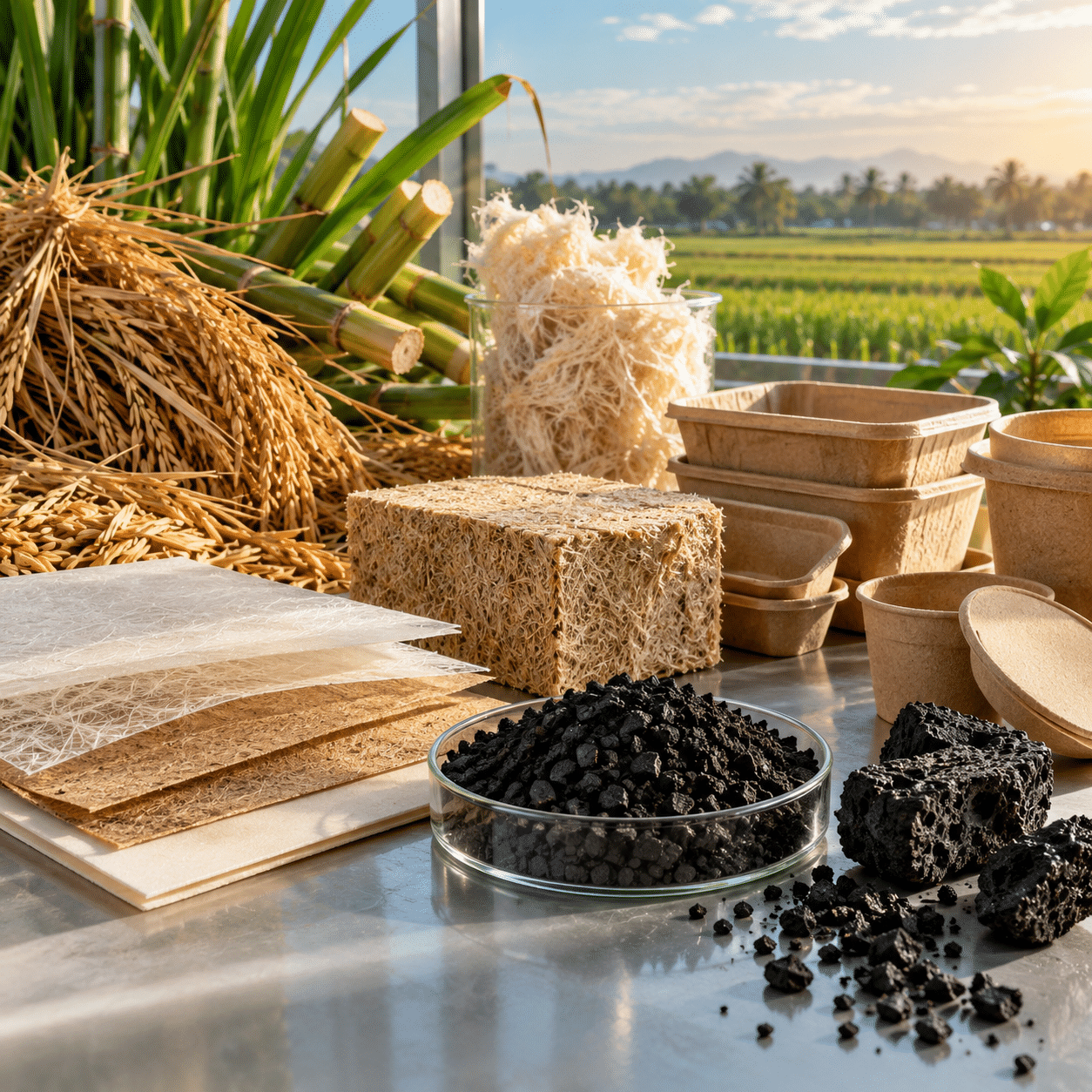
Agricultural waste is often treated as a disposal challenge. Yet rice straw, sugarcane bagasse and other residues could also become feedstocks for new industries, innovative products and skilled employment.
Lignocellulosic biomass, including sugarcane bagasse, rice straw, husks and wood residues, is a renewable resource rich in cellulose, hemicellulose and lignin. These components can serve as feedstocks for bioenergy, biofuels, biochemicals and biomaterials. Researchers are also exploring how agricultural residues can be transformed into advanced carbon materials, functional composites and sustainable alternatives to conventional plastics.
Biomass valorisation means converting agricultural and other biological residues into products with economic or environmental value. In practice, biomass is collected, pretreated and converted into useful products rather than being discarded. Conventional approaches include composting, animal feed, briquettes, biogas and energy recovery. Emerging approaches seek to extract greater functionality from biomass, producing materials and chemicals for applications beyond conventional waste management.
The potential of biomass extends beyond direct energy production to the development of advanced, durable materials with longer service lives. Innovations such as stimuli-responsive smart polymers, wear-resistant nanostructured coatings and AI-assisted 3D and 4D printing demonstrate how materials engineering can improve product longevity, performance and resource efficiency. Where compatible biomass-derived feedstocks can be incorporated, these advances may create opportunities across material processing, manufacturing, product design, testing and recycling, strengthening the wider bioeconomy.
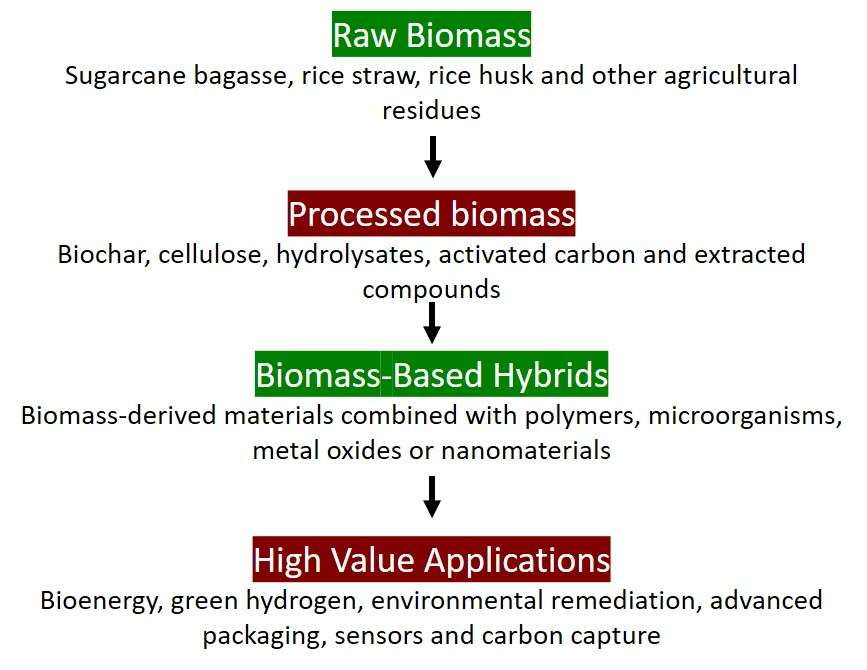
From raw biomass to high-value applications
Raw agricultural residues can be processed into biochar, cellulose, hydrolysates, activated carbon and other useful intermediates. These materials can then be combined with polymers, microorganisms, metal oxides, enzymes or nanomaterials to create biomass-based hybrids with tailored properties.
This progression represents an important shift: from simply using biomass to engineering, it to perform functions the original material could not. For example, biomass-derived carbon can be developed into conductive materials, while biomass fibres can reinforce polymers to create lightweight composites. Combining biomass-derived materials with microorganisms can also support bioelectrochemical systems, including microbial fuel cells.
When waste becomes an advanced material
Recent advances in biomass valorisation show how agricultural residues, forestry waste and marine biomass are being investigated for advanced functional materials. Emerging research explores the conversion of waste wood into graphene-like carbon materials to enhance the flame-retardant properties of bioplastics, as well as the use of biomass-based composite materials to remove dyes and other pollutants from wastewater. Biomass-derived carbon materials, biochar composites, biopolymers and nanostructured materials are also being investigated for energy storage, environmental remediation, sustainable packaging, construction and other high-value applications.
These developments show the potential for biomass valorisation to move beyond conventional biofuel production into advanced materials engineering and environmental technology. They also create opportunities for interdisciplinary careers in materials science, biotechnology, chemical engineering, nanotechnology, environmental engineering and industrial process development. However, translating promising laboratory findings into commercially viable products requires assessment of production costs, material performance, durability, environmental safety, scalability and market demand. Addressing these challenges will be essential to expanding the industrial use of biomass-derived materials and supporting employment in research, manufacturing and technology commercialisation.
These combinations represent research and development pathways rather than universally established commercial technologies. Their performance, safety, cost and environmental benefits must be demonstrated for each intended application.
Table 1. Potential biomass hybrids and their applications
|
Biomass-hybrids |
Potential Applications |
|
Biomass + polymers |
Biocomposites, biodegradable foams and sustainable packaging |
|
Biomass-derived carbon + metals or metal oxides |
Electrodes, catalysts, energy storage and hydrogen-related technologies |
|
Biomass + microorganisms |
Microbial fuel cells and wastewater-energy recovery |
|
Biomass + porous materials or nanoparticles |
Pollutant removal, gas adsorption and sensing |
|
Biomass + enzymes or natural pigments |
Biosensors, pollutant degradation and food freshness indicators |
|
Biomass + smart polymers or thermal-storage materials |
Responsive packaging and thermal-management products |
The workforce behind biomass innovation
The employment potential of biomass valorisation extends far beyond the laboratory where a new material or process is developed. Each technology requires a supporting value chain that includes feedstock collection, preprocessing, conversion, quality testing, manufacturing, logistics, marketing, and maintenance.
Consider a biomass-derived carbon material developed for energy storage. Its journey may involve agricultural suppliers, carbon-processing specialists, materials scientists, electrochemical engineers, analytical technicians, equipment manufacturers and quality-control professionals. Commercial deployment may create further opportunities in product certification, environmental assessment, supply chain management, and sales.
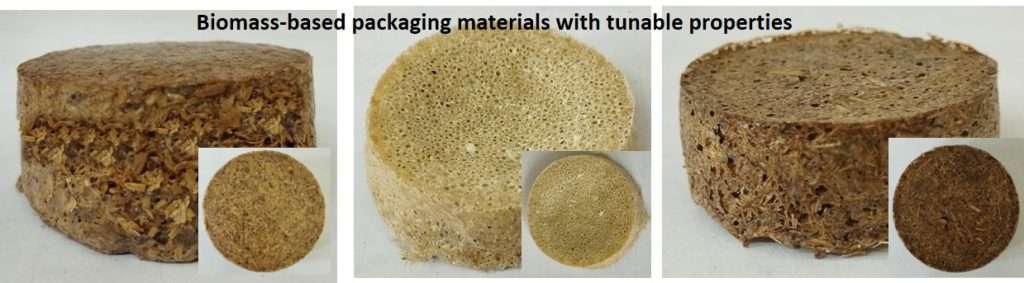
Similarly, biomass-based packaging requires more than a biodegradable formulation. Product developers must assess mechanical strength, moisture resistance, durability, manufacturing consistency and end-of-life performance. Wastewater-treatment materials require specialists in water analysis, adsorption processes, treatment-system design and operational monitoring.
One technological innovation can therefore support a network of occupations. The scale of that opportunity depends on whether the technology progresses from research to manufacturing and sustained market adoption.
Preparing for green careers
The emerging biomass economy requires interdisciplinary skills. Biotechnology graduates may contribute to microbial conversion and fermentation; chemists and materials scientists can develop functional compounds and composites; and chemical, mechanical and environmental engineers can optimise processes and design industrial systems.
Additional opportunities may arise in analytical testing, process monitoring, life-cycle assessment, quality assurance, regulatory compliance, product design, logistics and entrepreneurship. Skilled technicians and equipment operators will also be essential as pilot plants and manufacturing facilities expand.
Universities can prepare students through interdisciplinary coursework, laboratory training, industry-linked projects, internships and exposure to pilot-scale processing. Training should connect scientific knowledge with practical skills in characterisation, process optimisation, safety, sustainability assessment and product development.
The goal is not to make every graduate an expert in every discipline. It is to develop a workforce capable of collaborating across the biomass value chain.
India’s opportunity: from research to industry
India’s agricultural residues offer opportunities for bioenergy, bio-based products and rural employment. Realising this potential requires reliable feedstock supply chains, infrastructure, investment and supportive policies. Collaboration among researchers, farmers, start-ups and industry can accelerate commercialisation through pilot-scale validation, life-cycle assessment and techno-economic evaluation. Public funding, technical training and accessible testing facilities can further support rural enterprises, promote sustainable technologies and enable equitable growth across the biomass value chain.
Beyond generating value-added products, biomass valorisation can be tuned to explore advanced next-generation hybrid and composite materials, creating potential employment opportunities.
— Prof. S. M. A. Shibli
Biomass valorisation and future green employment
Biomass valorisation offers a pathway to transform agricultural and organic waste into economic value while supporting green careers. The European Union’s bioeconomy generated approximately 17.1 million jobs and €863 billion in value added in 2023. Separately, global renewable-energy employment reached 16.6 million in 2024, including 3.7 million jobs in bioenergy. These figures describe different, broader sectors and should not be interpreted as jobs created by biomass valorisation alone. As investment in biorefineries, bio-based chemicals, advanced materials, biofuels and sustainable packaging expands, employment opportunities could grow across agriculture, research, manufacturing, logistics and entrepreneurship. For India, agricultural residues offer potential to link waste management with rural livelihoods and green industrial development. Realising that potential will require investment in innovative technologies, skills, supportive policies and commercially viable products.
Over the next decade, expanding biomass valorisation could increase demand for skilled professionals across biorefineries, bioenergy, bio-based materials, waste management and circular manufacturing. Employment opportunities may extend beyond direct processing jobs to feedstock supply, logistics, research and development, quality assurance and technology commercialisation. The scale of growth will depend on industrial investment, technological maturity, supportive policies and market demand. For India, agricultural residues offer a potential route to connect rural employment with green industrial development, provided that technologies prove commercially and environmentally viable.
Reference
LASARTE, L. J., & M’BAREK, R. (2025). The EU bioeconomy at a glance: Focus on economic value added, employment and innovation. https://publications.jrc.ec.europa.eu/repository/handle/JRC143759