
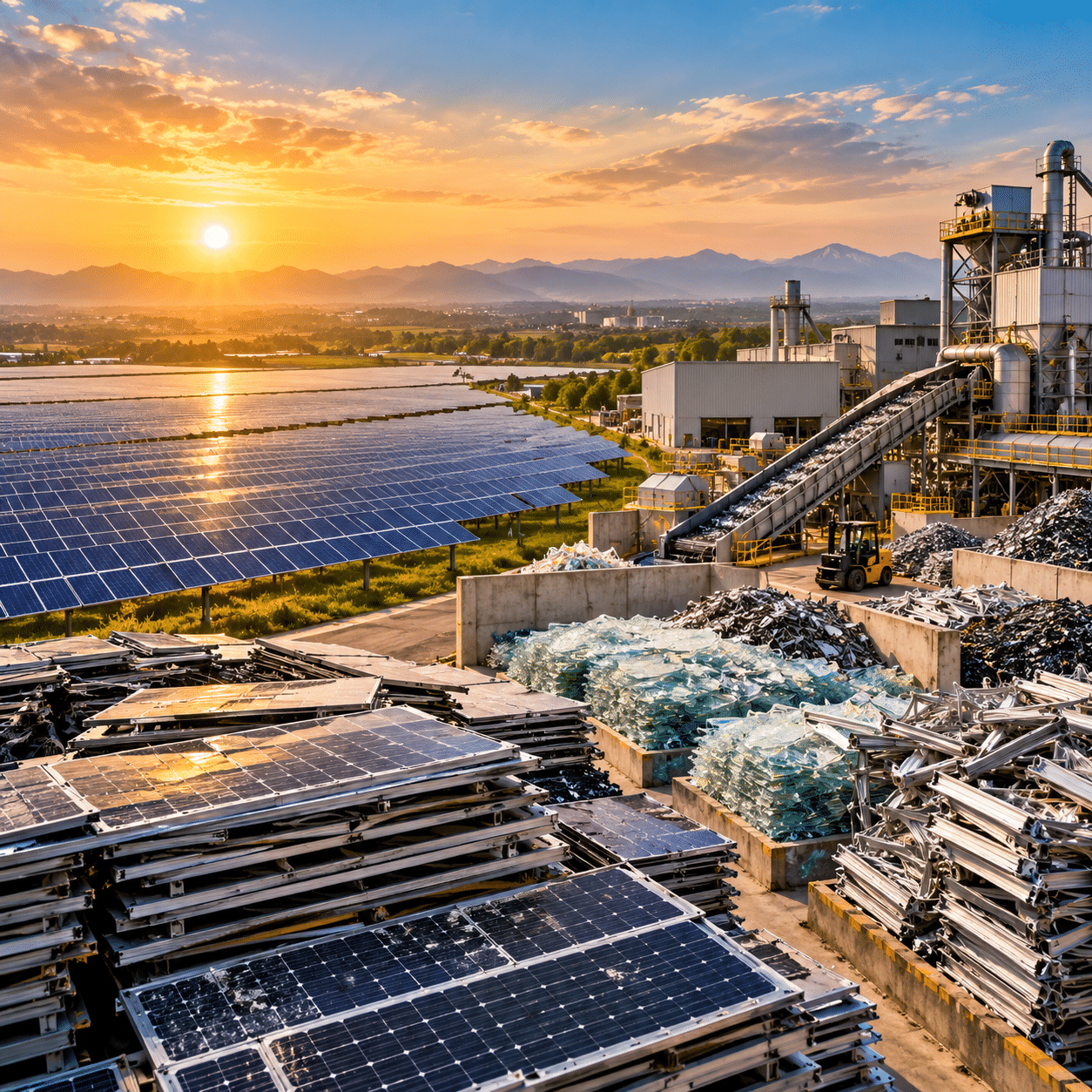
Solar photovoltaic (PV) panels generate electricity without direct emissions during operation. However, they do not last indefinitely. As installed panels age, degrade or become damaged, they eventually enter the waste stream. Managing this growing volume of end-of-life equipment will require more than conventional waste disposal. It will demand effective recycling technologies, material recovery systems, and policies that account for the entire life cycle of solar infrastructure.
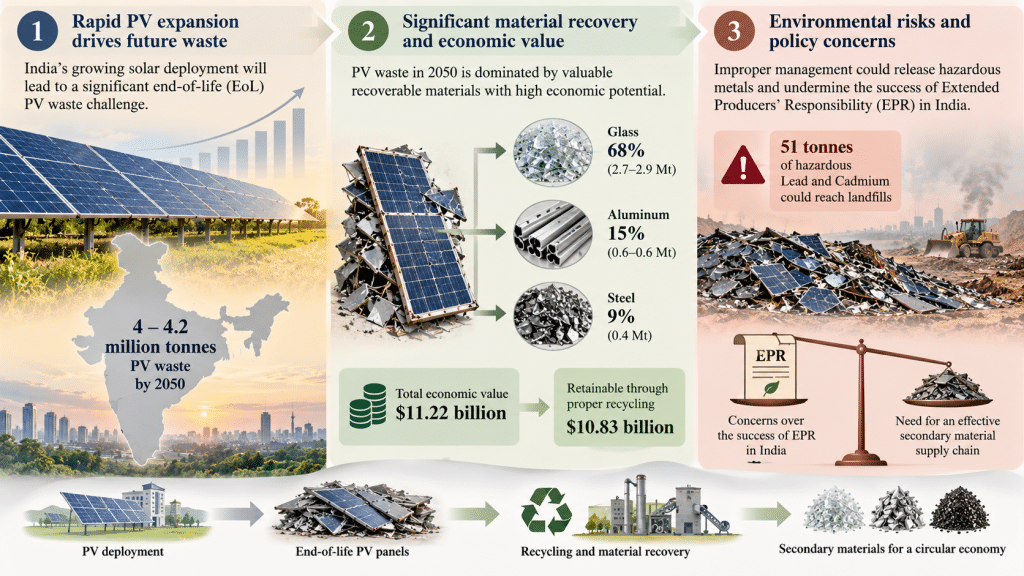
A research study titled Material flow assessment of photovoltaic waste in India: Quantification, characterization, and resource recovery potential to 2050, published in the journal Resources, Conservation & Recycling, examines the scale of this emerging challenge. The first author, Amim Altaf Nabi, and coauthor Prof. Arvind Kumar Nema, from the Department of Civil and Environmental Engineering at the Indian Institute of Technology Delhi (IIT Delhi), estimate that India could generate approximately 4 to 4.2 million tonnes of solar panel waste by 2050 from its existing installed capacity alone.
The success of the solar revolution should not be measured solely by the capacity we install today, but also by how responsibly we manage that capacity tomorrow. Solar PV waste, if managed strategically, can become an important resource for the very energy transition that generates it.
—Amim Altaf Nabi
The hidden waste behind clean energy
Solar photovoltaic technology has become a central component of the global transition towards renewable energy. Increasing electricity demand, concerns about climate change and the need to diversify energy sources have accelerated solar installations across many countries, including India. Yet the environmental performance of solar energy cannot be assessed solely by the electricity generated during a panel’s operational life.
Photovoltaic modules have finite service lives, commonly considered to be around 25 years in end of life modelling. Their eventual disposal creates a waste stream that must be anticipated well before large numbers of panels become obsolete. Unlike ordinary household waste, PV waste contains a mixture of glass, metals, polymers and other materials that require different treatment and recovery processes.
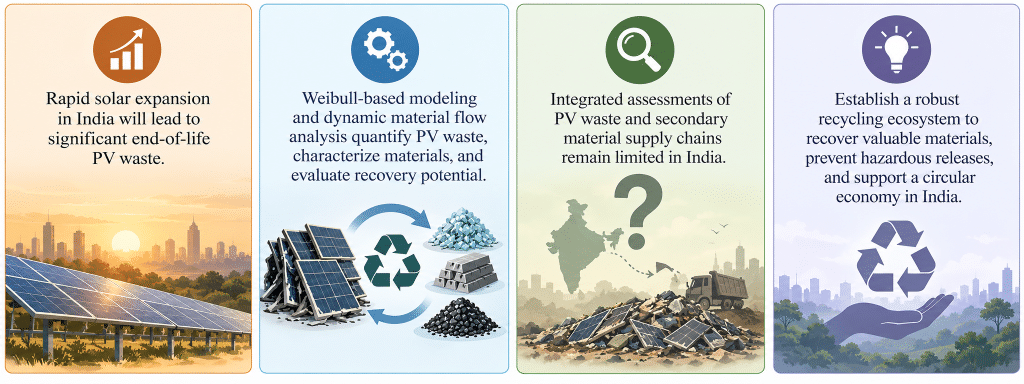
The challenge is particularly relevant for a country expanding its solar capacity while developing the infrastructure needed to manage future waste. The researchers therefore approach the issue not merely as a disposal problem, but as a question of resource management. Understanding how much waste may arise, what it contains, and which materials can be recovered provides a scientific foundation for planning recycling capacity and developing a circular economy for solar technology.
How researchers estimated India’s solar panel waste
The study combines two analytical approaches: Weibull distribution-based lifetime modelling and dynamic material flow analysis (MFA). Together, these methods allow the researchers to estimate the quantities of photovoltaic waste expected to emerge over time and examine the composition and potential value of the resulting material stream.
Weibull modelling is commonly used to describe the probability of equipment failure over its lifetime. Rather than if every solar panel fails at precisely the same age, the approach can represent different patterns of failure, including early failures and failures occurring closer to the end of the expected service life. The researchers considered two scenarios, described as early loss (EL) and regular loss (RL), to account for variation in the timing of panel retirement.
Millions of tones could emerge by 2050
The researchers estimate cumulative photovoltaic waste of approximately 4 million tonnes under the regular loss scenario and 4.2 million tonnes under the early loss scenario by 2050. The difference reflects the effect of assumptions about how quickly panels leave service. Both scenarios indicate that end of life solar equipment could become a substantial waste stream requiring dedicated management.
The timing of this increase is as important as the projected total. According to the study, the contribution of retired panels becomes particularly significant as installed modules approach the end of their expected service lives. A substantial increase is projected during the later years of the assessment period, especially between 2045 and 2050, when many panels installed during earlier phases of solar expansion may reach the end of their service lives.
What discarded solar panels contain
One of the study’s important contributions is its assessment of material composition. The projected photovoltaic waste stream is dominated by glass, which accounts for approximately 68 per cent of the total. Aluminium represents around 15 per cent, while steel accounts for approximately 9 per cent. Ethylene vinyl acetate (EVA), a polymer used in panel construction, contributes about 6 per cent.
This composition matters because the management options differ between materials. Glass and aluminium occur in substantial quantities and have established uses in manufacturing and other industries. Recovering these materials can reduce the amount requiring disposal and potentially reduce demand for virgin raw materials. The study estimates that approximately 95 per cent of the glass could be recoverable under the recovery assumptions used in its analysis.
A potential US$11.22 billion resource
The economic assessment identifies a substantial potential value within the projected photovoltaic waste stream. The researchers estimate a total material value of approximately US$11.22 billion, with around US$10.83 billion potentially recoverable through appropriate recycling. This suggests that end of life solar panels could serve as a secondary source of raw materials for manufacturing and related industries.
The study identifies silver as a particularly valuable component, estimating its potential value at approximately US$2.6 billion. It also discusses the potential recovery of large quantities of glass and aluminium, alongside other materials that could support industrial supply chains. Recovered materials may contribute to reducing dependence on newly extracted resources and, in some applications, imported raw materials.
The environmental risks of improper disposal
The resource recovery opportunity is accompanied by an environmental concern. Photovoltaic panels can contain hazardous substances, including lead and cadmium, depending on the technology and materials used. If these substances are released through inappropriate dismantling, disposal or degradation, they can create risks of contamination in soil and water.
The study highlights the potential for hazardous metals to remain in waste that are not adequately recovered. Its abstract estimates that 51 tonnes of lead and cadmium could reach landfills if the waste is improperly handled. The detailed discussion further identifies approximately 14 tonnes of lead and 37 tonnes of cadmium as unrecoverable under the model’s assumptions. Although these quantities represent a very small share of the overall waste by mass, their environmental significance cannot be judged by weight alone.
Why producer responsibility presents a challenge
The researchers also examine the implications of India’s Extended Producer Responsibility (EPR) framework under the Electronic Waste Management Rules, 2022. EPR is intended to make producers responsible for managing products when they reach the end of their useful lives. In principle, this approach can encourage better product design, collection systems and recycling arrangements by linking manufacturers to end of life management.
However, the study identifies a potential geographical challenge. Solar panel manufacturers, installation sites and recycling facilities are not distributed evenly across India. Panels manufactured in one region may be installed hundreds of kilometres away, including in remote locations. Returning retired panels to their original manufacturers could consequently involve substantial transportation and logistical costs.
Reference
Nabi, A. A., & Nema, A. K. (2027). Material flow assessment of photovoltaic waste in India: Quantification, characterization, and resource recovery potential to 2050. Resources, Conservation & Recycling, 237, Article 109157. https://doi.org/10.1016/j.resconrec.2026.109157