Autoimmune diseases arise when the immune system mistakenly attacks the body’s own tissues, leading to chronic inflammation, organ damage, and long-term disability. Conditions such as multiple sclerosis, type 1 diabetes, rheumatoid arthritis, and lupus affect millions of people worldwide and are commonly managed using immunosuppressive therapies. While effective at reducing disease activity, these treatments often act broadly, weakening both harmful and protective immune responses.
This lack of selectivity remains a major limitation in autoimmune therapy. Many current drugs deplete entire populations of immune cells or indiscriminately dampen immune signaling, leaving patients vulnerable to infections and malignancies. The challenge facing researchers has therefore been how to suppress pathogenic immune activity without permanently compromising immune competence.
A new study published in Acta Pharmaceutica Sinica B proposes a promising solution. Led by first author Lauren C. Naatz under the guidance of Mingnan Chen and coauthors at the University of Utah, the research introduces a bispecific antibody-based strategy that selectively eliminates activated immune cells driving autoimmune disease while sparing resting immune cells. The work titled “Bispecific killer engager for targeted depletion of PD-1 positive lymphocytes: A new avenue for autoimmune disease treatment” suggests a potential shift towards precision immunotherapy in autoimmune conditions.
Targeting the cells that drive autoimmunity
A growing body of evidence suggests that immune cells expressing programmed death 1, commonly referred to as PD-1, play a crucial role in the progression of autoimmune diseases. PD-1 is a surface receptor upregulated on activated T and B lymphocytes during sustained immune responses. While PD-1 normally functions as a regulatory checkpoint to limit immune activation, PD-1-positive cells accumulate in several autoimmune diseases, contributing to chronic inflammation.
Previous studies have shown that selectively depleting PD-1-positive lymphocytes can alleviate disease symptoms in animal models of multiple sclerosis and type 1 diabetes. However, translating this concept into a clinically viable therapy has proven difficult. Conventional depleting antibodies targeting PD-1 have demonstrated only modest efficacy, particularly against primary immune cells that express PD-1 at moderate and dynamic levels.
The study by Naatz and colleagues addresses this challenge by combining PD-1 targeting with active recruitment of the innate immune system, specifically natural killer cells. This approach leverages immune effector mechanisms rather than relying solely on passive antibody-mediated depletion.
Introducing bispecific killer engagers
The technology at the centre of the study is known as a bispecific killer engager, or BiKE. Bispecific antibodies are engineered molecules designed to bind two different targets simultaneously. In oncology, BiKEs have gained attention for their ability to redirect cytotoxic immune cells towards tumour cells with high precision.
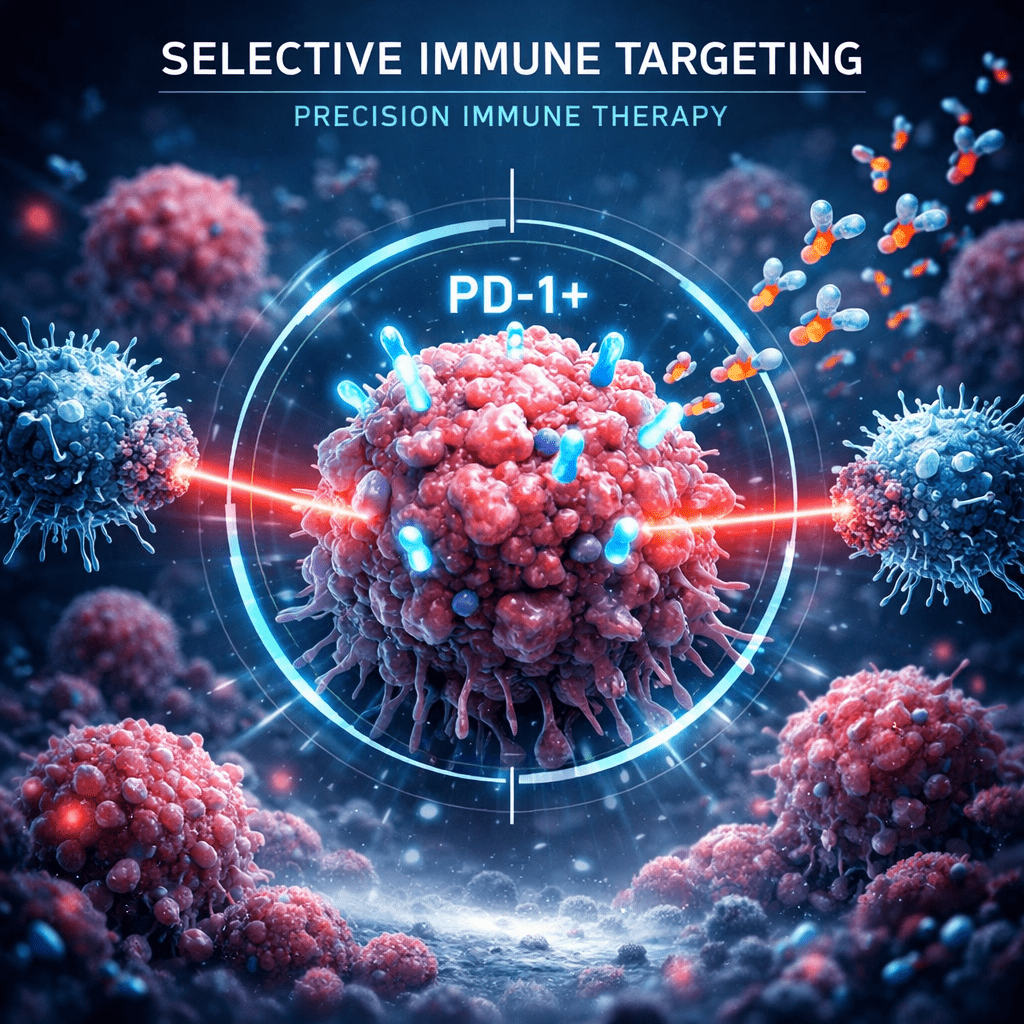
In this study, the researchers designed a PD-1 specific BiKE that binds both PD-1 on activated lymphocytes and CD16 on natural killer cells. CD16 is an activating receptor expressed on the majority of mature natural killer cells and plays a crucial role in antibody-dependent cellular cytotoxicity. By physically linking PD-1-positive immune cells to natural killer cells, the BiKE facilitates targeted immune-mediated killing.
Importantly, this strategy differs from traditional immune checkpoint inhibitors used in cancer therapy. Rather than blocking PD-1 signalling, the PD-1 BiKE exploits PD-1 expression as a marker of pathogenic immune activation and uses it as a trigger for selective cell depletion.
Engineering a tetravalent immune engager
The PD1 BiKE, developed by the research team, adopts an IgG-like tetravalent structure. It incorporates a full-length anti-PD1 antibody backbone derived from nivolumab, combined with two additional single-chain variable fragments that bind CD16. This design provides two binding sites for PD-1 and two for CD16, enhancing both target recognition and natural killer cell engagement.
Laboratory characterisation confirmed that the molecule exhibits high stability under physiological conditions and retains simultaneous binding capacity for both targets. Compared with conventional anti-PD1 antibodies, the BiKE demonstrated significantly stronger binding to CD16, a critical factor for efficient natural killer cell activation.
This structural design allows the BiKE to overcome a key limitation of standard depleting antibodies, namely the relatively weak and competitive interaction between antibody Fc regions and CD16. By directly engaging CD16 with high-affinity binding domains, the BiKE achieves more robust immune activation.
Selective killing of PD-1 positive cells
Using both engineered cell lines and primary human immune cells, the researchers demonstrated that the PD-1 BiKE induces potent natural killer cell-mediated cytotoxicity against PD-1-positive targets. In co-culture experiments, the BiKE triggered apoptosis and depletion of PD-1-expressing B and T cells, while leaving PD-1-negative cells largely unaffected.
Notably, the depletion effect was observed at very low nanomolar and even sub-nanomolar concentrations, indicating high potency. Importantly, the BiKE exhibited no intrinsic cytotoxicity in the absence of natural killer cells, confirming that cell death was immune-mediated rather than a direct toxic effect.
This selectivity is particularly relevant in the context of autoimmune disease. Unlike many existing therapies that indiscriminately deplete lymphocytes, the PD-1 BiKE preferentially eliminates activated immune cells that are actively involved in disease processes.
Sparing naive immune cells
One of the most compelling findings of the study is the BiKE’s ability to spare naive and inactive immune cells. When tested against primary human T cells, the PD-1 BiKE selectively depleted activated PD-1-positive T cells while leaving unstimulated, PD-1-negative T cells intact.
Further analysis revealed that the BiKE significantly reduced the number of CD69-positive, activated T cells, a key marker of immune activation, without affecting CD69-negative, resting T cells. This suggests that the therapy targets pathogenic immune activity while preserving the immune repertoire necessary for normal immune defence.
This level of selectivity addresses a major safety concern associated with long-term immunosuppression. By avoiding broad immune depletion, PD-1 targeted BiKE therapy may reduce the risk of infections and secondary malignancies that currently limit many autoimmune treatments.
Advantages over conventional antibody therapies
The study directly compared the PD-1 BiKE with a conventional depleting anti-PD-1 antibody engineered in an IgG1 format. Across multiple assays, the BiKE consistently outperformed the standard antibody in terms of CD16 binding, natural killer cell activation, and target cell depletion.
Even at concentrations more than one hundred times lower, the BiKE achieved greater immune activation and cytotoxicity than the depleting antibody. These results underscore the advantage of bispecific engagement in harnessing immune effector functions.
From a therapeutic perspective, this enhanced efficiency could translate into lower dosing requirements and improved safety profiles. Reduced systemic exposure may also limit off target effects and immune related adverse events.
A broader future for bispecific immunotherapy
While bispecific killer engagers have been extensively studied in oncology, their application in autoimmune disease remains largely unexplored. This research represents one of the first demonstrations that BiKE technology can be adapted to target pathogenic immune cells rather than malignant cells.
Autoimmune diseases present unique challenges compared with cancer, including dynamic antigen expression and the need for high safety margins. The success of the PD1 BiKE in selectively depleting activated immune cells suggests that these challenges may be surmountable with careful molecular design.
More broadly, the study highlights the potential of immune engineering approaches that go beyond blocking signalling pathways and instead reshape immune cell interactions. As understanding of immune cell heterogeneity continues to grow, such precision strategies are likely to gain increasing prominence.
Reference
Naatz, L. C., Dong, S., Evavold, B., Ye, X., & Chen, M. (2025). Bispecific killer engager for targeted depletion of PD 1 positive lymphocytes: A new avenue for autoimmune disease treatment. Acta Pharmaceutica Sinica B, 15(3), 1230–1241. https://doi.org/10.1016/j.apsb.2024.10.014