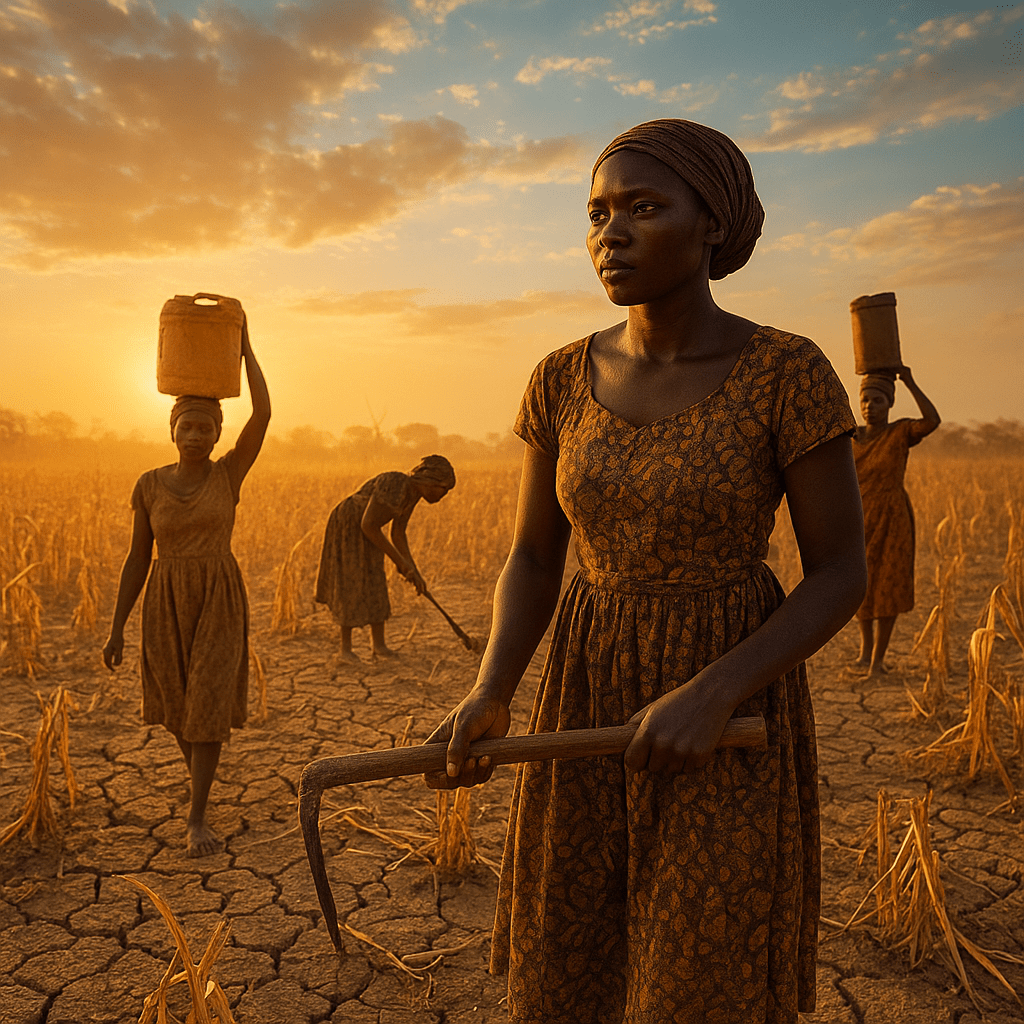
When people think of climate change, they often picture melting glaciers, shrinking forests, or dying coral reefs. But in Africa, it is also changing something less visible: the lives and livelihoods of millions of women.
Climate change is often discussed as an environmental or economic challenge, but less frequently as a gendered one. In Africa, however, a warming climate is rapidly becoming both a women’s rights issue and a labour market concern. According to new research by Simon Alain Song Ntamack (University of Yaoundé II, Yaoundé) and Jacques Simon Song (University of Dschang/University of Ebolowa), published in Natural Resources Forum, climate change is eroding women’s participation in the African workforce and widening existing inequalities.
Across forty eight African countries, the researchers found a consistent trend. When the temperature rises, fewer women are able to work. The change may seem small on paper, but it has deep social consequences. A one percent increase in average temperature can reduce women’s participation in the labour force by up to two percent.
Heat, rain, and disappearing work
Between 2000 and 2019, Africa’s average temperature climbed from 24.15°C to 24.63°C. During the same period, the number of women participating in the labour force fell from 46 percent to just over 41 percent.
The reason lies in the link between climate and livelihood. Around sixty percent of African women depend on agriculture for income, often through small family farms or informal trading. These jobs depend on the land, the weather, and the rhythm of the seasons. When droughts strike or floods destroy crops, the losses are immediate and personal.
As the climate becomes more erratic, the opportunities for paid work diminish. Crops fail, livestock perish, and household income dries up. Many women are then forced to spend more time on unpaid domestic work such as fetching water, caring for children, or gathering firewood, leaving less time for economic activity.
This cycle traps women in poverty and increases dependence on men, which in turn widens existing gender gaps.
A closer look at the evidence
The researchers used data covering forty eight countries across the continent and applied an advanced statistical model known as the System Generalised Method of Moments. This method allowed them to measure the relationship between temperature, rainfall, and women’s employment while taking into account economic and social factors such as income, education, fertility, and technology access.
Their results show that both higher temperatures and irregular rainfall significantly affect women’s ability to find and keep jobs. When the rains are good, crops thrive and work increases. But when they fail, entire communities lose their main source of income.
The team also found that the impact is not uniform. In regions where agriculture dominates, such as West and East Africa, the effects are strongest. Urban areas are not immune either. Flooding and heatwaves can damage infrastructure and disrupt transport, making it harder for women to access markets or workplaces.
Why women suffer more
According to the authors’ analysis, the participation rate of women fell from 46.4 percent in 2000 to 41.5 percent in 2019. The largest drop occurred in the agricultural sector, where women have traditionally formed the majority of the workforce. Women in Africa face multiple layers of vulnerability. They are often responsible for food production and household management, yet they have less access to land, credit, and modern technology than men. This means they have fewer tools to adapt when the weather changes.
In many communities, when farming becomes impossible, men migrate to towns in search of work. Women stay behind, managing what remains of the land and caring for families with fewer resources.
The study highlights that this gender imbalance is not just a question of fairness. It has real economic consequences. As women are forced out of paid work, families lose income and productivity declines. Entire economies become less resilient to climate shocks.
Previous studies have shown that empowering women leads to higher agricultural productivity, better child health, and faster poverty reduction. Losing that contribution because of climate change is a setback for everyone.
Education and technology: Not enough on their own
The authors examined whether education could shield women from the effects of climate stress. Surprisingly, they found that higher education levels did not always translate into better job security. Even educated women often face limited employment options when economic structures are tied to climate sensitive sectors like farming and small trade.
This finding challenges the idea that education alone can solve inequality. While learning is crucial, it must be combined with access to finance, markets, and technology. Mobile phones, for instance, have become powerful tools for women traders, giving them access to price information and financial services. The study found that regions with higher mobile penetration rates tend to show greater female participation in work.
Economic development also helps, but only up to a point. As some economies shift from agriculture to services, new barriers appear. Many industries remain male dominated, and cultural expectations continue to restrict women’s mobility and choices.
When rainfall helps and hurts
Rainfall, like temperature, plays a complex role in shaping women’s livelihoods. Moderate and timely rain supports farming and boosts employment. Too much or too little can be devastating.
The study found that in years of excessive rainfall, women’s employment often drops because floods destroy roads, crops, and marketplaces. In dry years, droughts reduce agricultural output and limit water access. Both extremes force women to devote more time to survival tasks and less to paid work.
This double vulnerability shows how important it is to design adaptation strategies that account for local realities. Building dams, improving irrigation, and supporting water storage systems can all help make farming more resilient and protect women’s incomes.
Culture, religion, and resilience
The study also explored how cultural factors influence women’s participation. It found variations across religious and social groups, with Catholic women on average participating more in paid work than their Muslim counterparts. The difference reflects the way community norms shape gender roles and labour expectations.
Although these cultural differences are sensitive to interpret, they underline an important truth: policy solutions must be context specific. What works in one region may not fit another. Building resilience requires listening to local voices and recognising how religion, custom, and tradition affect behaviour.
Policies that can make a difference
So, what can be done? The authors call for gender responsive climate policies that address both environmental and social dimensions. Governments should invest in climate resilient agriculture, irrigation systems, and renewable energy to reduce dependency on rainfall.
They also stress the importance of giving women access to land ownership, credit, and technology. When women have the means to invest in their farms or start small businesses, they can adapt more easily to environmental changes.
At the international level, Africa needs greater access to climate finance. Despite contributing less than four percent of global greenhouse gas emissions, the continent receives only a small share of global adaptation funding. Much of that goes to infrastructure projects rather than community programmes that support women directly.
Including women in climate planning and decision making can change that. Women are often the first to see the effects of a changing climate. Their knowledge and experience are essential for designing effective solutions.
A warning and a chance
If the trends identified in this study continue, Africa could face a future where millions of women are pushed out of the workforce. The researchers warn that this would not only harm families but also weaken the continent’s ability to grow and adapt.
Yet there is also hope. The same study that exposes the problem also points to the solutions. Investments in technology, education, and climate adaptation can help turn the tide. Countries that prioritise gender equality in their climate policies will be better equipped to face the challenges ahead.
As the world works toward the Sustainable Development Goals, the message is clear: progress on gender equality and climate action must move together. Climate justice is not only about cutting emissions. It is also about protecting people, especially women, who are most affected by the crisis.
Reference
Ntamack, S. A. S., & Song, J. S. (2025). Does climate change hinder women’s participation in the labour market in Africa? Natural Resources Forum, 1–21. https://doi.org/10.1111/1477-8947.12601