
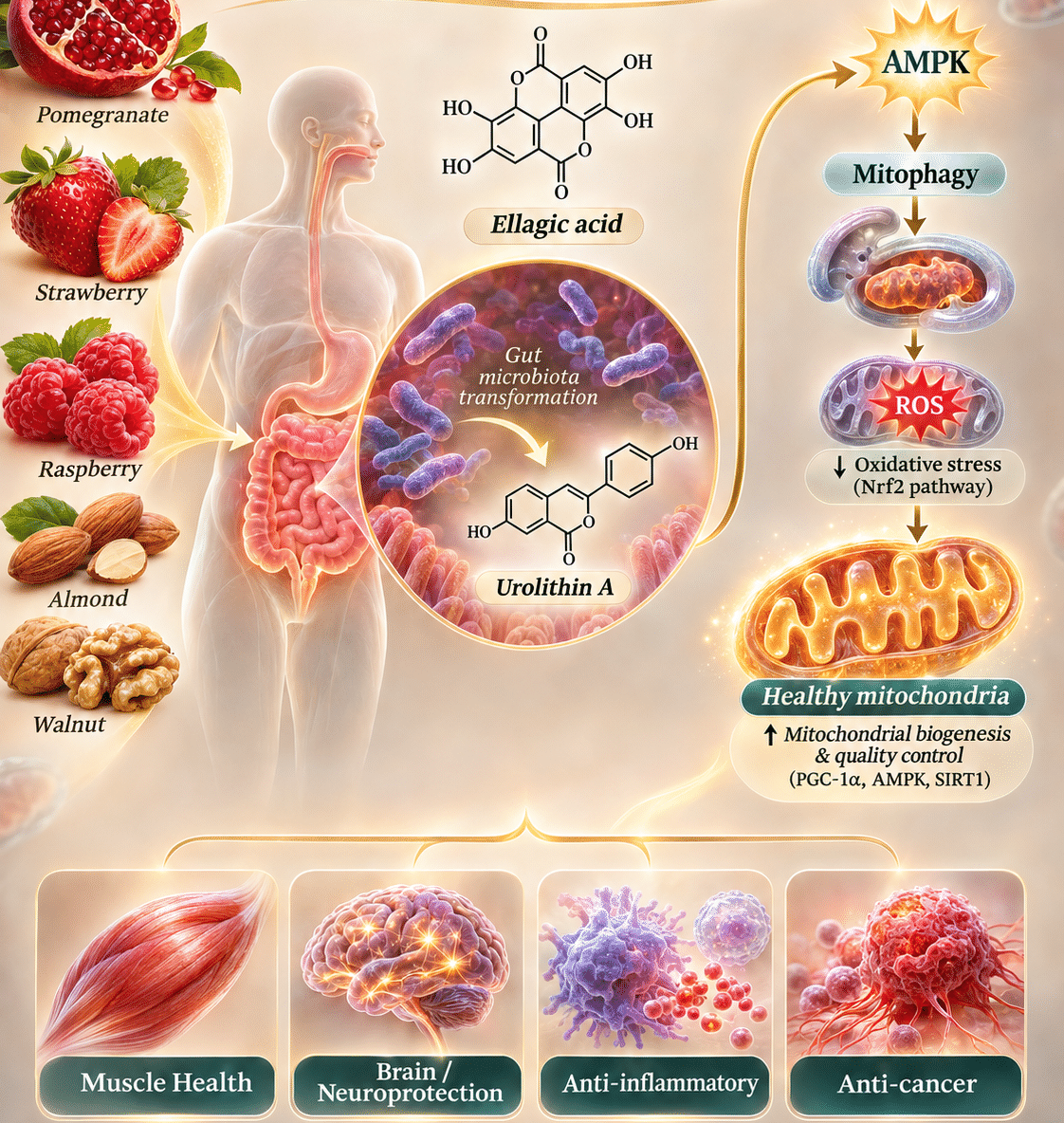
The human gut microbiome is increasingly recognised as an important contributor to health, influencing processes that extend far beyond digestion. Among its many functions is the ability to transform compounds found in everyday foods into biologically active molecules that interact with different organs and tissues. One such molecule, Urolithin A (UA), is attracting growing interest because of its potential role in maintaining cellular health and addressing biological processes associated with ageing.
Produced when specific gut bacteria metabolise dietary compounds known as ellagitannins and ellagic acid, Urolithin A has demonstrated promising biological activities in laboratory and animal studies. Research suggests that it can stimulate the removal of damaged mitochondria, regulate inflammatory pathways and influence muscle function. These properties have prompted investigations into its possible applications in healthy ageing, metabolic health and the development of future therapeutic approaches.
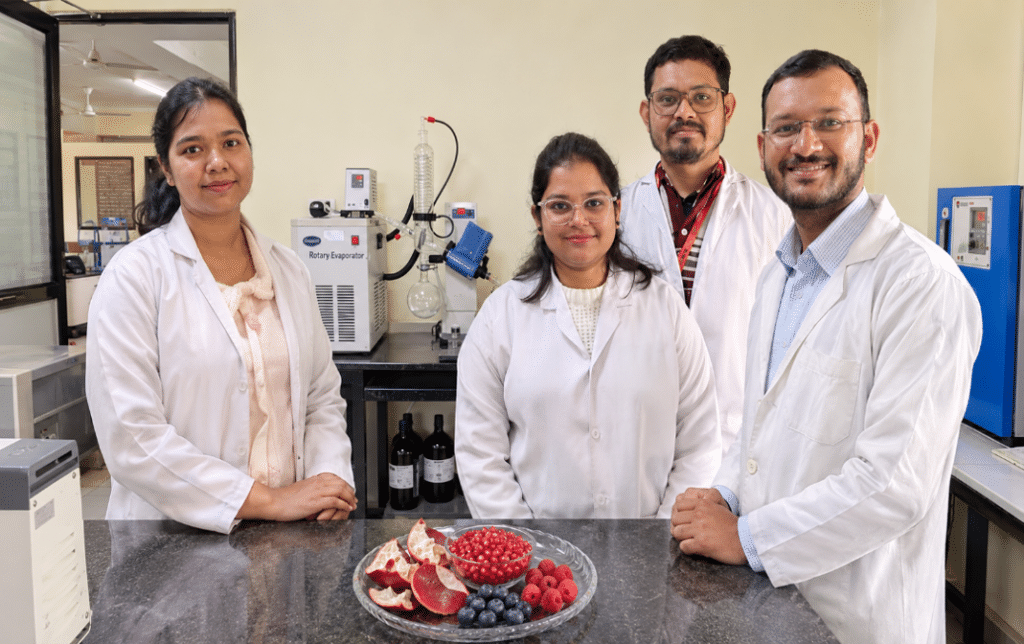
A review article titled Urolithin A: A Novel Postbiotic for Inflammation, Aging, and Cancer: A Journey from Dietary Ellagitannins to Clinical Use, published in the journal Molecular Biology Reports in 2026, examines the growing scientific evidence surrounding this compound. The review was led by first author Saniya Thakur of the School of Pharmaceutical Sciences at Lovely Professional University, Punjab, India, with Dr M.V.N.L. Chaitanya as corresponding author. The researchers examine how Urolithin A is produced, absorbed and processed by the body, alongside its molecular mechanisms and potential therapeutic applications. By bringing together preclinical findings and early human clinical evidence, the review highlights the relationship between gut microbial metabolism, mitochondrial function, inflammation and age-related changes.
From everyday foods to a biologically active compound
Urolithin A is a gut microbiota-derived metabolite formed through the breakdown of dietary ellagitannins and ellagic acid. These naturally occurring polyphenolic compounds are present in several plant-based foods, including pomegranates, walnuts, raspberries, strawberries and other berries. Once consumed, ellagitannins undergo chemical transformation in the digestive system, eventually providing the precursors required for Urolithin A production.
The process involves several stages of microbial metabolism. Initially, enzymes such as tannase break down ellagitannins into ellagic acid. Specific intestinal bacteria then modify the resulting molecules through reactions involving decarboxylation, lactone ring opening and the removal of hydroxyl groups. These transformations produce different urolithins, including Urolithin A, Urolithin B and other related metabolites.
Among these compounds, Urolithin A has attracted particular attention because of its ability to influence mitochondrial quality control. Unlike dietary polyphenols that may act directly as antioxidants, its biological activity is closely associated with the way it interacts with cellular signalling pathways. This makes the relationship between food, gut bacteria and human metabolism an important area of investigation.
The cellular cleaning process behind its potential
One of the most significant properties of Urolithin A is its ability to stimulate mitophagy, a specialised form of autophagy responsible for identifying and removing damaged or dysfunctional mitochondria. Mitochondria are essential cellular structures that generate much of the energy required for normal biological activity. However, they can become damaged through ageing, metabolic stress and the accumulation of reactive oxygen species.
When dysfunctional mitochondria remain inside cells, they can contribute to oxidative stress, impaired energy production and inflammatory signalling. Mitophagy helps maintain mitochondrial quality by directing damaged organelles towards lysosomal degradation, allowing cellular components to be recycled. This process is particularly important in energy-demanding tissues such as skeletal muscle and the brain.
How Urolithin A may influence healthy ageing
The relationship between mitochondrial dysfunction and ageing has become an important subject in biomedical research. As cells age, their ability to maintain mitochondrial quality and energy production may decline. This can affect muscle performance, metabolic regulation and the functioning of other organs. By stimulating mitophagy, Urolithin A may help preserve mitochondrial efficiency and influence several biological processes associated with ageing.
Experimental research has provided encouraging findings. In studies involving the nematode Caenorhabditis elegans, Urolithin A increased average lifespan by approximately 45 per cent and improved locomotor capacity. Research involving aged rats also reported increased mitochondrial biogenesis markers, including PGC-1α, TFAM and NRF1, alongside improvements in ATP generation. The animals demonstrated increased spontaneous activity and modest improvements in grip strength.
However, these findings must be interpreted within the context of the experimental models used. An increase in lifespan in nematodes does not establish that the compound can extend human lifespan. Similarly, improvements observed in animal models cannot automatically be translated into equivalent outcomes in people. Nevertheless, the findings provide a scientific basis for investigating Urolithin A as a potential regulator of mitochondrial health.
Potential benefits for muscle health and physical performance
Skeletal muscle is particularly dependent on efficient mitochondrial activity because muscle contraction requires a continuous supply of energy. Mitochondrial dysfunction can contribute to reduced endurance, muscle fatigue and age-related loss of muscle function. This has encouraged researchers to investigate whether improving mitochondrial quality through mitophagy could support physical performance.
Early human investigations have also examined its potential effects on muscle endurance and mitochondrial biomarkers. The ATLAS trial, for example, evaluated daily supplementation with 500 mg or 1,000 mg of Urolithin A over four months in 88 middle-aged adults. The study reported improvements in certain measures of muscle strength, aerobic capacity and mitochondrial proteins, alongside reductions in C-reactive protein, an inflammatory marker. However, its primary outcome, maximum power, did not reach statistical significance compared with the placebo group. A separate four-month trial in 66 adults aged 65 to 90 found that a daily 1,000 mg dose improved endurance in hand and leg muscles and lowered inflammatory markers, but its main outcomes, walking distance and peak muscle energy production, did not improve significantly. In both trials, this distinction is important when interpreting the clinical significance of the findings.
The connection between inflammation and cellular protection
Chronic inflammation is associated with several age-related conditions, including metabolic disorders and cardiovascular disease. At the cellular level, inflammatory responses are regulated by complex signalling networks that determine how immune cells respond to stress, infection and tissue damage. The ability of Urolithin A to influence these pathways has therefore become another important area of research.
Preclinical studies discussed in the review indicate that Urolithin A can suppress the nuclear factor kappa B (NF-κB) signalling pathway and regulate the NLRP3 inflammasome. These mechanisms are involved in the production of inflammatory mediators such as tumour necrosis factor alpha (TNF-α), interleukin-1 beta (IL-1β) and interleukin-6 (IL-6). By influencing these pathways, Urolithin A may help reduce inflammatory responses under certain experimental conditions.
Its antioxidant activity is also associated with the nuclear factor erythroid 2-related factor 2 (Nrf2) pathway, which regulates the expression of genes involved in cellular defence against oxidative stress. Activation of this pathway can increase the activity of antioxidant enzymes, including superoxide dismutase (SOD), glutathione peroxidase (GPx), haem oxygenase-1 (HO-1) and NAD(P)H quinone dehydrogenase 1 (NQO1). Together, these findings suggest that Urolithin A may influence cellular protection through interconnected mitochondrial, antioxidant and inflammatory mechanisms.
What makes urolithin A remarkable is that our food only supplies the raw material, while our gut bacteria do the real work. Because not everyone carries those bacteria, future studies must test who benefits rather than assume everyone will.
— Dr M.V.N.L. Chaitanya
What the research says about cancer and other diseases
Beyond mitochondrial health and inflammation, Urolithin A has attracted interest for its potential effects on cancer-related biological processes. Laboratory investigations have reported that the compound can influence cancer cell metabolism, regulate cell-cycle progression and promote apoptosis, the programmed process through which damaged or unwanted cells are eliminated.
The review discusses findings involving colorectal cancer cells, in which Urolithin A was associated with cell-cycle arrest at the G0/G1 phase and changes in the p53-p21 signalling pathway. Other experimental studies have investigated its effects on glioblastoma growth and signalling pathways such as PI3K/AKT/mTOR. These observations provide possible directions for further cancer research, particularly in understanding how mitochondrial regulation and cellular stress responses influence tumour biology. So far, however, these effects have been seen in cell and animal studies, often at concentrations well above those reached in the human body, and have not been tested in people with cancer.
Why gut bacteria determine its production
An important challenge in understanding Urolithin A is that not everyone produces it in the same way. Its formation depends on the composition and metabolic activity of an individual’s gut microbiome. Certain bacteria, including members of the Gordonibacter and Ellagibacter groups, participate in the conversion of ellagic acid into urolithins.
Researchers classify individuals into three principal urolithin metabotypes based on the metabolites produced after consuming ellagitannin-rich foods. Metabotype A is characterised mainly by the production of Urolithin A and its conjugated metabolites. Metabotype B produces Urolithin A alongside other urolithins, including isourolithin A and Urolithin B. Metabotype 0 is characterised by the absence of detectable urolithin production.
These differences may be influenced by several factors, including age, genetic predisposition, dietary habits and previous antibiotic exposure. Consequently, consuming foods rich in ellagitannins does not necessarily guarantee that an individual will produce significant amounts of Urolithin A. This variability presents an important consideration for researchers investigating dietary interventions and personalised approaches to postbiotic supplementation.
What researchers still need to establish
The review also highlights a substantial gap between laboratory findings and what happens in the body. Once absorbed, Urolithin A is quickly modified by the liver into conjugated forms that are far less active. As a result, the concentrations thought to reach tissues such as muscle and brain are roughly a thousand times lower than those that produced effects in cell studies.
The human trials conducted so far have also been small, involving 20 to 88 participants, and short, lasting four to sixteen weeks. Most volunteers were inactive middle-aged or older adults. There are no safety data beyond sixteen weeks, and none in people with liver, kidney or other long-term diseases. Researchers are testing delivery systems such as liposomes to increase the amount of Urolithin A that reaches the bloodstream, but these have so far been studied only in animals.
Because Urolithin A is already sold as a dietary supplement, the authors argue that larger and longer trials are now needed, particularly in people with age-related muscle loss, fatty liver disease or brain disorders, and with participants grouped by metabotype. Such studies, together with firm quality standards, would help consumers, doctors and regulators separate genuine benefits from marketing claims.
“Urolithin A shows how closely our health is tied to the microbes we carry,” says Dr M.V.N.L. Chaitanya, Professor of Pharmacognosy at Lovely Professional University and corresponding author of the review. “The biology is exciting, but the human evidence is still early. Before it can be recommended, we need longer and larger trials that also check who can and cannot make it naturally.”
Reference
Thakur, S., Chaitanya, M. V. N. L., Singh, S. K., Khurana, N., Selvaraj, J., Arya Lakshmi, M., Mazumder, A., & Sengupta, P. (2026). Urolithin A: A novel postbiotic for inflammation, aging, and cancer: A journey from dietary ellagitannins to clinical use. Molecular Biology Reports, 53, Article 746. https://doi.org/10.1007/s11033-026-11950-4