Researchers at CSIR-Central Salt and Marine Chemicals Research Institute in Bhavnagar have developed guanidinium-based coordination nanoplates that improve lithium-ion conductivity. The article published in Angewandte Chemie International Edition (Wiley) offers a new direction for solid-state battery research.
Why solid electrolytes matter
Lithium-ion batteries are found in a wide range of electronics used in daily life, including phones, laptops and electric cars. As electric cars grow in popularity, automobile makers are looking to pack more energy per volume into vehicle batteries. All these technologies rely on the lithium-ion. Right now, these ions move through a liquid electrolyte inside conventional lithium-ion batteries. That liquid works, but it can leak and is flammable. Battery performance can also be affected by temperature, while safety remains an important consideration in battery design.
Scientists are investigating solid materials as alternatives to liquid electrolytes. Think of it like paving a dirt road with a high-speed railway track. But finding a solid material that lets lithium ions move efficiently has been a persistent scientific challenge. Solid-state batteries use a solid electrolyte to transport ions between electrodes, and they may offer safety and performance advantages. Those benefits, however, depend on the material and the design of the complete battery. A solid electrolyte alone does not make a battery incapable of failing or catching fire.
A new approach from Indian researchers
Researchers at CSIR-Central Salt and Marine Chemicals Research Institute (CSIR-CSMCRI), Bhavnagar, India, have developed four novel cationic guanidinium-based coordination nanoplates that conduct lithium ions. The research was published in the peer-reviewed journal Angewandte Chemie International Edition on 31 August 2026. The paper is titled “Sequencing 4f–2p Gradient Orbital Coupling Within Guanidinium-Based Coordination Nanoplates to Boost Lithium-Ion Conductivity”. Aniruddha Das is the first-listed author, while Dr Amal Kumar Mandal is a corresponding author and contributed to conceptualisation, investigation, funding acquisition, writing and supervision.
An electrolyte is the internal pathway that allows charged particles, including lithium ions, to travel through a battery. In a solid-electrolyte battery, this pathway is formed by a solid material rather than a liquid. One challenge is to develop solids that combine useful ionic conductivity with the properties needed for practical battery operation. The CSMCRI team investigated how the structure and electronic characteristics of coordination nanoplates could help lithium-ions move more readily.
How does the material help lithium ions move?
The CSMCRI researchers addressed the ion-conductivity challenge with four new, positively charged materials composed of guanidinium-based building blocks. Guanidinium is a nitrogen-rich molecular unit. Think of lithium ions as cars. Conductivity describes how readily those ions can move through a material, much as a road network determines how smoothly cars can travel from one point to another. Improved ionic conductivity can make it easier for lithium ions to move, although conductivity measurements alone do not establish how quickly a finished phone or electric-car battery will charge.
The researchers focused on three connected strategies: promoting ion-pair dissociation, immobilising anions and improving lithium-ion mobility. Lithium ions can interact strongly with negatively charged partners. Separating these ion pairs can make more lithium ions available for transport. At the same time, limiting the movement of anions can help favour lithium-ion conduction. The third strategy is to create a material structure through which lithium ions can migrate with less energetic resistance. Together, these approaches target the movement of lithium ions within the solid electrolyte.
The original article compares this process to breaking up a huddle of players so they can run across a field and to putting roadblocks in place to stop unwanted traffic. These analogies help explain the broad idea, but the chemistry is more specific. The researchers used positional isomers and controlled coordination at metal sites to alter the electronic structure of the materials. The resulting changes influence ion-pair dissociation and the interactions between the material and anions.
Why molecular arrangement and orbital coupling matter
The research employed a strategy involving positional isomers and gradient 4f–2p orbital coupling to manipulate the material’s internal electronic structure. Positional isomers contain the same basic components arranged differently. Imagine using the same building blocks to make a tall tower rather than a wide house. The ingredients are similar, but their arrangement can change how the resulting structure behaves and how other particles interact with it.
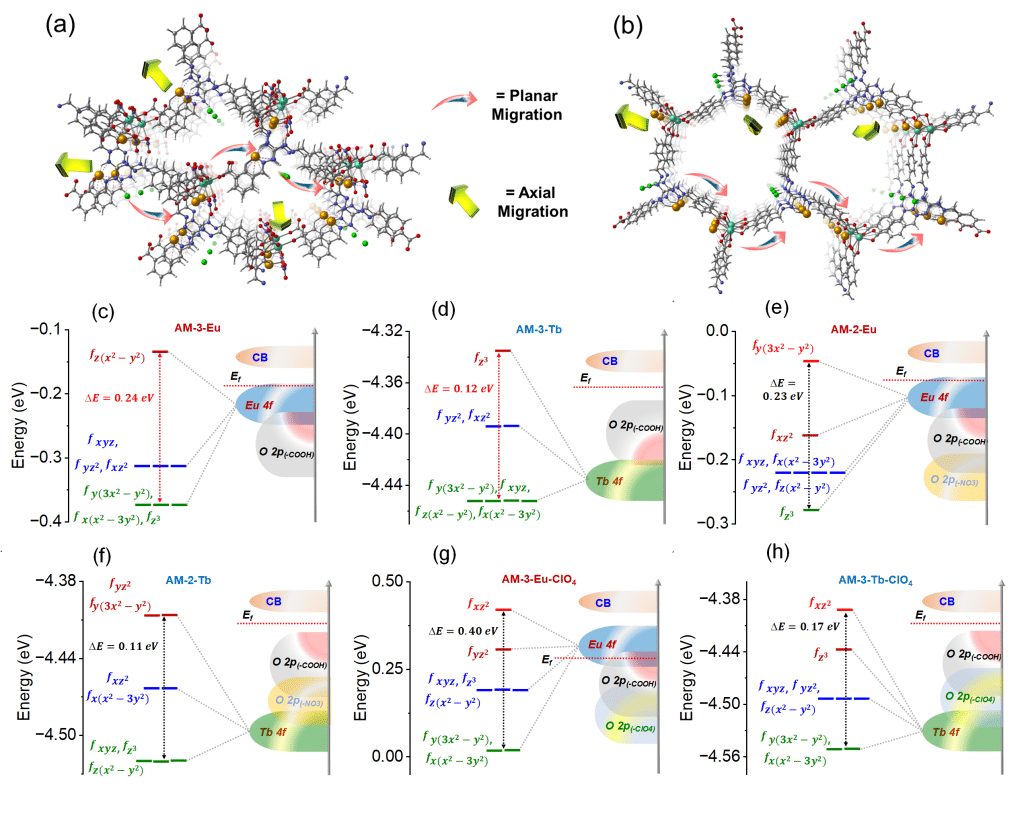
In this study, the sequence of gradient 4f–2p orbital coupling was used to adjust charge density at the metal sites in the coordination nanoplates. Orbital coupling refers to interactions between electronic orbitals. By changing the coupling sequence, the researchers altered the splitting of the metal-centred 4f energy levels and adjusted the positive charge density at the metal sites. These electronic changes supported greater ion-pair dissociation and stronger adsorption of anions, both of which can contribute to lithium-ion transport.
This is a more targeted approach than treating a solid electrolyte as a passive structure through which ions simply travel. As co-author Dr Rabindranath Lo explained:
The genuine potential of this method lies in connecting quantum chemistry, particularly atomic orbital interactions, to alter the energy terrain for ion migration. This transformation in perspective shifts the focus from passive material discovery to customizable ion transportation. The advancement of solid electrolytes transcends simply seeking an improved route for lithium, but rather involves electronically manipulating the route itself.
— Dr Rabindranath Lo
What the conductivity results show
The researchers reported a maximum lithium-ion conductivity of 3.11 × 10⁻³ S cm⁻¹, equivalent to 3.11 mS cm⁻¹, with an activation energy of 0.23 eV. Conductivity indicates how readily ions move through a material, while activation energy describes the energy barrier associated with that movement. In general, a lower activation energy can support ion transport, although battery performance also depends on factors such as interfaces, stability, electrode chemistry and operating conditions.
The study combined experimental and theoretical analyses to investigate the relationship between orbital coupling and lithium-ion conductivity. Molecular dynamics simulations, together with radial distribution function analysis, indicated that lithium-ion migration along the axial pathway was preferred over movement along the planar pathway. The result provides a mechanistic explanation for how the architecture and electronic properties of the coordination nanoplates influence ion migration.
A new direction, not a finished battery
The work is intended to advance the design principles for discovering solid electrolytes, rather than to claim immediate superiority over existing commercial materials.
The potential relevance is clear. Better solid electrolytes could contribute to the development of safer batteries and may help researchers address performance limitations in solid-state battery technologies. However, the reported conductivity of a material is not the same as a demonstration of a complete battery charging in minutes, delivering faster acceleration or lasting longer on a single charge. Such outcomes require testing in assembled cells and under relevant operating conditions. Related work on electrochemical energy storage includes magnetic-field-assisted supercapacitors.
Dr Mandal has highlighted the use of non-toxic and readily available elements in the formulation, suggesting possible environmental advantages. Those advantages will need to be assessed in the context of the full material composition, manufacturing process, durability and end-of-life management. Further work is also needed to improve production, broaden applications and establish compatibility with existing battery technologies. These are important steps between promising laboratory material and practical deployment.
This material does not directly compete with existing solid electrolytes. The objective of this research is to forge a new path in the discovery of solid electrolytes, with an emphasis on improving lithium mobility and enhancing overall battery performance.
— Dr Amal Kumar Mandal
What happens next?
The study offers a molecular design strategy for improving lithium-ion mobility in guanidinium-based coordination nanoplates. By linking orbital interactions with ion-pair dissociation, anion immobilisation and transport pathways, the researchers show how changes at the electronic level can influence a measurable property of the material. This approach may help guide the discovery of other solid electrolytes, but its wider value will depend on reproducibility, manufacturability and performance in practical battery systems. The wider role of molecular architecture in designing functional materials is explored in research on metal-organic frameworks.
For consumers, the research is not a signal that battery anxiety has ended or that commercial solid-state batteries are ready to transform charging overnight. Instead, it is a step in the fundamental materials research needed to make future energy-storage technologies more reliable. The work highlights how chemistry, quantum-level interactions and materials engineering can work together to address one of the central challenges in solid-state battery development. Related materials research also examines magnetic semiconductors for future electronics.
Reference
Das, A., Dhandapani, H. N., Ankola, J., Singh, A., Ramlal, V. R., Kannan, P., Tripathy, S., Das, P., Lo, R., Kundu, S., & Mandal, A. K. (2026). Sequencing 4f–2p gradient orbital coupling within guanidinium-based coordination nanoplates to boost lithium-ion conductivity. Angewandte Chemie International Edition, e1258536. https://doi.org/10.1002/anie.1258536