
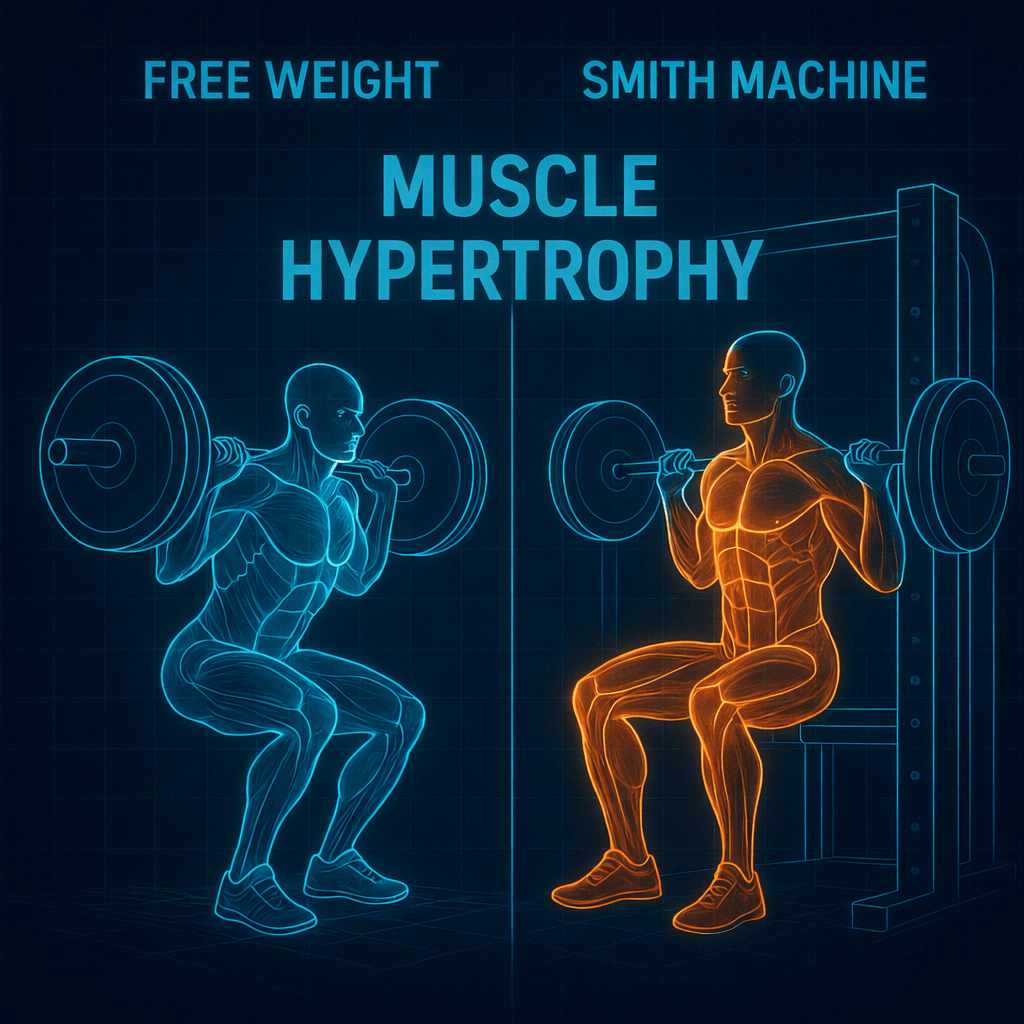
For decades, fitness enthusiasts have debated the effectiveness of free weights versus machines in achieving strength and muscle growth. Gyms are divided between those who swear by the freedom of barbells and those who prefer the guided stability of machines. Now, research led by Daniel Marcos-Frutos from the University of Granada offers fresh insights into this debate, suggesting that both approaches may be more alike than previously thought, with some key differences that athletes and everyday lifters should consider.
The study, published in the International Journal of Sports Physiology and Performance, is one of the first to directly compare velocity-based training with free weights and Smith machines while using the same exercises: the back squat and the bench press. Its findings could shape the way coaches and gym-goers think about training modalities and help demystify an argument that has persisted since machines became a fixture of gyms worldwide.
The study at a glance
The researchers recruited 37 sports science students, 14 of whom were female, from the University of Granada and the University of A Coruña. These participants were randomly assigned into two groups. One was trained using free weights, while the other relied on the Smith machine. Both groups followed the same eight-week programme consisting of squats and bench presses, performed twice per a week, at 70 percent of their one-repetition maximum.
Training was carefully monitored using velocity-based training, a method that prescribes exercise intensity based on the speed of the lift rather than fixed percentages of maximum strength. This method allowed precise adjustments in training loads and offered a more dynamic picture of progression. Participants trained to moderate effort levels, stopping before muscular failure but pushing lifts at maximum intended velocity.
Before and after the training programme, the researchers measured several outcomes. These included the load–velocity profile, which indicates force and speed capacities; the cross-sectional area of the quadriceps and pectoral muscles, a marker of hypertrophy; and the number of bench press repetitions completed until failure. Crucially, each group was tested using both free weights and the Smith machine to assess whether adaptations were specific to the training method.
Training gains and the principle of specificity
Both groups experienced improvements in almost all measures, with stronger lifts, larger muscles, and more repetitions completed after the eight weeks. Yet the study highlighted the importance of specificity: athletes showed greater improvements when their training and testing conditions matched. Those who trained with free weights performed better when tested with free weights, and those who trained on the Smith machine excelled when tested on the Smith machine.
This finding reinforces a cornerstone of sports science. The principle of specificity suggests that adaptations are most pronounced when training closely resembles the performance environment. For competitive athletes, this means that if their sport involves free-weight lifting, such as powerlifting, they are better off training with free weights to maximise carryover. Conversely, individuals who rely more on machine-based training for rehabilitation, accessibility, or safety may benefit from using the Smith machine without sacrificing progress.
The role of velocity in training
A novel aspect of the study was its reliance on velocity-based training. Traditional strength training often prescribes intensity as a percentage of one-repetition maximum. However, this approach can overlook day-to-day fluctuations in fatigue, recovery, and readiness. By monitoring bar speed in real-time, velocity-based training enables more precise and adaptable load adjustments.
In the study, lifters were instructed to push the bar as fast as possible on every repetition. This emphasis on maximal velocity ensured consistency and created a stimulus more aligned with improving power output. Interestingly, the Smith machine group tended to show slightly greater improvements in velocity-axis intercept, a marker of maximal speed potential, suggesting that the stability of the Smith machine may help lifters generate force more quickly.
For practitioners, this raises questions about when to prioritise free weights or machines. Athletes seeking maximal transfer to sports that demand stability and coordination may benefit more from free weights. Yet those aiming to improve raw lifting speed or those who want the safety net of guided movement may find the Smith machine advantageous.
A level playing field
One of the enduring myths in strength training is that free weights inherently build more muscle than machines. The new study challenges this assumption. Using ultrasound imaging to measure the quadriceps and pectoral muscles, the researchers found that both groups experienced similar increases in muscle cross-sectional area.
This finding aligns with recent meta-analyses, which show that hypertrophy is not significantly affected by the choice of free weights or machines when overall training volume and intensity are matched. For gym-goers primarily focused on appearance and muscle growth, this suggests that preference and comfort can guide their choice of equipment. As long as the intensity and progression are adequate, both free weights and machines can deliver similar hypertrophic results.
-Daniel Marcos-Frutos
Strength, endurance and performance differences
When it came to strength endurance, measured by the number of repetitions participants could perform in the bench press until failure, improvements were observed across both groups. Slightly different trends emerged, however. The free weight group showed marginally better improvements in bench press endurance, while the Smith machine group gained more in terms of bar velocity.
These nuanced findings suggest that stability and movement freedom may subtly affect the type of adaptation. Free weights, which demand greater stabiliser muscle engagement, may promote resilience over repeated efforts. Meanwhile, the Smith machine, with its controlled path, may facilitate quicker and more explosive lifts.
Practical implications for athletes and the public
If the goal is to compete or perform in free-weight disciplines, training with free weights remains the most effective way to maximise specific strength gains. Similarly, those whose testing or sport involves machine-based lifts may see greater transfer from machine training.
As lead author Daniel Marcos-Frutos and his colleagues concluded, individuals unconcerned with performance specificity can select the training method that best suits their preferences and lifestyle. Whether motivated by enjoyment, safety, or convenience, both free weights and machines will deliver strength, endurance, and muscle gains.
This conclusion may also encourage adherence. One of the most significant factors in long-term fitness success is consistency. By validating the effectiveness of both modalities, the study empowers individuals to choose the option they are most likely to adhere to, without fear of missing out on potential benefits.
Reference
Marcos-Frutos, D., Miras-Moreno, S., Márquez, G., & García-Ramos, A. (2025). Comparative effects of the free weights and Smith machine squat and bench press: The important role of specificity for strength adaptations. International Journal of Sports Physiology and Performance, 20(2), 292–300. https://doi.org/10.1123/ijspp.2024-0274