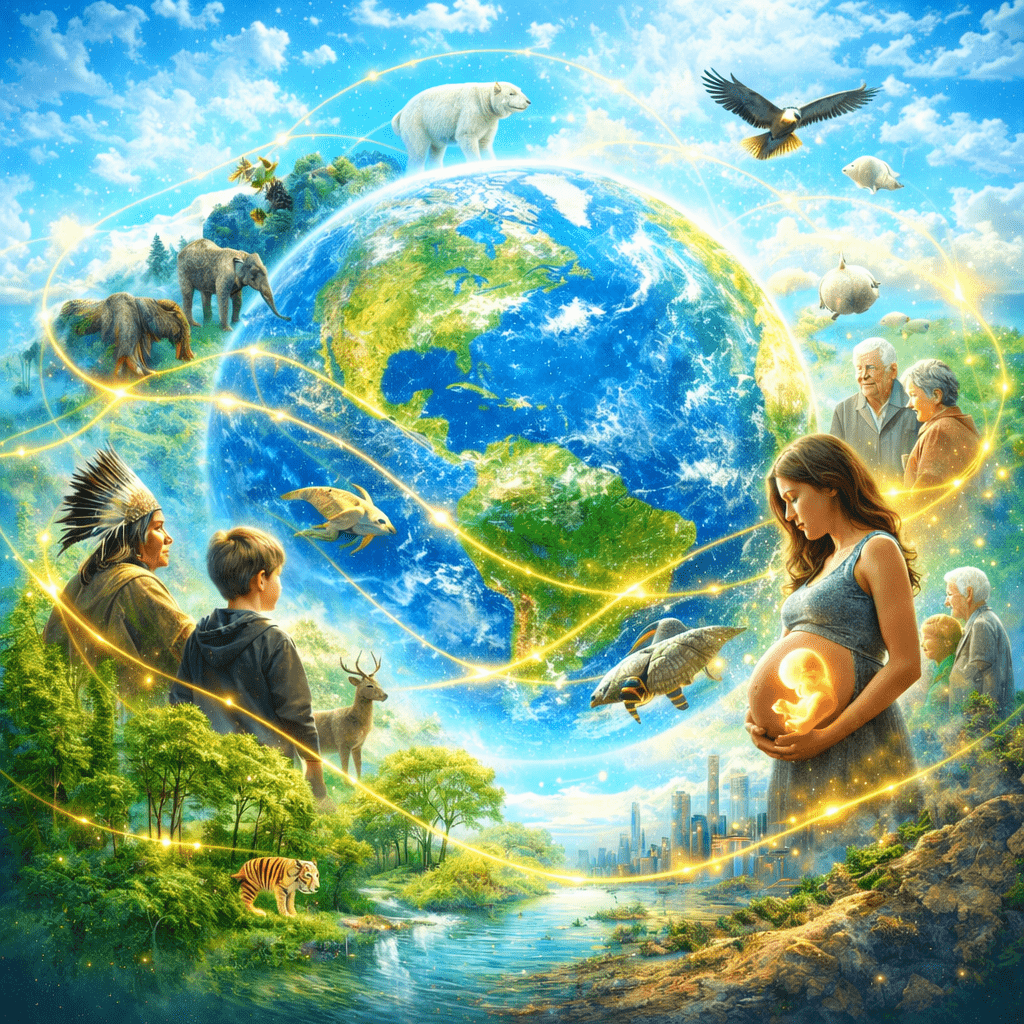
Most of the time, leaders, including business, community, and policy leaders, don’t think much about how the natural environment, past or future generations, marginalized peoples, or animals and other species are affected by their decisions. They are focused almost exclusively on the well-being of their own institution and the sometimes very vocal stakeholders who demand their attention. Typically, these other groups don’t have (sufficient) “voice” to make their concerns heard. They often cannot speak for themselves, or when they do, their voices go unheard. But that doesn’t mean that decisions made don’t affect them or that they aren’t important for long-term flourishing.
The article “An Eco-Social Lens on Voice for Undervoiced and Unvoiced Stakeholders” argues that for the sake of justice and the well-being of whole ecological and social (eco-social) systems, it is vital to take the perspectives of these groups, species, and ecosystems into account. Despite generally being overlooked, the un(der)voiced have important “stakes’ in the long-term flourishing of human institutions, societies, and nature. In other words, they and we are all stakeholders when the health of the whole eco-social system, not just an organization, is the focus.
Why are un(der) voiced stakeholders important?
Generally, leaders assume that the only interests that matter are those associated with their organization or community. But the world is facing many interacting crises today that threaten the future of humans and other Earthly beings. These crises include the climate emergency, potentially collapsing fisheries and rainforests, topsoil erosion, disruptive and growing inequality, and many others. These crises are entangled in what is now called polycrisis—the intersecting array of big civilization- and Earth-system threatening problems.
Polycrisis demands that leaders take a different point of view: that of the well-being of whole eco-social systems. That is, the stakes of all of nature and all living beings need to be considered, whether they have an easily heard “voice” or not.
Polycrisis demands that leaders take a different point of view: that of the well-being of whole eco-social systems.
— Sandra Waddock
Nature as an unvoiced stakeholder
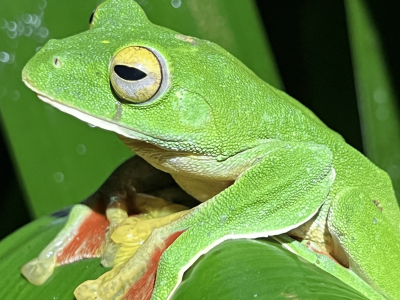
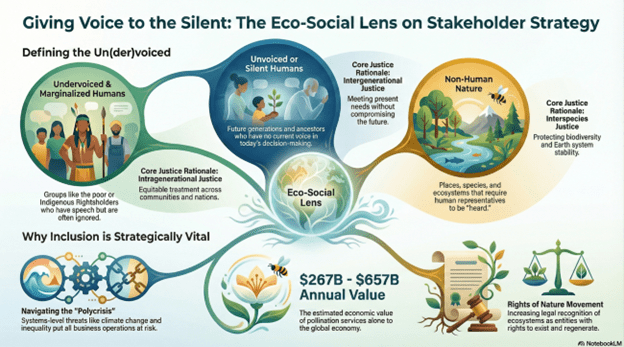
Bee populations have been collapsing due to industrial agriculture, overuse of fertilizers and pesticides, and habitat loss. Yet the estimated value of pollination alone is between $267 and $657 billion dollars annually (in 2020 dollars). That should give us pause about ignoring the “silent” voices of species that pollinate. In natural ecosystems, the amount of diversity of species and organisms is directly related to the health of that environment. The resilience of ecosystems to disasters and their productive capacity to support human enterprise are threatened when diversity decreases. That happens when biodiversity is reduced. If there is insufficient biodiversity, and pollination, for example, doesn’t happen, then many crops won’t develop properly, affecting food supply and, ultimately, human life.
Polycrisis recognizes all these things as interrelated, even when species or ecosystems can’t speak for themselves. Indeed, a growing global “rights of nature” community speaks to that very perspective. It helps provide a human voice for aspects of nature, such as forests, parks, and rivers, by legally recognizing that “Nature in all its life forms has the right to exist, persist, maintain, and regenerate its vital cycles”. And we humans rely on nature for everything. So it is up to humans to think about how all of these systems affect each other holistically, from an eco-social perspective that includes all life forms, not just those of a single organization or even a community.
Silent or ignored people need to be heard
It isn’t just nonhuman nature that matters. There are many groups of people with a vital interest in the flourishing of the world whose voices are also not being heard. They are under- or un-voiced. These groups include marginalized peoples like the poor, many Indigenous peoples, and, too often, people in the Global South. They do have a voice, if only they were listened to. They certainly have an interest in how well their societies and natural environments are able to support their dignity and flourishing. They may also have much-needed insight or wisdom for ensuring equity for all and ecosystem flourishing, which gets ignored at all our peril.
There are also completely unvoiced human stakeholders, like past or future generations and others unable to speak for themselves. It is easy to see the link between the impacts of decisions made today, for good or ill, on the well-being of future generations. Destroyed ecosystems or an increasingly warm climate surely will impact how well grandchildren and great-grandchildren can live. Further, past generations may have worked hard to leave a positive legacy, a set of values, rituals, or ideas that are important for present and future generations. Destruction of these legacies leaves future and present generations culturally, socially, and otherwise poorer. So finding ways to hear past voices also counts.
Justice matters, too
There is also a values-based rationale for taking un(der)voiced stakeholders into account, as articulated in the Earth System Justice framework. This framework argues for three types of justice to ensure that humanity’s activities stay within planetary boundaries to support life. Intergenerational Justice is justice across generations, whether past, present, or future, whether they can speak up for their own interest or not. Intragenerational Justice is foundational to ensuring that people everywhere today, no matter their circumstances, status, or capacity for voice to be heard, are treated equitably and can live lives of dignity.
What is possibly the most important form of justice is also the least widely recognized. The Earth Commission calls this form of justice Interspecies Justice and Earth System Stability. What that means is that Earth’s life support systems need sufficient “functional integrity” to support both humans and other species. That means ensuring nature’s capacity to provide what are known as ecosystem services, or nature’s contributions to support human existence, and increasingly protecting nature’s rights.
Notably, this form of justice places humans in and of nature, where they rightly belong, as is widely recognized in many Indigenous worldviews, not somehow separate, distinct or dominant. Recognizing these silent or under-voiced stakeholders and at least making an effort to “hear” what they as stakeholders might want to say to living humans could make things better and more just for all living beings.
Reference
Waddock, S. (2025). An Eco‐Social Lens on Voice for Undervoiced and Unvoiced Stakeholders. Business Strategy and the Environment. https://doi.org/10.1002/bse.70359