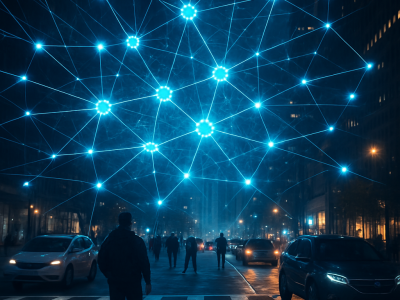

Modern society depends on wireless connectivity in ways that were unimaginable just a decade ago. From video consultations and cloud computing to immersive entertainment and smart transport systems, mobile networks now underpin everyday life and national infrastructure alike. Yet despite the rollout of fifth-generation networks, users still experience dropped calls, fluctuating data speeds, and unreliable coverage, especially in dense urban spaces or highly dynamic environments.
A new industrial research review published in IEEE Network argues that the root of this problem lies not only in network hardware or spectrum availability, but in the physical environment itself. Titled “Smart Wireless Environment Enhanced Telecommunications: An Industrial Review on Network Stabilization”, the article is led by Yangyishi Zhang of BT Group and co-authored by researchers from the University of Nottingham, the University of Surrey, and the University of Warwick. The work proposes a fundamental shift in how wireless systems are designed, operated, and stabilised by making the environment an active participant in communication rather than an uncontrollable obstacle.
Why wireless signals struggle in the real world
Wireless communication does not take place in a vacuum. Radio waves propagate through streets, buildings, vehicles, trees, and human bodies, all of which reflect, scatter, absorb, and distort signals. These interactions give rise to what engineers call fading channels, where the strength and phase of a signal vary unpredictably over time, frequency, and space.
The research explains that even with advanced modulation schemes, multiple-input multiple-output antennas, and sophisticated error correction, mobile networks remain fundamentally limited by the instability of the wireless channel. Small environmental changes, such as a passing bus or a moving crowd, can significantly degrade signal quality. This is particularly problematic for latency-sensitive applications like autonomous driving, remote surgery, and extended reality.
Historically, network design has focused on mitigating these effects at the transmitter and receiver. Power control, beamforming, adaptive coding, and channel estimation are all attempts to react to environmental variability. What Zhang and colleagues propose instead is to address the problem at its source by shaping the physical environment itself.
Introducing the smart wireless environment
The central concept explored in the paper is the Smart Wireless Environment, often abbreviated as SWE. This paradigm brings together advances in reconfigurable intelligent surfaces, wireless sensing, and artificial intelligence to actively control the propagation of radio waves through space.
In a smart wireless environment, surfaces such as walls, lamp posts, building facades, and even vehicles can be equipped with thin programmable materials known as holographic metasurfaces. These surfaces can redirect, focus, or reshape radio waves in real time, effectively transforming passive objects into active components of the network.
The goal is not to eliminate fading entirely, which is physically impossible, but to stabilise it. By engineering what the authors describe as artificial fading channels, network operators could create communication links that are more predictable, more reliable, and easier to manage. This process, referred to as network stabilisation, forms the practical core of the study.
To unlock the full potential of future mobile communications, network deployment must address the fundamental limit imposed by the radio propagation environment at its root.
– Yangyishi Zhang
From reacting to controlling wireless propagation
One of the most striking arguments in the review is that mobile networking has long been constrained by a reactive mindset. Networks observe channel variations, estimate their impact, and adapt accordingly. This approach is effective but inherently limited because it treats the environment as an external disturbance.
Smart wireless environments reverse this logic. Instead of adapting solely at the endpoints, the network intervenes directly in the propagation process. Holographic metasurfaces act as augmented scattering clusters that can be configured to counteract known sources of signal degradation, such as multipath interference and Doppler effects.
The authors draw an analogy to signal-processing filters. Just as engineers design filters to produce a smooth frequency response, smart wireless environments aim to synthesise a smooth and stable channel response across time, space, and frequency. This represents a conceptual leap that bridges physical electromagnetics and information theory.
The role of sensing in environmental awareness
Controlling the environment requires understanding it. For this reason, the proposed framework relies heavily on wireless sensing, particularly integrated sensing and communication systems. These technologies allow the network to monitor physical changes in the environment, such as moving vehicles or pedestrians, without relying solely on user devices.
Unlike conventional channel state information, which provides an abstract representation of the link between transmitter and receiver, sensing offers physical-level insight into the causes of channel variation. Radar-like echoes and reflected signals can reveal which objects are responsible for instability and how they are evolving over time.
The paper emphasises that sensing becomes especially important when metasurface coverage is partial, which is the most realistic deployment scenario in the near term. By tracking uncontrolled scatterers, the network can compensate for their effects and maintain local channel stability even in complex environments.
Artificial intelligence as the control engine
The third pillar of the smart wireless environment is artificial intelligence. The volume and complexity of sensing data generated by future networks exceed what traditional optimisation methods can handle in real time. Machine learning models are therefore needed to interpret environmental data, predict channel evolution, and control metasurfaces efficiently.
The authors highlight the relevance of transformer-based architectures and large physical models that can capture long-term dependencies and spatial correlations. These models could classify network scenarios such as urban streets or stadiums and deploy specialised control strategies tailored to each environment.
However, the paper also adopts a critical stance on the challenges of AI-driven control. Latency constraints at the physical layer, energy consumption during training, and vulnerabilities to adversarial attacks all pose serious risks. As such, the authors argue for hybrid approaches where lightweight models operate at the network edge under the guidance of centrally trained systems.
Evidence from network stabilisation case studies
To illustrate the potential benefits of smart wireless environments, the review presents a numerical case study focusing on end-user signal-to-noise ratio and outage probability. The scenario considers a fixed wireless link influenced by multiple scattering objects, some of which are augmented by metasurfaces.
The results show that as metasurface coverage increases, the distribution of signal quality becomes more concentrated, reducing extreme fluctuations. Outage probability decreases significantly, especially when sensing is used to monitor uncontrolled scatterers. In cases of full environmental control, the channel effectively hardens, behaving more like a stable wired connection.
While these results are based on simulations, they align with experimental findings from earlier studies and provide quantitative support for the network stabilisation concept. Importantly, the authors stress that these gains are not limited to theoretical performance metrics but translate directly into improved quality of experience for users.
Commercial reality and technology readiness
Despite its promise, the smart wireless environment remains at an early stage of development. The paper notes that most enabling technologies currently operate at low technology readiness levels, with research largely confined to simulations and small-scale prototypes.
System-level prototyping presents a major challenge due to the complex electromagnetic interactions introduced by metasurfaces. Existing network simulators struggle to capture correlations between metasurface elements, cascaded channels, and shared environments. New modelling frameworks and public datasets will be required to bridge the gap between theory and practice.
Regulatory and operational issues further complicate deployment. Since metasurfaces may be installed in public spaces, questions arise around spectrum interference, coexistence between operators, and privacy concerns related to environmental sensing. The authors argue that early engagement with regulators and standardisation bodies is essential to address these challenges.
Implications for 6G and beyond
The review positions smart wireless environments as a foundational technology for sixth-generation networks rather than a speculative add-on. Integrated sensing, reconfigurable intelligent surfaces, and AI-driven control are already being studied within international standardisation efforts for future mobile systems.
By focusing on network stabilisation rather than headline data rates, the paper aligns with a growing recognition that reliability, predictability, and energy efficiency will define the next phase of wireless innovation. For network operators, the ability to engineer the propagation environment could offer a new dimension of competitive advantage while reducing operational complexity.
For researchers and policymakers, the work highlights the need for interdisciplinary collaboration spanning electromagnetics, signal processing, machine learning, and regulation. The environment, once considered an uncontrollable adversary, may soon become a programmable asset.
Reference
Zhang, Y., Mhlope Ziwenjere, K., Walker, A., Chen, T., You, M., Burton, F., Gradoni, G., & Zheng, G. (2025). Smart wireless environment enhanced telecommunications: An industrial review on network stabilization. IEEE Network. https://doi.org/10.1109/MNET.2024.3484573